Ron Kruszewski once mistook a summons to the boss’s office for good news. He had challenged a corporate strategy, forcefully enough to believe he had done everyone a service. A promotion seemed plausible. He was fired.
It is a useful beginning for a chief executive’s story. The young financier had confidence to spare; persuading colleagues required further study. At Robert W. Baird, where he worked before joining Stifel, he found a mentor who helped him take that subject seriously.
His description of his younger self is wonderfully inconvenient for the usual business biography: an accomplished football player who kept tackling his own teammates. Talent had become a contact sport. The problem was choosing the wrong people to knock over.
“Be passionate about your views, but listen with empathy.”
Ron Kruszewski
A lawn mower, a college bill, a loan
Kruszewski grew up near South Bend, Indiana, the second of four children. His father worked several jobs. Before finance became his profession, Ron’s working life included mowing lawns, restaurant work and selling women’s shoes. The early résumé had customers long before it had shareholders.
He became the first person in his family to attend college. At Indiana University, he helped pay his way through work that included tending the door at a bar. Accounting provided an entry into professional life; investment banking took more persistence. After KPMG and Illinois Company Investments came Baird, and eventually the offer from St. Louis.
In 1997, he accepted the chief executive’s job at Stifel. He took a pay cut. He also borrowed money and invested his savings in the company’s shares. There are several ways to announce confidence in a new employer. Assuming personal debt is among the less ambiguous.
That choice matters because Kruszewski was joining an existing institution, with its own history and employees. Stifel’s brokerage roots reach back to 1890. He had to persuade people already inside the business that a different future was possible, while taking responsibility for a considerable portion of his own financial future.
The putters were innocent
A glimpse of his office in 2014 offers a pleasant corrective to the solemnity of executive portraits. About a dozen golf putters stood near a table. Kruszewski complained that none worked, then conceded that the golfer might bear some responsibility. The admission suited someone whose career had already involved learning to inspect his own contribution to a problem.
By then, Stifel had made 24 acquisitions since his arrival. He kept a chart of competitors that had disappeared or sold, with names marked in red. For an executive seeking room to grow, the shrinking population of regional brokerages was a map of opportunities.
The setting mattered too. He argued that St. Louis offered an operating-cost advantage over New York. His sporting loyalties had moved from Chicago to his adopted city. A business can expand across borders while its chief executive develops firm opinions about the local baseball team.
Buying another set of capabilities
Stifel’s expansion becomes easier to understand when the acquisitions are examined for what arrived with them. The 2005 purchase of Legg Mason’s capital-markets business brought investment banking, research, sales and trading, along with operations in the United States and Europe. It widened the work the firm could do for clients.
Then came Ryan Beck in 2007, extending the branch network and the East Coast presence. During the aftermath of the financial crisis, Stifel acquired 56 UBS wealth-management branches in 2009. These were consequential additions to the organisation, arriving as other firms were reconsidering their commitments.
The practical question after each transaction was whether the enlarged firm could make its parts useful to one another. An adviser needs people who answer the telephone. A company raising capital needs expertise that survives the change of name over the door. Acquisition announcements make neat timelines; integration produces much untidier calendars.
The pattern continued in June 2025 with the completion of the Bryan Garnier acquisition. The European investment bank added sector knowledge, relationships and cross-border advisory reach. Kruszewski described a goal of building Stifel’s position as a global middle-market investment bank. The middle market remained the intended customer even as the map grew.
That distinction gives his long tenure some coherence. The firm can become larger without requiring every client to become larger first. More capabilities give its bankers and advisers additional reasons to remain in a conversation as a client’s circumstances change.
A bigger firm still has to earn its quarter
By 2025, Stifel’s annual net revenue exceeded $5.5 billion. Its institutional business increased revenue by 26% that year, and wealth management also set a revenue record. Those results put substance behind a career often described through the acquisitions alone. The company had to keep operating after every deal closed.
The October 21, 2026 results provide a more mixed, useful snapshot. Third-quarter net revenue was about $1.43 billion, essentially level with the year-earlier quarter. Wealth-management net revenue rose to $980.3 million, while institutional net revenue fell to $430.3 million from $500.4 million. Different parts of the business were pulling in different directions.
GAAP diluted earnings per share reached $1.40. The separate adjusted figure was $1.46. Client assets stood at $576.5 billion. The distinction between earnings measures belongs beside the figures: attractive numbers lose their usefulness when their definitions wander away.
Client assets at September 30, 2026
The ski team on the other side of the desk
For another view of Kruszewski’s approach to people, follow him away from the quarterly results and toward a ski race. He serves as a trustee of the U.S. Ski and Snowboard Team Foundation. Stifel began its partnership with U.S. Ski & Snowboard in 2022, then broadened its support across the ski disciplines.
The connection has a social life in St. Louis. In September 2023, the fundraiser he hosted adopted the theme “Mikaela’s Roadhouse,” celebrating Mikaela Shiffrin’s then-total of 88 World Cup victories. Route 88 signs supplied the joke. Dierks Bentley supplied the music. The event raised more than $1 million.
That is a fairly elaborate way to bring mountain sports to Missouri. It also makes the relationship tangible: athletes, donors and a financial company meet in a room, with something more agreeable than a slide presentation to sustain the conversation.
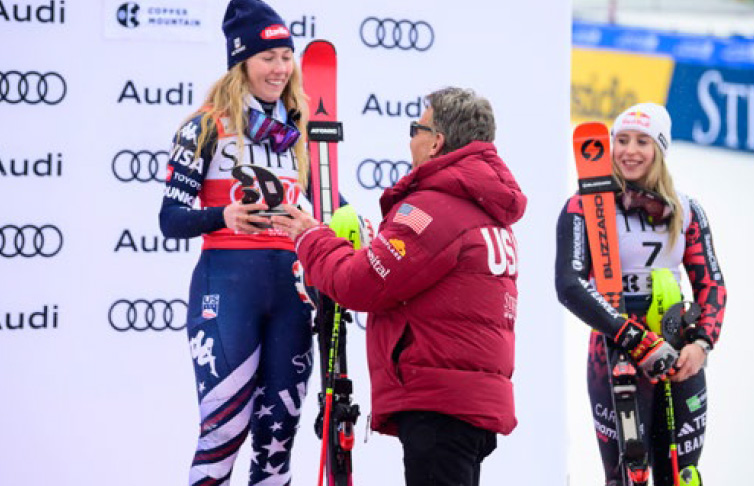
In May 2025, the organisations announced an eight-year renewal running from May 2026 through April 2034. The agreement encompasses the Stifel U.S. Ski Team and stretches across three Olympic and Paralympic Winter Games. A commitment with that horizon gives sporting development time to work.
“This partnership is about helping athletes reach their full potential,” Kruszewski said. It is a straightforward ambition, with money and duration attached. In the business analogy he drew when the partnership expanded, recruitment was followed by investment, development and promotion from within. A talented person still needs an organisation willing to support the work.
By February 2026, he could joke that a successor would be unable to undo the long agreement. He had also offered helmet sponsorships to athletes without a sponsor. The arrangement included a medal bonus whose existence he remembered when Breezy Johnson won Olympic downhill gold. An expensive reminder, and apparently a welcome one.
Information is plentiful. Time is another matter.
Kruszewski’s argument for human financial advice has become more pointed as artificial intelligence improves. In a September 2026 conversation with Tony Sirianni, he used himself as the example: access to research, traders and financial technology, and still too little time. He needs advice too.
He described Stifel’s position between large brokerage firms and independent practices, offering advisers operating support while allowing room to build their client relationships. The choice has become more explicit. Stifel sold its independent-adviser subsidiary in February 2026, concentrating its effort on its employee-adviser business.
His intended use of AI follows that emphasis. He wants it inside advisers’ workflows, helping them work, while the adviser remains responsible for the human conversation. In a separate appearance on Inside the ICE House, he returned to human judgment and the value of relationships, alongside a caution about chasing financial fashions.
The argument should be read as the view of an executive whose firm employs advisers. His commercial interest is clear. So is the question he raises: how much of a client’s decision is solved by receiving more information, and how much requires someone to understand what the client is trying to do?
Still learning how to keep the room
His responsibilities now extend beyond Stifel. Elected SIFMA chair for 2025-26, he has spoken about investor trust, the movement of financial risk and the conditions smaller companies face in public markets. In his 2025 annual-meeting remarks, he warned that stronger regulated bank balance sheets do not make leverage elsewhere disappear.
He also keeps returning to the firm’s financial advisers when asked who deserves recognition. His 2026 account of leadership emphasised listening across disagreements; when stuck, he said, he talks with associates. The mentor he names is Baird’s Fred Kasten, who taught him to treat people well.
There is a pleasing circularity to that answer. The young financier who expected a promotion after delivering an unwelcome verdict became a chief executive whose stated method involves hearing other people out. The acquisitions, the borrowed money, the ski sponsorship and the technology plans all require colleagues willing to join him. After nearly three decades at Stifel, keeping those people in the conversation remains part of the job.
Keep the conversation going
- Stifel executive biography
- Ron Kruszewski on LinkedIn
- The early years and Horatio Alger Award
- The 2026 St. Louis conversation
- Watch: Inside the ICE House
- Watch on YouTube: the NYSE conversation
- Listen: What’s the Point with Mikaela Shiffrin
- Read: the September 2026 adviser interview
- Third-quarter 2026 results
- Stifel’s official social accounts