At RIVERSPORT in Oklahoma City, the adventure began with a software problem. The outdoor recreation nonprofit had four live systems. Athletic memberships lived in one place; front-gate admissions in another. Before a guest could get on with the enjoyable business of being outdoors, somebody had to make the administrative pieces agree. For the staff, that meant learning several versions of the same day.
- The problem: tickets, waivers and memberships can become separate jobs.
- The proposition: ROLLER puts those jobs in a connected venue platform.
- The test: measure the work removed, then count the full cost.
ROLLER occupies this peculiar corner of the leisure economy: the work required to let other people stop working. It sells cloud software for attractions, from trampoline parks and playcenters to museums and water parks. Online checkout, point of sale, payments, memberships and reporting sit together. The interesting part is what happens at their boundaries. A ticket sold is only the beginning of a visit.
01 / The call from the theme park
The company’s direction was not obvious at the start. Luke and Mark Finn began with a consumer business offering hospitality experiences. In a 2023 Forbes Australia interview, Luke described an inbound call from Adventure Park near Melbourne as a prompt for the 2014 pivot. A venue had an operational need. Here was a customer willing to explain what happened behind the booking button.
Earlier, Luke had described the platform taking shape with Mark and Will Nicholson in a Prahran cafe in late 2012, after exploration begun in 2010. These accounts suggest a business discovered over time. The useful lesson for another founder is quite concrete: pay attention when a customer asks your product to do a different job. The request may reveal a better buyer.
Luke’s hospitality work had exposed him to venue workflows. Mark brought finance experience from PwC and Macquarie. Today Luke is CEO and Mark is CFO. Their stated purpose is to help venues create joyful experiences. That purpose puts remarkably unglamorous things on the product agenda: deposits, refunds, staff permissions and the question of who has actually signed the waiver.

02 / One visit, several moving parts
Consider a birthday party, as an illustration. There is a booking, a deposit, a room or time slot, and a group whose members may arrive separately. Some need waivers. Someone wants extra food. The host wants the party to begin. Each item is manageable alone; coordinating them is where the work accumulates.
ROLLER’s specialization is to bring those steps together. Guests can buy ahead on a venue’s website. Digital waivers connect with bookings. Memberships support recurring payments and validation. Staff can sell and redeem at the counter, while kiosks offer self-service. Capacity controls help operators sell the sessions they can accommodate. HQ tools let groups publish changes across locations.
- 01BookTicket + time slot
- 02SignDigital waiver
- 03EnterPOS + redemption
- 04ReturnMembership + loyalty
Less information to find again at the next step.
At RIVERSPORT, consolidation was the reason to change. In ROLLER’s customer account, controller Jon Shaw described a cheaper enterprise license than the previous systems combined. The venue also reported roughly $5,600 in hardware savings after replacing its iPad waiver setup, and $3,000 to $5,000 from camera add-ons in their first month. Those are vendor-published customer results, specific to this operation.
“The ROI of just consolidating systems is huge.”
Jon Shaw / Controller, RIVERSPORT
03 / The price is more than the plan
ROLLER earns money through software subscriptions and payment-related services. Its public pricing page lists Lite, Pro, Premium and Enterprise. Device allowances rise with the tiers; richer customization and integrations appear further up. Dollar prices require a sales conversation. Hardware is excluded, and applicable usage fees are separate from merchant processing fees. Implementation help and some integrations can add charges.
For a buyer, the comparison should therefore begin with an entire month of operations. Count subscription bills, transaction charges, hardware, training and the hours spent reconciling information. Then ask for a quote against the same workload. A cheaper headline subscription can be poor value if the missing functions create manual work; consolidation can also be excessive for a simple operation.
The competitive field includes accesso, whose offering spans ticketing, POS, virtual queuing and guest experience. Operators can also consider specialists such as CenterEdge and Semnox. ROLLER’s pitch centers on an integrated workflow for attractions. The buying question is whether its particular combination fits the venue’s admissions rules, hardware and guest journey.
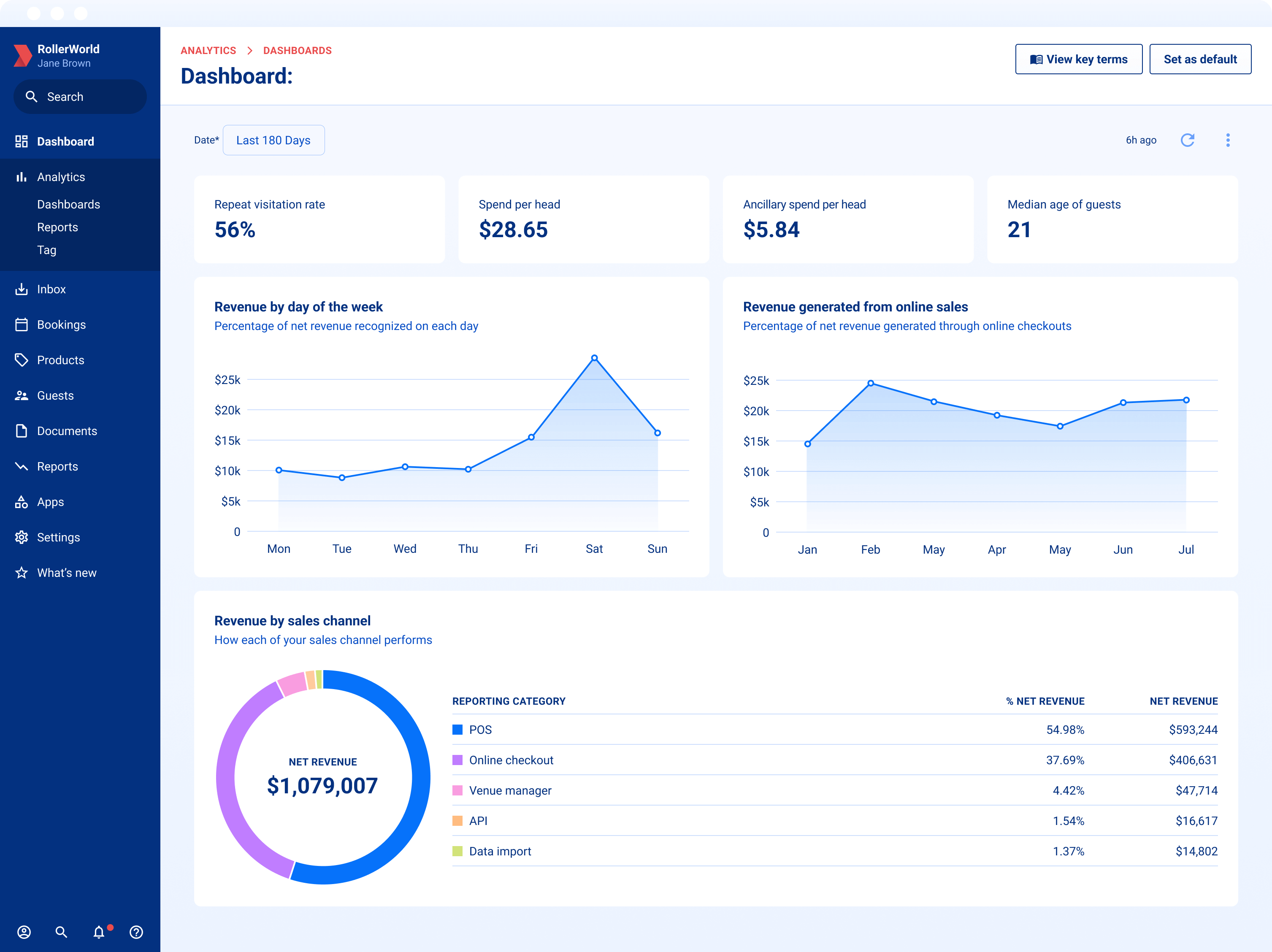
04 / More of the venue, inside the system
Growth has widened that proposition. ROLLER acquired Active8 in 2022 and BookNow in September 2025. BookNow brought a Salesforce-based platform and CRM expertise, with a stronger European presence. The following month, ROLLER announced US$50 million in funding led by Insight Partners, with J.P. Morgan participating. Insight had also led its US$50 million round in 2023.
Growth capital announced in October 2025.
Insight Partners + J.P. Morgan
Some expansion reaches into the equipment itself. With QubicaAMF, Conqueror ROLLER connects reservations to bowling lane management. Lane availability synchronizes, and a POS check-in can activate a lane. That is a useful detail: a booking system becomes more valuable when its picture of availability matches the physical room.
The May 2026 launch added guest-facing AI assistance, loyalty and ROLLER Capital, alongside expanded iQ capabilities for insights and booking actions. These features extend the company’s role beyond recording a sale. Its stated values also guide hiring and performance decisions; the people building the platform are being asked to treat guest experience as an operational responsibility.
05 / Start with the handoff
There are practical limits. ROLLER’s support guidance requires reliable internet and warns that connection dropouts can affect bookings and waiver updates. Migration also demands product configuration and staff training. A venue dependent on incompatible systems, or needing little beyond occasional ticket sales, should examine whether the additional capability justifies the change.
The transferable idea is to map a real visit. Watch where a guest repeats information, where an employee checks another screen, and where a booking needs rescuing. Put a number on those interruptions. That gives an operator something more useful than a feature checklist: a reason to change. The payoff should be visible at the front desk, where the next guest is waiting to get on with the day.