Roland Green's first serious instrument was language. He studied English literature in Colorado, wrote poetry, and gave the mountains enough of his time to earn the cheerful, unmarketable description “ski bum.” Then the Berlin Wall fell. Green did not want to experience the moment as a paragraph in a history book, so he left college, went to Prague, and taught English at a university. “This is history,” he later recalled. “I wanted to see it, not just read about it.” It was not an efficient route to a biotechnology résumé. It was, however, excellent training in following a live question.
Back in the United States, Green decided that meaningful work might begin with damaged forests. He switched fields, earned a biological sciences degree at Colorado State University in 1994, and entered the environmental toxicology program at the University of Wisconsin-Madison. The poet acquired chemistry. The skier acquired a laboratory bench. Curiosity, previously free-range, gained instruments and deadlines.
The inconvenience that became an invention
Graduate research supplied a wonderfully specific annoyance. Green needed a DNA microarray for a plant he was studying, but the commercial product he wanted did not exist. Custom arrays were expensive because each design relied on a new set of physical masks. The established method treated the mask as inevitable. Green and his collaborators treated it as removable.
Their Maskless Array Synthesizer used a digital micromirror device - hundreds of thousands of tiny programmable mirrors - to direct patterns of light onto a glass slide. Software could change the pattern. Photochemistry could build the DNA probes. A custom design no longer had to wait for a custom physical stencil. In 1999, Green explained the practical ambition in refreshingly democratic terms: “We think this will be a tool that will allow small labs to get into the DNA chip field.”
The important move was not merely scientific. Green recognized that a clever workaround had acquired customers before it had acquired a sales team. “The idea was so cheap and it worked so well that everybody told us to commercialize the technology,” he said. NimbleGen Systems was formed that year. Green was its first employee, and the thesis project began the long, less romantic migration from invention to product.
“The idea was so cheap and it worked so well that everybody told us to commercialize the technology.”Roland Green, on the origins of NimbleGen
An inventor learns the factory floor
Founding stories like to freeze at the eureka moment. Companies begin immediately afterward, when the eureka must survive manufacturing schedules, quality controls, hiring plans, customer demands, and colleagues who reasonably expect the apparatus to work again on Tuesday. Green became NimbleGen's chief technology officer and vice president of research and development. By 2004, his remit also included manufacturing, engineering, quality assurance, and chemistry.
At the time of Roche's acquisition, he was overseeing more than 80 people and three sites: research, engineering, and quality in Madison; manufacturing in Reykjavik; and chemistry in Waldkraiburg, Germany. This is the quieter credential on his biography. Patents show that someone made a novel claim. An operation spread across countries shows that the claim learned to travel.
The science also traveled into the broader genomics community. Green appeared among contributors to the pilot phase of the ENCODE project and co-authored research on gene regulatory sequences. NimbleGen's high-density, long-oligonucleotide arrays turned controlled light on glass into a tool other scientists could use. Roche bought the company in 2007 for approximately $273 million.
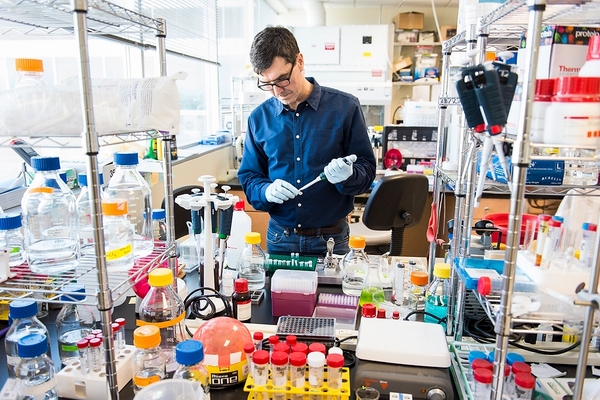
A second company, a familiar instinct
Green did not spend the next chapter polishing the exit. In 2008 he founded GreenStone Technologies around dye-sensitized solar cells, carrying his experience with photochemistry on glass into energy technology. Three years later, he co-founded Invenra with fellow UW-Madison environmental toxicology graduate Emile Nuwaysir. The material changed. The operating question did not: how do you make sophisticated laboratory work faster, cheaper, and sturdy enough for commercial development?
Invenra began in Madison and built technology for discovering, expressing, and evaluating antibodies. One early method worked with samples roughly one-thousandth the scale of competing approaches. Less material meant less reagent expense and fewer preparatory steps. Green described the advantage without ceremonial fog: “We don't need much antibody for the screening, and that allows us to make the antibody from a single molecule of DNA.”
The company later concentrated on bispecific and multispecific formats. A conventional antibody is often drawn as a Y, with two arms engaging the same target. A bispecific design can give those arms different assignments. Green's explanation is hard to improve: “There are a lot of things you can do with two hands instead of one.” It is the sort of sentence that suggests the English teacher never entirely left the laboratory.
“There are a lot of things you can do with two hands instead of one.”Roland Green, explaining bispecific antibodies
Today Green is Invenra's co-founder, CEO, and chairman. Its B-Body platform is designed around the difficult pairing problems inside bispecific molecules, while newer services and the T-Body platform extend the company's work into rapid expression and trispecific formats. The organization has announced collaborations and licensing relationships with companies including Exelixis, Catalent, Orion, Xcellon Biologics, and Twist Bioscience. Green's role is no longer the lone scientist correcting an unavailable chip. It is to keep a growing institution pointed at useful translation.
The Madison method
Both major companies in Green's story grew from the same city and the same university orbit. UW-Madison supplied more than credentials. It supplied collaborators, technical variety, patient capital, research relationships, and the density of people required when biology collides with engineering. At Invenra, scientific co-founders and senior researchers sit alongside commercial operators, directors, and academic advisers. Green's career makes a persuasive case that geography matters less as a brand than as a repeated set of working relationships.
His interpersonal reputation fits the setting. A former NimbleGen colleague, Jaz Singh, remembered exceptional scientific skill, but the sharper detail was social: Green was easy to work with, and his “inquisitive nature” was infectious. A 2018 profile noticed jeans, collar-length hair, and an unhurried manner that looked more outdoorsman than corner-office chief. The description matters because biotechnology is full of severe titles. Green's authority seems to come from staying interested in the work.
There is also a useful modesty in the way he explains scale. When an early partnership carried a theoretical value of $1.4 billion, Green called such projections “biobucks” and pointed out that the largest payments were conditional and far away. The line punctured the press-release arithmetic without dismissing the work underneath it. This is another kind of translation: letting an ambitious company describe possibility while keeping the verbs in the correct tense.
Curiosity with a production schedule
There is an appealing temptation to treat Green's early detours as colorful prelude: poetry for the opening paragraph, Prague for atmosphere, skiing for the photograph. But they explain the work. He has repeatedly crossed boundaries that specialists are trained to respect. Literature became biology; biology met chemistry; chemistry required optics and software; research demanded factories; a scientist became an operator. The crossings were not ornamental. They were where the useful ideas appeared.
His timeline also resists the mythology of the overnight founder. NimbleGen's origin fits neatly into a sentence; making its technology dependable occupied years. Invenra was founded in 2011, and its platform work has unfolded across more than a decade of experiments, partnerships, service launches, and organizational changes. Green's public career is full of breakthroughs, but its actual unit of progress is sustained attention. Even the surprising turns - Prague, solar cells, a return to biotech - carry an old habit forward rather than wiping the slate clean.
The lesson worth stealing is not to collect unrelated interests and hope they arrange themselves into genius. It is to bring them to the same stubborn problem. Green's companies have emerged when an accepted scientific process looked too slow, costly, or cumbersome. He did not stop at identifying the flaw. He built teams capable of engineering around it and organizations capable of repeating the result.
That may be the cleanest description of his aspiration now. In a 2024 conversation, Green called antibody work “nature's approach to fighting the bad guys.” Behind the friendly phrase sits a demanding corporate task: preserve the ingenuity of the science while giving it manufacturing discipline, partners, and time. The poet's eye spots a different structure. The operator makes sure it can ship.