The most revealing thing Rodney Rambo has said about marketing may be the sentence in which he gives marketing away. “People tell the best stories, not brands,” he has argued. It is a curious creed for an executive paid to guide what a famous brand says. It is also the thread that makes his career legible: a quarter century spent near subcultures, creators and athletes who become suspicious the instant a company sounds too pleased with its own voice.
Rambo is the Chief Marketing Officer of Converse Global, a role he reached in 2024 after more than a decade moving through the company's marketing and general-management ranks. Before Chuck Taylor came Volcom, Pacific Sunwear and Vans. Read in order, those names form a tour through the places where American youth culture has bought clothes, scraped boards and decided which adult attempts at cool deserve an eye roll.
His education adds a neat bit of symmetry. Rambo earned a degree in speech communication at Northern Arizona University, then built a profession around deciding when a company should speak and when it should listen. He has spent much of that profession with an object that says almost nothing by itself: canvas upper, rubber toe, ankle patch. The Chuck Taylor is recognizable across a room and strangely accommodating up close. It can belong to a basketball player, a punk band, a skater, a fashion designer or the person doodling on the white rubber during a dull class.
“People started to see through their lens that the Chuck was not just an athletic sneaker. It was a blank canvas and badge of self expression.”Rodney Rambo on the Chuck Taylor's cultural turn
A career in other people's territory
In 1999, Rambo started in marketing and team support at Volcom, a brand fluent in surf, skate and snow. He moved to Pacific Sunwear in 2002, handling affiliate marketing and strategic digital accounts while online retail was still losing its training wheels. Vans followed in 2004. He began with national accounts, moved into global marketing, and was there when the company was signing athletes such as wakeboarder Randall Harris. In the press release, Rambo praised Harris for attention to detail and for pushing his sport forward. Even then, the athlete's practice came before the sponsor's logo.
Twenty-five years near the culture
Converse hired him as Global Marketing Director in 2012. Within a year he was Global Vice President of Brand Marketing. He later led brand marketing in Europe, the Middle East and Africa, served as General Manager for the West, and became North America CMO before taking the global brief. The sequence matters. His résumé is not a straight climb through advertising alone. It crosses product markets, regions and operations, useful preparation for a brand that is local in how people wear it and global in how often they do.
It also gave him an unusually long view of one company. Marketing tenures often move at campaign speed: launch, applause, new title, new building. Rambo stayed long enough to see Converse through different regions, leadership assignments and chapters of basketball. His public account of those years includes both “tough times” and comebacks. That memory matters around an old brand. A trend line can describe the quarter; a veteran operator remembers which apparently new idea the company already tried, which old idea deserves another look, and which piece of heritage customers consider their own property.
The shoe that would not stop appearing in the comments
The cleanest example of Rambo's listening-first instinct began with a very impractical shoe. Converse had introduced the Chuck Taylor All Star XXHi, a knee-high tower of laces, in 2006. It found a devoted home in emo and scene fashion, then disappeared early in the next decade. Nostalgia, naturally, refused to consult the product calendar.
Around 2021, requests for the knee-high began appearing under Converse videos. Then they appeared under videos that had nothing to do with the shoe. TikTok's #KneeHighConverse tag accumulated tens of millions of views. The volume changed. As Rambo described it, “The whispers finally became screams,” with five, six, seven or eight requests beneath each video.
From comment to comeback / relative signal
The company did not rush a nostalgia drop into production. Work on an updated shoe started in 2022 and the social campaign stretched across roughly two years. Converse teased the demand with an April Fools unboxing video and jokes that told fans, without disclosing the project, that someone was reading. When the XXHi returned in June 2024, it had a practical zipper so wearers did not have to negotiate every lace. The campaign turned the persistent commenters into its stars.
This is social listening stripped of its dreary dashboard aura. The comments affected the product, the timing and the creative. More important, patience helped distinguish durable affection from a noisy afternoon. A company famous for selling self-expression allowed the audience to alter the plan. Conversation was not the decoration around the strategy. It was the strategy.
Do not improve away the reason people care
Listening at Converse also means hearing what customers do not want changed. In 2015, while explaining the Chuck Taylor's journey from hardwood to punk clubs and skate spots, Rambo gave the internal rule plainly: “Don't mess with Chuck.” New materials are welcome. Comfort may improve. The waterproof rubber Chuck particularly amused him. Yet the familiar look remains guarded because customers love it as it is.
Brand work tends to reward visible intervention. A fresh identity arrives with before-and-after slides; restraint arrives with no slides at all. But the Chuck is valuable because generations have supplied meanings Converse could never manufacture centrally. Filling every blank would spoil the canvas. Rambo's job is therefore part editor, part custodian: introduce possibility, remove clutter, leave enough white space for the wearer.
His own retelling of the Chuck's history keeps returning to handoffs. Basketball coach and salesman Chuck Taylor helped adjust the early shoe. Color choices later gave customers more room to declare a personality. Punk musicians adopted it. Early street skateboarders put it to work in another sport. The company participates, but it never gets sole authorship. Rambo's language makes the history sound less like a controlled brand funnel and more like a relay race in which nobody owns the baton for long. For a chief marketer, this is a useful lack of vanity.
The Chuck's silhouette remains familiar enough to carry memories between generations.
Materials, colors, collaborators and wearers keep changing what that silhouette can mean.
From the canvas shoe to the signature shoe
Converse's renewed basketball program presents a different stewardship problem. Here the product is new and the athlete is singular. Rambo has described the brand's relationship with Shai Gilgeous-Alexander as a meeting of independent spirits, with the work intended to move beyond sport and toward creativity. “Converse is allergic to conformity,” he said when discussing the partnership in 2024.
The timing became almost suspiciously tidy. In 2025, Gilgeous-Alexander carried his first signature model, the SHAI 001, through an MVP season and a championship run. Colorways drew from members of his family. A special gold pair appeared after the title. The shoe sold out quickly on its first release. Yet Rambo's public emphasis stayed on what made the player interesting before the trophies: his style, his authorship and the fact that he “moved differently” on and off the court.
That logic connects the new basketball shoe to the ancient canvas one. The person cannot be a billboard pasted onto the product. The fit has to feel native. Chuck Taylor was an early player-salesman whose name entered the shoe; Gilgeous-Alexander is a modern creative director of his own line. A century apart, both stories depend on a human point of view giving footwear a life beyond rubber and fabric.
The logo may begin the object. The people who wear it finish the story.The through-line in Rambo's work
Independent, together
Rambo's public notes about Converse are warmer than standard executive bulletins. In 2025 he wrote a letter beginning “Dear Chuck,” addressing the shoe as a colleague who had taken him from Boston and Los Angeles to China and Europe. He recalled building a hotel in London, Alexis Sablone skating through the Guggenheim, hard moments and comebacks. He signed it “Love, RR.” Corporate affection usually arrives focus-grouped. This sounded lived in.
The letter also named a useful paradox: “independent, together.” Converse sells individuality, but Rambo repeatedly places that individuality inside communities. A Design Museum exhibition traced the shared evolution of skateboards and skaters. At Camp Flog Gnaw Community Day, he spoke with more than 65 Los Angeles youth and young adults about careers behind the festival, followed by speed mentoring. In his letter, he looked forward to spending more time alongside creators in Converse Rubber Tracks.
The museum partnership made the point in physical form. Its London exhibition assembled roughly 90 rare boards and more than 100 related objects, then placed a working skate ramp inside the institution. Rambo described Converse's role as creating experiences at the crossing of creativity and skateboarding, with “useful inspiration” as the aim. Useful is the modest but telling word. A brand could simply sponsor the room and admire its own name. His stated ambition was to help bridge audiences and interests, while the skaters, designers and objects carried the substance.
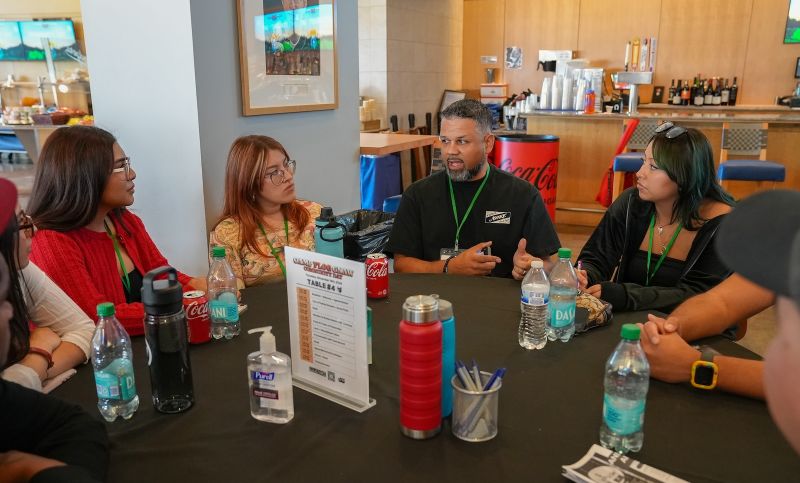
The Los Angeles mentoring day translated that posture from exhibition design to a table conversation. Young participants met people responsible for the partnerships, production and practical labor behind Camp Flog Gnaw. Rambo was one person in that network, not presented as a solitary oracle. The photograph captures him mid-explanation, hands moving, the group close enough to interrupt. It is a better picture of his philosophy than a polished podium shot would be: expertise offered at conversational distance.
None of this resolves the central tension of marketing a uniform worn by nonconformists. That tension is probably unresolvable, which may be why the shoe remains interesting. Rambo's answer is not to speak more loudly than the people in it. Protect the recognizable shape. Notice the persistent request. Choose collaborators with their own gravity. Then allow the story to escape the building.
A century-old sneaker does not stay young by pretending to have been born yesterday. It stays young when the next person can make it theirs. Rambo's quiet trick is to leave them room.