A billion views ought to settle an argument. It has the reassuring heft of a number with nine zeroes, the sort of number that makes a meeting go quiet. For Rob Gabel, it raises another question: what, exactly, did anybody watch? A video that flickers past in a feed and a programme someone chooses to finish can both arrive in a spreadsheet under the same agreeable heading. The spreadsheet looks tidy. The business underneath it needs more explanation.
Gabel has spent much of his career working on that explanation. He co-founded Tubular Labs with Allison Stern in 2012 and became its founding chief executive. Today he is chief strategy officer at Spotter, where the audience a creator has already earned can help finance what comes next. Across those jobs runs a stubbornly practical interest: turning information about people’s attention into something another person can use.
His more recent projects bring that interest down to street level. In 2026, he launched a guide to events along California’s Highway 4, then built another for Los Gatos. Somewhere between measuring global video audiences and finding a decent evening out, a consistent character begins to emerge.
The fifth employee learns to count
Gabel graduated from the University of Houston in 1993 with a degree in chemical engineering. He also earned an MBA at Stanford. The combination puts engineering and commerce on the same résumé, although his later work offers a more revealing introduction: he likes to know whether an apparently good idea changes what people actually do.
At LowerMyBills, which he joined in 2000, he was the fifth full-time employee. He later held senior marketing and product responsibilities as the business grew. His public account of that period is unusually specific. He describes a forty-person marketing team, acquisition costs, conversion rates and a proprietary testing platform. There are executives whose biographies resemble acceptance speeches. His contains the working parts of an experiment.
He reports that website testing improved lending conversion by more than 70 percent over fifteen months. It is a self-reported result, but a useful clue to the work that interested him. An advertisement gets someone through the door; the page they encounter decides whether the expensive introduction goes anywhere. Gabel had responsibilities on both sides of that encounter.
LowerMyBills was acquired by Experian in 2005 for roughly $400 million. Gabel subsequently worked at Inadco, Machinima and Netflix. At Machinima, a network built around gaming entertainment on YouTube, he held the advertising performance brief. His consulting work also included DanceOn and AwesomenessTV. He was getting a close look at an industry in which entertainment, audience building and advertising were learning to share an office.
YouTube had viewers. Creators had questions.
By December 2012, Tubular had raised a $2.5 million funding round led by FirstMark Capital and was running a private beta. Machinima, AwesomenessTV and Big Frame were among the early participants. More than 300 people had applied; only a few dozen had been accepted. Gabel was building tools for people who already understood that publishing a video was merely the beginning of the job.
The questions were quite concrete. Which other channels attracted a similar audience? Who were the engaged fans? Which collaborations had worked? The answers could influence the next invitation, the next video or the next attempt to reach someone who had never heard of a channel. A tally of yesterday’s success left plenty of work for tomorrow.
“I purposely didn’t name my company Tubular Metrics”
Rob Gabel, discussing Tubular’s launch in 2012
That little naming decision carried a product argument. Gabel wanted the information to lead to action. A creator trying to grow a channel did not need another elegant way to admire an old number. The attraction was being able to decide what to do next, with something firmer than a hunch for company.
In 2014, Tubular raised another $11 million, with Canaan Partners leading the round. Its Intelligence product addressed a marketplace whose participants were difficult to see together. A game publisher, for example, could identify YouTubers making videos about its titles and consider working with them. Relationships that might once have depended on knowing the right channel could start with a broader view of the field.
From answering a channel’s next question to serving organisations across the video business.
The audience outgrows the scoreboard
By 2016, the commercial question was widening. Tubular announced $10 million in new financing, bringing its total raised to $31 million. Alongside it came media property rankings, designed to bring a company’s distributed video activity into one picture. A media business might own many publishers and publish across several services. Looking at a single channel could leave much of the actual audience outside the frame.
Branded content was part of the problem Gabel wanted to solve. Publishers needed to prospect for advertisers, make a pitch and report what happened afterwards. Those are three different moments in a sale, and each benefits from evidence both parties can understand. A popular video could be entertaining on its own terms while still being awkward to value in a commercial conversation.
In 2018, Tubular became the subject of a Stanford Graduate School of Business case by William Barnett and Adam Markovitz. The public description recorded more than 200 enterprise customers and technology gathering information from billions of videos across dozens of platforms. It also described an unfinished managerial problem: how software and consulting should fit together as customers’ needs kept changing.
That detail matters. A growing database does not automatically become a useful business. Someone must decide which questions the software answers by itself, where a customer needs help and what the whole arrangement should cost. The case caught Tubular in the middle of those choices, rather than preserving it as a completed success story behind glass.
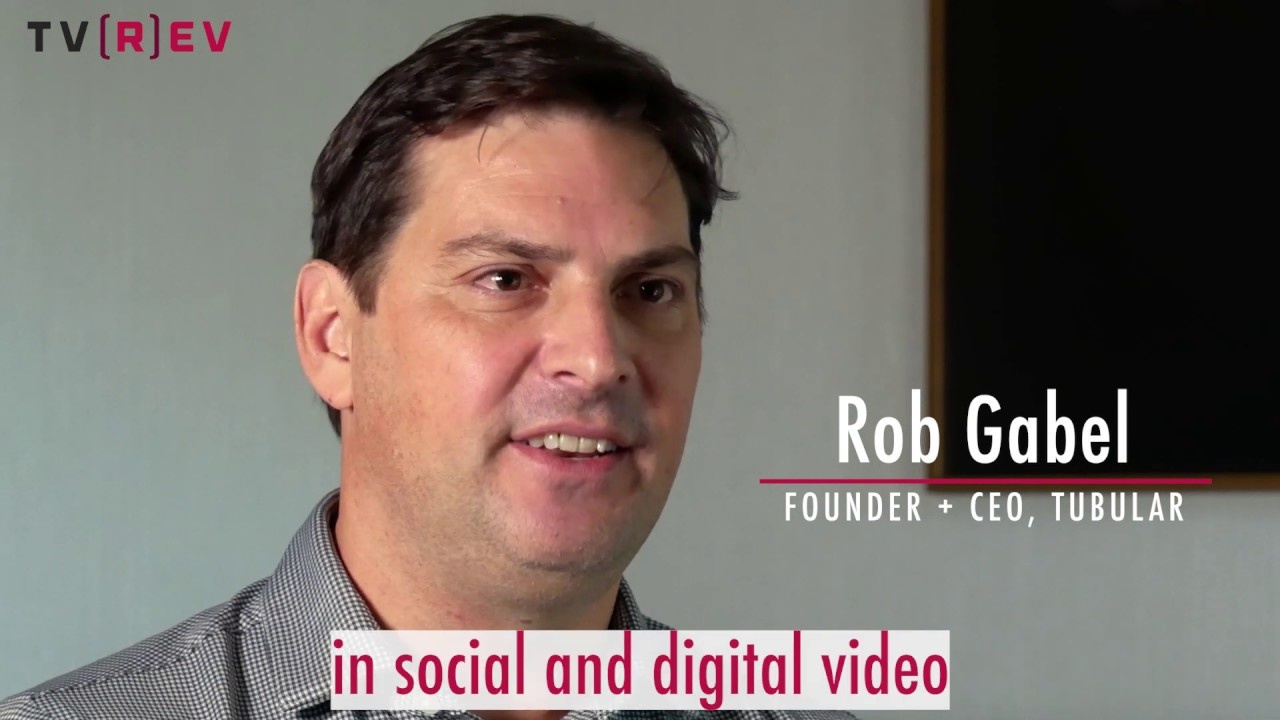 ▶ Watch the conversation
A view needs a common language
In January 2019, Gabel introduced the Global Video Measurement Alliance, bringing Tubular together with Vice, BuzzFeed and Group Nine. The ambition was to give publishers and advertisers a shared way to assess social video. Later that year, broadcasters including Viacom and Corus, along with Ellen Digital Network, joined the effort.
The technical details sound dry until money enters the room. Counting unique viewers means distinguishing people from repeated encounters with the same content. Measuring minutes watched adds duration to the picture. Together, they help answer a more useful question than how many times a counter moved.
ViewsHow often a play is counted
Unique viewersHow many distinct people watch
Minutes watchedHow much time they spend
In September 2019, Tubular unveiled time-based and deduplicated audience metrics developed with the alliance. Gabel wanted social video to have the kind of transparency that other media buyers already expected. The difficulty was that audiences were crossing borders and platforms while many measurement products still described a narrower world.
He was also spending time with the people making the programmes. At Cannes Lions that summer, he moderated a discussion with publishers about engagement, audience impact and branded partnerships. Measurement has an obvious danger: it can become an absorbing conversation among the measurers. Sitting with publishers brings it back to the choices that will eventually appear on screen.
When yesterday’s video pays for tomorrow’s
Gabel left Tubular’s chief executive role in September 2020. By early 2021, he was executive vice president and general manager of TubeBuddy, the YouTube optimisation business acquired by BEN Group, while remaining on Tubular’s board. His move to Spotter was publicly announced in January 2022.
There, he reunited with Aaron DeBevoise, who had also worked at Machinima. Spotter licensed revenue from creators’ existing YouTube libraries for a defined period in exchange for money upfront. Creators could put the cash into production while retaining ownership and creative control. For someone who had spent years examining audiences, it was another use for understanding how videos behave over time.
A back catalogue is an odd sort of asset: yesterday’s upload can keep earning while its maker is busy filming something else. Spotter’s model required judgments about that continuing revenue and the risks attached to it. Gabel joined as its first chief strategy officer, with a brief to explore ways of financing creators beyond the original offering.
The same practical concern was moving from one job to the next. Information helped make an audience legible; capital could help a creator act on the opportunity. Neither removed the uncertainty of making something people would choose to watch. They could, however, change the resources available for the attempt.
Leave room for the next idea
By 2025, Gabel was talking about another tool: Spotter Studio. He traced its origin to creators at a 2023 summit asking whether the company’s data and AI could help them develop ideas. His favourite part was the back-and-forth, a process of trying possibilities until an unexpected direction appeared.
“You can’t spell improve without improv.”
Rob Gabel, July 2025
The line suits an executive who has spent years counting things but still wants the work to leave room for surprise. Outside the office, he credits parenting with teaching him patience and leadership. He enjoys long audiobooks on walks. Useful ideas, in his telling, do not keep office hours.
His local projects supply a pleasingly modest example. Gabel’s family had been visiting Arnold since 2015, but events were scattered across websites, Facebook groups and physical notices. Over Memorial Day weekend in 2026, he launched Hwy 4 Events. He describes it as a labour of love. Later, back in Los Gatos, the search for Halloween outings and places to go with Millie, the family’s sheepadoodle, prompted a sister site.
There is something rather satisfying about that destination. After years of helping businesses understand where the world’s attention goes, Gabel is also helping his neighbours decide where to go themselves. The scale has changed; the question remains practical. A useful answer might lead to a new production, a new partnership, or simply a band worth leaving the house for.
Continue the conversation
- 01 Rob Gabel on LinkedIn ↗
- 02 Follow Rob on X ↗
- 03 His GitHub projects ↗
- 04 Gabel’s writing at Tubular Labs ↗
- 05 Watch: explaining the measurement alliance ↗
- 06 Tubular Labs 2018 - the Stanford case ↗
- 07 A closer look at Gabel’s move to Spotter ↗
- 08 Find an outing with Hwy 4 Events ↗
- 09 Explore Los Gatos Events ↗