The circus language is unavoidable. Ringmaster calls its products Quote-LinQ, Smart-LinQ, Rx-LinQ and Pro-LinQ. Its invitations ask customers to “step into the ring.” But the act it is trying to tame is not theatrical at all. It is the annual, document-heavy routine through which a self-funded employer buys protection against unusually large health claims - and then tries to collect when those claims arrive.
In that world, a broker or third-party administrator assembles a request for proposal. Carriers and managing general underwriters retrieve files, re-enter information and decide whether to quote. Proposals return in different formats. Someone compares rates, terms, exclusions and contingencies. After binding, another group tracks claims against specific and aggregate contract thresholds. A reimbursement request can fail because of something as ordinary as a missing date or incomplete supporting document.
Ringmaster Technologies, a privately held Boca Raton company founded in 2018, has made those handoffs its business. Its premise is refreshingly specific: insurance experts should make the judgments; software should move, normalize, compare and remember the data.
The first failure is usually boring
The company is not fixing the price of hospital care or inventing a new insurance policy. It sits one layer lower, in the operating machinery. Ringmaster’s 2024 description of the status quo reads like a field report from inbox purgatory: secure emails with multiple attachments on the buy side, manual retrieval and data entry on the sell side, and RFPs that may not match a carrier’s business goals.
What fails first? Often, consistency. One submission has a field another lacks. An updated proposal becomes another attachment instead of a traceable version. Contract terms do not reliably become administrative tasks. Claims and eligibility live in reports that must be hunted down. The cost is time, but also selection risk: incomplete information can delay a quote, misroute an opportunity or weaken a reimbursement filing.
“Trust but Verify.”Ringmaster’s own guidance on importing proposal data by OCR, XML or manual entry
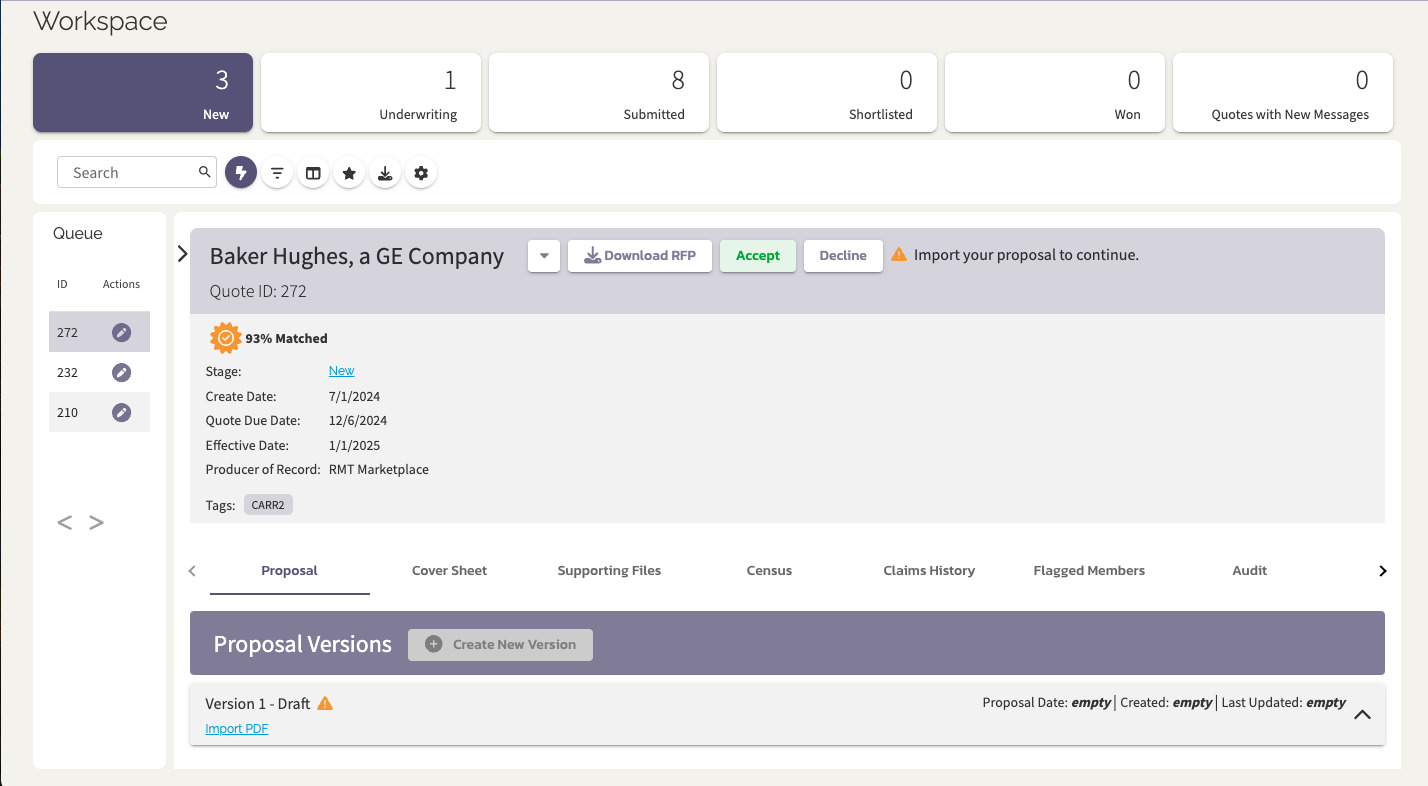
That four-word warning is the most useful line in Ringmaster’s public material. It punctures the fantasy that automation abolishes human work. Quote-LinQ can import a proposal and preserve its versions, but the carrier user still validates the information. Smart-LinQ can trigger action from claims and eligibility feeds, but the underlying policy terms and data mappings still have to be right.
One workflow, three complicated markets
Quote-LinQ is the front door. Producers use it to issue and renew stop-loss RFPs, connect with carriers, collect responses and compare options. The pitch is not merely a prettier form. Normalized response data enables side-by-side analysis, while proposal versions create a record of what changed between draft, submission and binding. Ringmaster says one agency analysis found the software could reduce the time its partners spend on annual procurement by 40 to 50 percent. That is a customer-reported result, not a neutral benchmark, but the mechanism is legible.
Smart-LinQ takes over after the contract is signed. It combines policy terms with medical claims, pharmacy claims and eligibility feeds; tracks specific and aggregate accumulators; and triggers work when an event approaches a contractual threshold. It also guides administrators through the documents for reimbursement requests and packages a cover sheet with member claim-line detail. The clever part is translating a contract from a static artifact into a queue of timed obligations.
Rx-LinQ applies the same organizing instinct to pharmacy benefits. Consultants can run a PBM RFP, compare contract language, model scenarios and monitor whether a selected PBM performs financially and contractually. Ringmaster says integrations can compress a pharmacy renewal process from eight weeks of chasing and entry into one or two weeks. RapidQuote, for preset contracts and partners, is advertised as producing an analysis in about 15 seconds.
The pharmacy bet gets more clinical
The pharmacy expansion was prompted by a pattern Ringmaster heard while working with TPAs and brokers: many teams struggled to interpret PBM responses and compare contract details such as exclusions, generic definitions, specialty drugs and limited-distribution terms. That changed the scope of the company. A stop-loss workflow vendor became the owner of a pharmacy data warehouse and RFP engine, because the adjacent process was breaking in the same places - inaccessible data, inconsistent language and analysis trapped with a few specialists.
In July 2025, RingmasterRx launched Clinical EQ. Instead of stopping at unit-cost comparisons, the tool models interventions such as biosimilar conversion, patient-assistance programs, international sourcing and manufacturer coupons. Users can adjust adoption assumptions and account for rebates that might be lost. The argument is pointed: a cheap-looking drug contract can produce a misleading answer if the model ignores how programs change behavior and net cost.
This is where Ringmaster begins to look less like a workflow utility and more like a decision-support system. Yet it remains careful about who supplies the judgment. Clinical EQ puts assumptions in the consultant’s hands. Rx-LinQ lets a firm standardize preferred PBM templates across offices while preserving its own consulting style. The software scales an expert’s playbook; it does not claim to become the expert.
The moat is the handoff
Competitors include established insurance administration systems, benefits procurement tools and PBM analytics vendors. The most stubborn rival, however, is the do-it-yourself stack: email, Excel, shared drives, carrier portals and institutional memory. Those tools are cheap, familiar and flexible. They are also weak at maintaining one version of the truth across companies.
Ringmaster’s differentiation is therefore connective. A broker gains more when responding carriers use the same channel. A carrier gains more when incoming opportunities arrive complete and normalized. A TPA gains more when policy terms, claims feeds and reimbursement documents live in one operating record. Each participant can buy efficiency; together they create the outline of a network.
- Brokers & TPAsStandard requests, faster comparisons, renewal oversight and fewer manual handoffs.
- Carriers & MGUsMore complete submissions, structured proposal entry and clearer quote-stage visibility.
- PBMs & consultantsRFP analysis, contract modeling, reconciliation and performance monitoring.
- Self-funded employersIndirect benefit through faster procurement, tighter administration and clearer cost analysis.
What it costs - and what the money bought
Ringmaster does not publish list prices. Buyers are directed to a demo-led enterprise sales process, so the bill presumably varies with modules, integrations, users and service scope. That makes a clean return-on-investment comparison impossible from public material. The useful test is operational: count the hours spent preparing submissions, rekeying proposals, reconciling data and assembling filings, then compare that burden with implementation and subscription cost.
The company itself has raised roughly $13.7 million in disclosed equity financings. Edison Partners led a $5 million growth investment announced in January 2020. Later filings and databases show another $5 million in 2021, $1.9 million in 2023 and about $1.76 million in late 2025. Ringmaster also expanded a Comerica Bank revolving credit commitment to $5 million in December 2024, saying the capacity would support products and hiring. No public valuation has been disclosed.
The product sequence shows what the capital supported. Ringmaster began with quoting and policy administration, opened RingmasterRx in 2022, partnered with Benecon on a level-funded marketplace in 2024, then added Clinical EQ and a business-process-outsourcing division in 2025. Pro-LinQ, the services offer, supplies back-office processing, technical help and virtual-assistant support around Quote-LinQ and Smart-LinQ. Selling the workflow and people to operate it can ease adoption, though services are harder to scale than pure software.
A founder steps sideways
Founder Todd Roberti came to Ringmaster after building Premier Healthcare Exchange, a cost-management company later sold and folded into what became Zelis Healthcare. That history helps explain his taste for administrative problems. In October 2025, he moved from chief executive to executive chairman. Jason Wenzke, who had led RingmasterRx, became CEO, with responsibility for strategy, operations and growth.
The succession is also a clue about the next phase. Ringmaster is no longer a single-product stop-loss company. It has a marketplace, administrative software, pharmacy analytics, clinical modeling and outsourced operations. The job now is to make the pieces feel like one system without letting the suite become another complicated collection of tools.
The copyable playbook - and its limits
Other operators can copy Ringmaster’s method without copying its market. Choose a workflow where information repeatedly crosses organizational boundaries. Define a common data model. Preserve every consequential version. Turn contract terms into visible tasks. Automate the repeatable steps, and leave an explicit validation point before money or coverage depends on the output. Finally, measure cycle time before and after.
Transaction volume is high, the inputs can be normalized, partners will use a shared process and delays have measurable cost.
Source data is unreliable, policy terms change after ingestion, integrations are weak or a small team has too little volume to justify implementation.
The caveats are not hypothetical. Ringmaster’s support notes explain that changing policy dates after claims data has been ingested can require scripts or a delete-and-reimport operation to correct eligibility flags. The product documentation also makes users responsible for checking imported proposal data. Connected software reduces clerical risk; it does not repeal it.
That is why the company’s least glamorous claim is its most credible. The value is not that a machine understands every edge case in self-funded health care. The value is that the edge cases become visible, assigned and auditable before they disappear into somebody’s inbox.