Imagine a customer standing outside a station, looking for somewhere to eat. The customer knows the brand. The branch is nearby. But the listing says it is closed. At that moment, a national advertising budget meets an opening time, and the opening time wins. This is a hypothetical customer, but it is the very ordinary problem around which RightChoice.ai has built a software business.
- One dashboard for business listings, reviews and local search measurement.
- Geo-grid tracking shows how visibility changes across a neighbourhood.
- Built for single storefronts, agencies and brands managing many locations.
The company sells a way to keep those details organised: business information, reviews, posts, keywords and the places where a branch appears in search. Its proposition becomes easier to understand when you stop picturing a corporate website and start picturing a map. Every pin has its own information to maintain. Every address can make its own bad first impression.
A ranking needs an address
Rishabh Karwa dates the company’s beginnings to mid-2023, when he co-founded it with Marouf Shaikh. His experience at the automotive service business GoMechanic had exposed the difficulty of keeping many locations visible and consistent. RightChoice.ai grew out of that operational problem. The interesting unit was the individual branch.
The Geo Grid Ranker turns that idea into a measurement tool. Rather than rely on one search from one position, it checks rankings across geographic points. A business can compare its own presence with competitors and see where its position weakens. The resulting grid gives a marketing team somewhere specific to investigate.
That matters because distance is part of the system. Google describes local ranking in terms of relevance, distance and prominence. Software can help a business supply better information and understand its position. It cannot move the building closer to every searcher. A good map tells you where the difficulty lies; it does not promise to abolish geography.
RightChoice.ai pairs measurement with maintenance. Its multi-profile tools centralise updates, while its directory offering distributes business information beyond Google. Agency features include white labelling and reporting; enterprise features include team access and bulk-verification assistance. The appeal is practical: fewer separate places to visit when something changes.
The listing has a maintenance bill
Keeping information correct also means watching what happens after it is published. Google explains that profile information comes from several sources, including businesses, public web content and user contributions. A listing is therefore a living record, with more than one possible source of change.
RightChoice.ai’s Profile Lock is marketed as monitoring changes and rejecting unwanted edits or false ownership claims. Its separate suspension-risk tool checks a profile for potential problems. These are useful categories of work to put on a dashboard. They remain monitoring and diagnostic features operating within Google’s systems, where enforcement decisions belong to Google.
The company’s Apollo Hospitals case study gives the workload a recognisable shape. It describes managing hospital, department and doctor information, alongside review responses and local visibility. A hospital campus can have several relevant destinations. Getting someone to the correct department requires more precision than putting the hospital’s name on a map.
The review is also a work order
RightChoice.ai also offers AI-generated review replies, sentiment analysis and content generation for business descriptions, services and posts. Its scheduler handles recurring publication. These tools address a different scaling problem: an operator may know how to write one useful response, yet struggle to keep up with feedback across many locations.
The distinction to watch is between replying and resolving. A generated response can acknowledge a complaint about waiting time. The branch still needs to investigate the queue. Used thoughtfully, sentiment analysis gives staff a place to start looking. Used as an excuse to stop reading, it produces polished answers while the same complaint keeps arriving.
There is a useful limitation in Karwa’s own account of expansion. He says taking the same approach from India into Southeast Asia and the Middle East required adjustment for local conditions. His formulation is concise:
“You can and should standardise your infrastructure and operations; you cannot standardise your strategy.”
Rishabh Karwa · The MarTech Summit
What the subscription buys
The business model is subscription software, with allowances for profiles, keywords, scans and credits called Magic Coins. The company advertises a seven-day trial without a credit card and custom enterprise pricing. G2’s listing, updated April 30, 2026, puts Monitor at $15 a month and Growth at $30. Treat those as dated directory prices; obtain a current quote for the intended workload.
RightChoice.ai sits among local marketing platforms such as Birdeye, Uberall, BrightLocal and Localo, all of which it addresses in comparison pages. Its pitch is the combination of profile protection, geographic measurement, review work and AI assistance. For a buyer, the useful comparison is whether that combination reduces recurring work enough to justify its subscription and usage limits.
A sensible trial would use a real branch and its actual workload. Check which features the chosen plan includes, how quickly scans consume allowances, and whether the reports answer a decision someone has to make. An agency should also test permissions and client-facing presentation before moving an entire portfolio into the system.
The next search may be a sentence
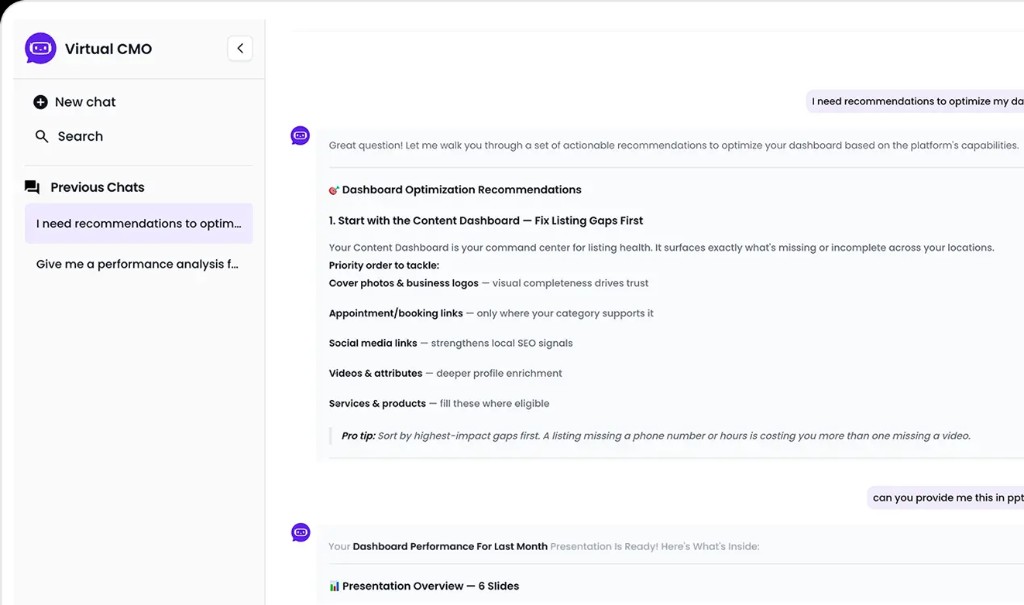
The company now markets an AI Rank Tracker for visibility, citations, sentiment and competitors across AI discovery platforms. Its Virtual CMO presents dashboard information through conversational recommendations. Both extend the same commercial idea: help businesses understand where they appear when somebody asks for an option.

The lesson a reader can copy is modest. Pick one location. Check its information. Establish a geographic baseline. Give someone responsibility for reviews and corrections. Then measure again. A business with few listings may manage that routine directly; a larger network may need software. Either way, the work starts with the same question the customer is asking: can I find the right place?
Take a closer look
Website · Plans · Product walkthroughs · Dashboard demo ↗
LinkedIn · X · Instagram · Facebook · YouTube
Read the founder interview ↗ · Inside the Pizza Hut workflow ↗