Richard Xia’s first contribution to Novelship’s inventory was, in a sense, his own wardrobe. To help finance the business he was starting with Chris Xue in 2018, Xia sold his collection of Bape streetwear. Xue parted with Air Jordans. Their plan contained a collector’s particular form of optimism: build the marketplace, then use it to buy everything back. Few business plans make such a persuasive case for keeping the receipts.
The sacrifice made sense because they knew the customer rather well. They were the customer. They understood the pleasure of finding something scarce, the disappointment of missing it and the uneasy moment when a stranger online promised to have exactly what they wanted. Novelship would place an inspection between that promise and the buyer’s front door. For Xia, turning a taste into a company meant taking responsibility for what happened after somebody clicked buy.
A queue that started an hour earlier
Before the warehouses and funding rounds, there was a winter morning in Tokyo. Xia had become interested in Bape around 2010, drawn to the clothes and their association with rappers including Kanye West and Lil Wayne. Finding the label in Singapore was difficult. In Shibuya, he joined a queue at five in the morning. He recalled waiting almost 20 hours, reaching the front and learning that the pieces had sold out.
His response was wonderfully literal. Next time, he arrived at four. The episode catches something about collecting that a price chart misses: frustration can increase appetite. Access becomes part of the object’s appeal, even when the process of obtaining it is absurd. Xia eventually wanted shoes to go with the clothing, and his first pair was Nike’s Air Force 1. The sneaker collection followed the wardrobe.
He has distinguished his tastes from Xue’s. Xue was the more committed sneaker collector; Xia was especially interested in streetwear. Browsing Harajuku’s shops fascinated him. This matters to the business they later built. A shoe can carry the memory of a player, a musician or a particular place. Xia understood the cultural attachment before he had to explain the transaction. The labels came with stories already attached.
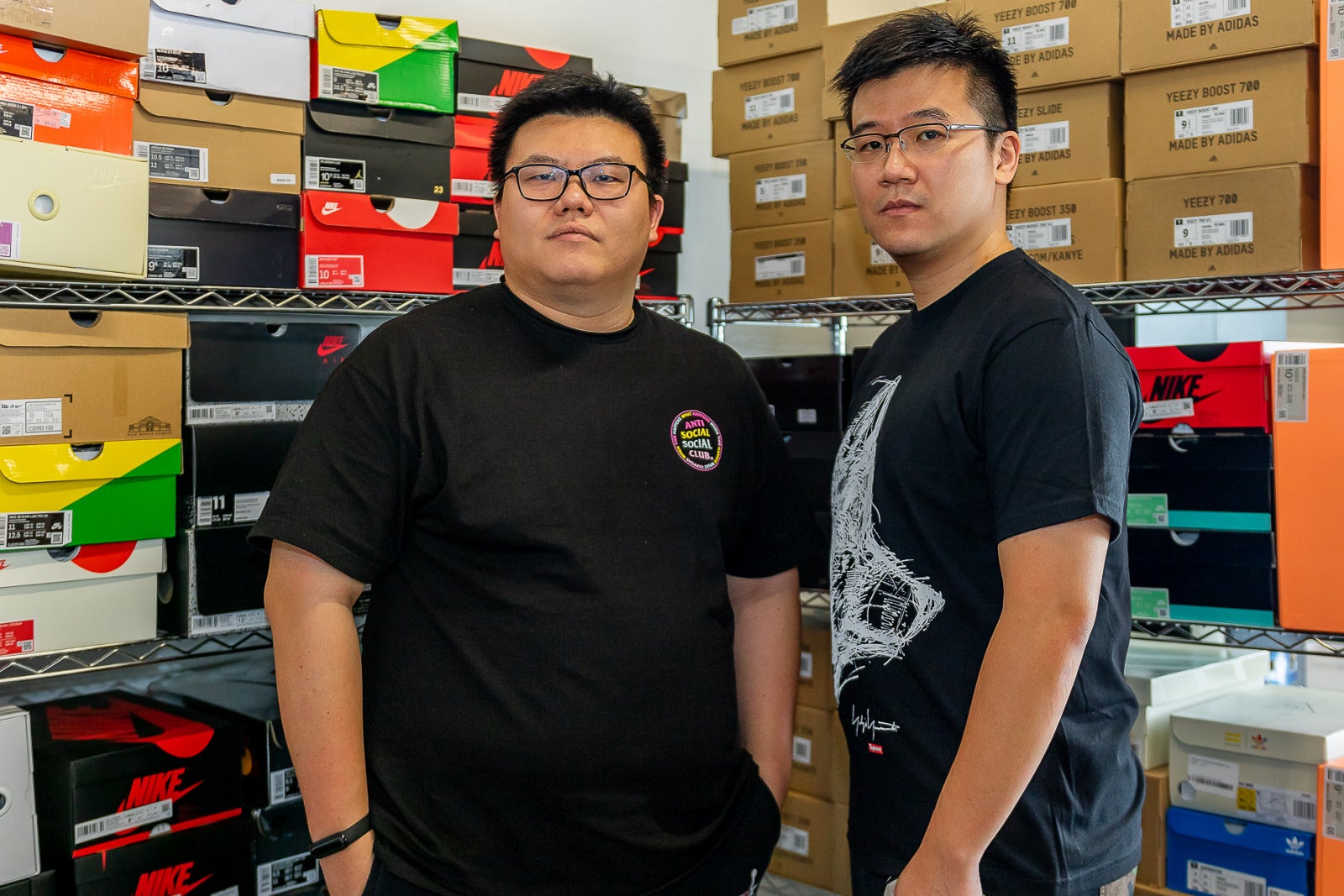
Two rehearsals before the shoe boxes
The partnership had a history longer than Novelship. In 2021, Xia described Xue as a friend and schoolmate of more than 16 years. They had already tried a mobile café and a software venture. The café operated outside the library at the National University of Singapore, where Xia studied. A university library supplies a plausible audience for coffee; it does not, by itself, supply a lasting business.
Xia has called the earlier attempts failures. What survived was the working relationship and a question about what they wanted to keep doing. Sneakers and streetwear offered familiar problems: desirable products were hard to obtain, and authenticity was difficult to establish. Starting with something they knew did not eliminate risk. It gave them specific questions to ask, and customers whose complaints they could understand without a glossary.
Money was tight. The founders sold pieces they cared about and used funds left from the previous venture. They began trading on Carousell, handling deliveries, customer service, invoices and investor pitches themselves. In that early version of the business, there was little distance between a strategic decision and the person carrying a parcel. Every sale brought work that somebody still had to do.
Company milestones, not measures of personal wealth.
The unglamorous route to a genuine pair
The core arrangement was straightforward. A seller’s item went to Novelship for checks before it continued to the buyer. By 2019, Xia described an authentication reference database containing approximately 25,000 photographs. The expertise included people who had worked for brands. A marketplace could display a photograph in an instant; deciding whether the physical object deserved the description required a different kind of attention.
His regional strategy was similarly concrete. In Jakarta, Novelship offered cash payments at convenience stores. In Kuala Lumpur, it offered local pickup. Xia wanted local operations, language support and customer service suited to individual markets. These details are less photogenic than a limited release, but they determine whether someone can actually use a service. An international catalogue is only useful when the buyer can pay and the parcel can arrive.
One delivery presented the problem in unusually handsome packaging: a rare pair of Air Jordan 1s accompanied by a metal suitcase. The suitcase contributed to the shoes’ value. It also made the shipping carton bulky and vulnerable to damage. Xia recalled DHL advising on the packing and delivering the order safely. A collector’s treasure had become an exercise in protecting corners.
There was another early difficulty: integrating Novelship’s shipping systems with DHL’s. Without the connection, labels and shipment details threatened to become manual work for a small team. Xia remembered an account manager offering help with those tasks until automation worked. The integration was eventually completed. The memory he retained was a partner’s willingness to help with the awkward part, before the process became smooth.
One extra stop. A reason to transact with a stranger.
Founder’s intuition meets the spreadsheet
Xia’s account of becoming a manager contains a useful admission. He and Xue had trusted their instincts, then found themselves arguing and wasting time. They began relying more on customer and market data. Experience had given them preferences; evidence helped them make decisions together. Knowing the culture was a starting point, rather than a permanent exemption from checking the numbers.
“Don’t take any assumptions for granted.”
Richard Xia, 2021
He also described learning to change his management style as the team grew. Employees needed room to contribute ideas and deliver results, rather than simply execute the founders’ wishes. That is a substantial adjustment for someone accustomed to doing the deliveries himself. Keeping a hand on every task becomes harder as the organisation grows; trusting other people becomes part of the job.
There were smaller checks on his own judgment, too. In 2021, Xia said he read Novelship’s Trustpilot reviews daily. Positive responses from customers who had secured a wanted pair motivated him; negative ones prompted investigation. A review page provided something the founder’s enthusiasm could not: the customer’s account of how the service had actually felt.
By March 2024, he described his working day as largely devoted to data and less glamorous responsibilities. The operations team handled processing and authentication. His remit included strategy, partnerships, marketing and growth. He still bought the occasional pair. Running a sneaker marketplace had given him a professional reason to spend much of his day looking at things other than sneakers.
What the next customer looks like
The funding milestones show the business acquiring more resources for that work. A US$2 million seed round in 2019 was followed by a Series A of close to US$10 million announced in May 2022, co-led by GSR Ventures and East Ventures. Novelship reported that sales volume had increased 5.3 times in 2021. The announcement set out plans to strengthen its existing markets and enter more of Asia-Pacific.
In September 2023 came a US$9.5 million Series B, with East Ventures, iGlobe Partners and GSR Ventures backing the round. The stated uses included better logistics and authentication, more in-house products and changes to delivery. Funding the company meant funding the handling of physical things: a reminder that an online marketplace has plenty of work to do away from the screen.
A collaboration with Snoop Dogg that year connected the platform to a musician from the culture its customers followed. There was a more everyday expansion of the offer as well. Novelship was adding women-focused products and developing its own items, including socks, shoelaces and sole protectors. Xia’s public ambition extended to smaller designers in the region, whom he wanted to give more opportunities to reach buyers.
His local knowledge sometimes emerged in a detail as small as shoe size. In 2023, he pointed to demand for US sizes six through nine in Asia. A buying platform built around another market’s assumptions could miss what customers nearby actually wanted. The argument for paying attention to a region could be found on a size label.
A collector with other centuries to think about
Outside the immediate business, Xia has described himself as a history enthusiast, interested in how earlier events shape customs and cultures. In March 2024 he was watching Shōgun. His ice cream preference was rum and raisin. These are modest particulars, but welcome ones in a biography otherwise populated by funding rounds and authentication procedures. Even a collector gets to have interests that need no protective box.
His stated ambition is to take Novelship beyond its regional base while keeping the community involved. He has talked about conversations among collectors, room for independent designers and broader access to products. The practical demands remain familiar: a payment, an inspection, a parcel, a customer waiting. By 2021, Xia said both founders had rebuilt collections they had sold to get started. The wardrobe had returned. It now came with responsibilities.
Follow the thread
- Novelship
- Richard on LinkedIn
- Richard’s Novelship articles
- Audio interviews · MONEY FM
- Video conversation · SIM Management360
- The 2024 conversation · BackScoop
- Five life lessons · BILLIONAIRE Asia
- The early years · CNA Luxury
- Shipping the unusual · CNA
- The 2019 conversation · Straatosphere
- The Series A announcement · East Ventures
- The Series B announcement · East Ventures
- Bape and the early queue · FZINE
- Streetwear and Singapore · Tatler Asia
- The hands-on founder · EnterpriseZone
- The founders’ stockroom · WORLD OF BUZZ
- Designers and regional ambitions · East Ventures