Before Naresh Ahuja had a retail software company, he had a connection worth exploring: a computer language on one side, a family furnishings business on the other. He encountered an advertisement for an NIIT course in COBOL and enrolled. He was also working with his uncle, the furnishings designer Shyam Ahuja. Software offered a way to put those two parts of his life together. The shop supplied the questions. The course supplied a new way of answering them.
“I fell in love with software development,” he recalled. The early arrangements were modest: an office, an employee and a computer bought with his savings. He began developing software for other businesses. In 1988, he founded ETP Group. A career that would eventually involve retailers across national borders began with the rather useful advantage of having seen retail from inside a family business.
“I fell in love with
Naresh Ahuja, recalling his early training
software development.”
There is an appealing lack of ceremony to that beginning. Furnishings have dimensions, colours, quantities and customers who want a particular thing. Computers ask for rules. Bringing them together requires someone willing to translate between an assortment on a shelf and a set of instructions. A beautiful piece of cloth can persuade a customer. The software still has to know whether there are three of them or two.
Ahuja had studied sciences at the University of Bombay before training at NIIT. His work in the family business covered retail and distribution operations. That combination matters to the shape of his career: he arrived at business software with experience of the activities it was supposed to serve. The practical question came first. The technology had a job waiting for it.
A founder learns to cross borders
ETP’s subsequent history runs through partnerships as well as products. An IBM partnership in 1994 helped extend its enterprise work. An alliance with Intentia followed in 1997, with a service delivery presence spanning London, New York and Singapore. The company introduced ETP VX in Singapore, Dubai and India in 2005, then entered Indonesia in 2007 and the Philippines in 2008. These were distinct steps, spread across years.
The dates make a useful corrective to the compressed way business careers are often told. Founding a company is one decision. Finding the next customer, adapting a product and supporting it in another market are decisions that recur. Ahuja’s story contains a long middle: the years in which a company has to keep earning its place after the novelty of its existence has worn off.
By his 2008 interview with Indian Retailer, Ahuja was describing a business headquartered in Singapore with research and development in Mumbai. He talked about configurable software, integration with existing financial tools, multiple currencies and different tax systems. Even the vocabulary was practical. The retailer already had a business to run and systems in place. Replacing everything was an expense, rather than an exciting slide in a presentation.
His emphasis on partnership is revealing. Selling a retailer software creates an ongoing relationship with the retailer’s habits, processes and exceptions. A tax change or a new store can make yesterday’s successful installation tomorrow’s urgent task. Ahuja’s description of the work allowed for that continuing obligation. The sale was an entry into the customer’s operations, with all the untidiness that operations tend to bring.
- 1988ETP founded
- 1994IBM partnership
- 2005ETP VX launch
- 2024ETP Unify launch
The shopper has already joined the channels
Over time, his subject became the movement between stores and screens. At ETP’s Futuretail gathering in Gurgaon in 2017, Ahuja joined executive director Raj Jagasia and Neev Ahuja in leading a discussion about the omnichannel transformation of Indian retail. Senior retail representatives had come together to consider the opportunities and difficulties. The premise was already clear: shopping was spreading across several connected encounters.
Consider a familiar shopping sequence. Someone looks at an item online, asks a question in a store and chooses home delivery. That is an illustration of the problem, rather than an account of a particular ETP customer. To the shopper, it is one purchase. Behind it sit stock records, a payment, a customer record and a delivery instruction. A retailer must keep the handoffs intelligible to everyone involved.
This is the territory Ahuja has kept returning to. In a March 2024 video conversation with ET Retail, he discussed the integration of ecommerce and physical retail, the prospects for organised retail in India and a view towards 2030. He also described engagement with a customer advisory board. Listening to customers was part of how the group considered what to build next.
The useful tension in that approach is between anticipating change and accommodating the business that exists today. A retailer cannot pause its tills while a software company works out the future. Ahuja has to talk about both. The industry may be moving towards a common operating picture; the employee taking payment still needs the transaction in front of them to go through.
New platforms, familiar questions
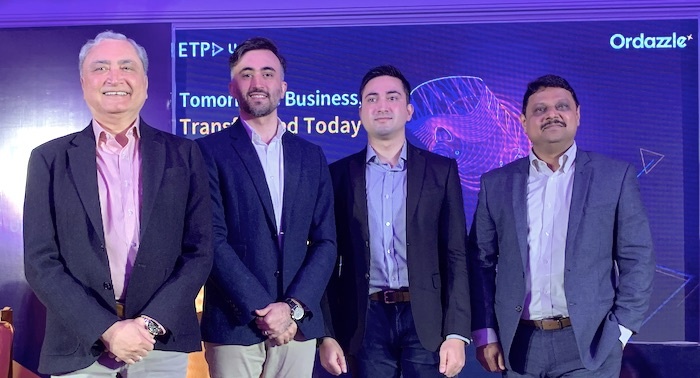
The March 2024 India launch of ETP Unify and Ordazzle put Ahuja alongside Neev Ahuja, Veer Ahuja and Bhavesh Doshi. The photograph is a reminder that a founder’s career gradually becomes the work of a wider team. There are four people in the frame, and a much larger set of responsibilities beyond it: designing, implementing, explaining and supporting what the company has built.
The two platforms address related sets of work. ETP Unify brings physical and digital retail functions together. Ordazzle handles ecommerce and marketplace operations. At the launch, Ahuja stressed scale and ease of adoption. Those aims belong together. Software that can process a large volume of business must also be usable by the people doing the ordinary work of selling, updating products and fulfilling orders.
ETP also continues to offer V5. Its published product information describes an offline mode that allows transactions to continue during downtime, with data uploaded when connectivity returns. That detail deserves its place beside newer cloud products. The moment a network connection fails, a rather abstract discussion about architecture becomes a very concrete discussion at the checkout.
The coexistence of these products gives Ahuja’s career an interesting texture. He has remained at the same group while the tools, language and delivery models around it have changed. The continuity lies in the retail work underneath: knowing the stock, recognising the customer, applying the right price and completing the sale. Each new platform has to make a convincing case at that level.
The pleasure of a system going live
Ahuja’s public reaction to a Matahari deployment offers a more personal glimpse of what he celebrates. In a 2023 LinkedIn post, he praised collaboration with the retailer’s leadership and team as ETP shared the first store go-live at Taman Anggrek. His comment singled out vision and execution. The accompanying company account described months of work between Matahari’s business and IT teams and ETP.
A go-live has a different kind of drama from a product announcement. An announcement describes what a system is intended to do. A go-live puts that intention into a working business. The staff, stock and customers now have a vote. Ahuja’s pleasure in the collaboration is easy to understand in that context: the achievement belongs to people on both sides who must get the details to agree.
His more recent public conversations stay close to such details. In the company’s “Mondays with Naresh Ahuja” interview series with Mannu Mathew, one discussion addressed data consistency, automated testing and geographically separated backups. These are the quieter subjects in a technology business. A backup attracts considerably less attention than a launch, right up until somebody needs the backup.
The technical concerns are also human concerns. Reliable information saves an employee from making a promise that another part of the business cannot fulfil. Consistent records reduce the need to argue with a screen while a customer waits. Those are modest outcomes to put beside an ambitious platform presentation, but they explain why the presentation might matter.
“Does it work?” becomes a much more interesting question when a customer is waiting.
An observation on the work of implementationA little science fiction, a lot of follow-through
Ahuja’s conference biography describes a father of three whose interests include scuba diving, golf, reading, mentoring and science fiction films. It is a welcome widening of the frame. The founder discussing software has other ways to spend an afternoon, and an appetite for imagined futures as well as practical systems. None of those hobbies needs to be recruited as a secret explanation for his business decisions.
His professional ambitions remain regional and specific. In a May 2025 interview, he discussed expansion across Asia Pacific, the Middle East and Australia, naming Indonesia, Vietnam, Thailand and the Philippines among the markets of interest. These plans extend the cross-border work that has occupied much of his career. A new market brings another set of local retail requirements to understand.
In July 2026, ETP announced him as a scheduled keynote speaker at Manila’s National Retail Conference and Expo. The announced topic concerned removing the invisible barriers within unified commerce. It was a fitting subject for someone whose work began with the connection between software and a shop. Nearly four decades later, the connections have multiplied: stores, marketplaces, warehouses, delivery services and customer records.
The distance travelled is substantial; the original question remains recognisable. Can software make the work of selling run more coherently? Ahuja has spent his career answering through products, partnerships and implementations. Somewhere beneath the changing terminology is the young programmer looking at a retail problem and deciding that he could write something useful. The customer would still like the right item. Preferably today.
Continue the conversation
Explore Ahuja’s interviews, public posts and the business he founded.