A filling machine has an instruction manual. It also has a person who has spent twenty-five years learning what the manual leaves out. When Richard Tester explained a new Redzone product in 2022, he chose that person as his example. Give the operator a phone or tablet, he suggested, and a few minutes of recorded demonstration could become a lesson for everyone else. The factory already possessed the expertise. Now it needed a way to pass it around.
It is an unusually modest image to place beside an acquisition reported at about $1 billion. Yet it gets closer to the business Tester helped build than the purchase price does. Redzone made software for people working on production lines, with tools for communicating, tracking work and sharing knowledge. The experienced operator had a part to play beyond keeping a machine running: becoming a teacher.
Tester co-founded Redzone with Mark Sutcliffe and Jon Clement in 2013. He was its CEO when QAD acquired it in February 2023. Between those dates lies a story about finding commercial value in the people manufacturing systems could so easily overlook. There are dashboards in this story, certainly. The interesting part is who gets to use them.
A career measured in factory visits
Tester studied science at the University of Birmingham, attending from 1998 to 2001. In 2004, he moved from the UK to Miami to launch MVI Technology in the North American market. His work put him inside the manufacturing software business well before Redzone existed, dealing with the practical task of taking a technology company into another market.
He was part of the leadership team that sold MVI to CDC Software and then spent several years working on its integration. Building a market, selling the business and helping fit it into a larger organization gave his career a sequence that would later sound familiar. Miami became the base from which he pursued that work.
His professional biography describes visits to more than 1,000 consumer packaged goods manufacturing facilities across North America and Europe over nearly twenty years. That is a useful measure of the career preceding and surrounding Redzone: repeated exposure to the places where manufacturing software must prove useful. A production line makes a fairly unforgiving product demonstration. It has work to get through.
At Redzone, Tester initially led the commercial organization, serving as chief revenue officer before becoming CEO. His responsibilities included building the route to customers and growing the community around the product. Sutcliffe and Clement were fellow founders, with their own contributions to the company. The business took shape through a team, and its subsequent growth belongs in that frame.
Twenty yards, twelve customers
The company’s name came from American football. In the final twenty yards before the end zone, players have to coordinate, read what is happening and adjust their decisions. Sutcliffe’s interest in high-performing teams helped supply the metaphor. In Redzone’s version, the factory floor was the place where plans encountered the pressure of execution.
It is a sporting analogy with unusually literal trade-show potential. At PACK EXPO Las Vegas in 2021, the Redzone team gathered on a booth floor marked like a football field. Screens, suits and yard lines shared the same small patch of exhibition space. A software demonstration had acquired home-field markings.
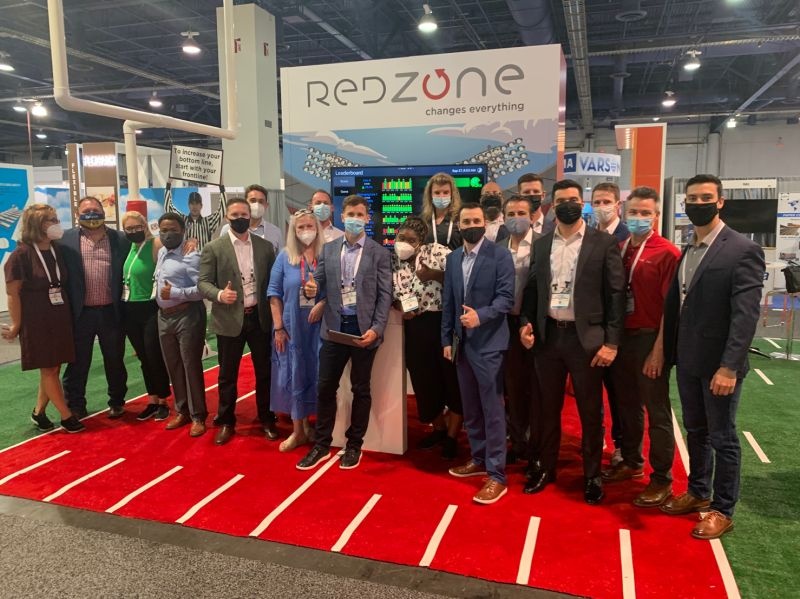
Redzone began with twelve customers in 2013. Its early proposition joined mobile software and collaboration with the everyday problems of production. For Tester, the commercial task was to grow adoption of something workers and managers could put to use while the line was running. Productivity would have to mean a difference in the working day.
The approach gave communication a central role. A goal needs to reach the team responsible for it. A problem needs to reach someone who can help. A useful adjustment needs a route to colleagues. These are ordinary exchanges, but a factory depends on them happening at the right time. Redzone’s tools were organized around making those exchanges easier.
The worker becomes the teacher
Tester’s filling-machine example arrived with the Frontline Learning Module, introduced at PACK EXPO International in 2022. An operator could record a short video demonstrating a startup, changeover or useful way of working. Colleagues could watch the demonstration when they needed it. Familiar consumer behavior supplied an explanation for an industrial product.
“It’s like a YouTube application for the plant floor.”Richard Tester, 2022
The comparison was deliberately accessible. People already turned to videos to learn practical tasks away from work. Tester was describing how the same habit could help inside a factory. The person with years of experience would supply the lesson, while the software provided somewhere for it to live and a way for others to find it.
The choice of teacher matters. An operator’s knowledge comes from repeated encounters with particular equipment and particular tasks. Recording it gives that experience another use. Someone starting a job can learn from it; someone changing responsibilities can return to it. The demonstration does not have to depend on both people being available for the same conversation.
Learning also sat alongside other parts of the product. Redzone’s offering covered productivity, compliance and reliability, with coaching as part of its approach. Software and changed working habits were sold together. That combination fits the practical character of Tester’s public explanations: the feature is interesting because of what a worker can do with it.
In his contributor profile, Tester described the opportunity as allowing frontline teams to organize around shared goals and act in the moment. The timing is central to the argument. Information about a completed shift serves a different purpose from information a team can use during the shift itself. His public case for the technology kept returning to that distinction.
It also helps explain why the product story includes a community. Redzone’s customer gatherings and awards gave factories occasions to discuss their work and recognize the teams involved. Tester publicly congratulated the 2022 award winners. The vocabulary could be exuberant, but the subjects were concrete: productivity, quality, reliability and engagement. The people on the line were part of the company’s account of its progress.
A decade, then a deal
Summit Partners invested in 2020, becoming Redzone’s first outside investor. By then the founding team had spent years developing the business. The investment brought another set of relationships into the picture, including Summit managing directors Jay Pauley and Len Ferrington, who joined the board that year.
In March 2022, Redzone reported that annual recurring revenue bookings had grown 78 percent during 2021 and that it had added more than 100 customers. Bill Berutti, whose software career included Plex Systems, BMC Software and PTC, joined as vice chair. The announcement also put revenue run rate above $65 million. These were company-reported figures, describing a business with substantial commercial momentum.
Tester connected the demand for its product to rising manufacturing costs. His argument was that better productivity could help businesses accommodate higher wages and protect margins. He expressed it with a line that became a recurring part of his public case for Redzone.
“We believe wholeheartedly that productivity is the antidote to inflation.”Richard Tester, March 2022
That was his business argument, rather than a promise that software could resolve every economic pressure. It put the worker’s experience and the manufacturer’s finances in the same conversation. The commercial opportunity depended on teams being able to accomplish more with the tools and knowledge available to them.
Worldwide use reported in QAD’s acquisition announcement.
QAD closed its acquisition of Redzone on February 1, 2023. Reuters reported a price of about $1 billion; the official announcement did not disclose financial terms. The companies said Redzone was on track for a $100 million annual revenue rate. A decade after its founding, the business was joining a larger manufacturing software organization.
For Tester, the appeal included access to QAD’s customers and international footprint, together with opportunities in additional manufacturing sectors. His stated ambition remained tied to empowering frontline teams. He subsequently served as president of QAD Redzone, extending a career that had already taken him from commercial leadership into the CEO role.
Listening beyond the factory gate
Tester’s writing after the acquisition continued to concentrate on manufacturing workers. In an April 2023 essay, he argued that the industry needed to address its reputation to attract new talent. Later that year, he wrote about using workers’ ideas to improve manufacturing processes. Recruitment, learning and the daily experience of work belonged in the same discussion.
His more recent public work includes an institution closer to home. He joined Miami Country Day School’s board of trustees in August 2024, according to his professional profile. He went on to chair its strategic planning committee, working alongside school leadership, fellow trustees, faculty and families on a five-year plan.
The process included drafting work in spring 2025, a wider community survey that fall and a faculty and staff working session in January 2026. The board approved the 2026–2031 plan on January 29. Its priorities include student learning, educators and community. Here, too, a plan had to make room for the experience of people carrying out the daily work.
A school has different obligations from a software company, and Tester’s role there belongs to a different chapter. It nevertheless offers a useful ending to a career story so often stopped at the acquisition announcement: he is still involved in the work of shaping an organization with other people. Back at the filling machine, the original observation remains pleasantly practical. Ask the experienced person to show you. Then make the lesson easier to share.