At Macatawa Bank Corporation’s 2011 annual meeting, Richard Postma offered an unusual picture of high finance: the chairman selling share certificates from the back of his car. The company was raising capital. Its shareholders had reasons to be anxious. Into that room, Postma brought a joke with the unmistakable atmosphere of a roadside transaction.
“I’m selling certificates out the back of my trunk on the way out of here,” he said. It was a joke, of course. The money behind his chairmanship was quite real. That April, he had bought a $1 million subordinated note from the holding company. In June, he converted that note, with accrued interest, into common shares and bought additional stock through the public offering.
The distinction matters. Postma had taken responsibility for helping to repair a financial institution, and he was putting his own capital into it. A chairman can offer a roomful of shareholders many things: reassurance, explanations, a carefully prepared presentation. A personal investment adds a rather different item to the agenda.
That episode gives a useful entry into an otherwise unusually varied working life. Postma trained as a lawyer, became a telecommunications entrepreneur, chaired a West Michigan bank, developed a golf destination, and helped fund a new clubhouse at the university where he had studied. The subjects change. The work repeatedly involves institutions and physical places that other people expect to keep using.
“I wanted to quietly do this.”
Richard Postma, on his Michigan gift, 2014
A law degree, then a different sort of practice
Postma graduated from Calvin College and earned his law degree at the University of Michigan in 1976. His early professional life included the Grand Rapids firm Miller, Johnson, Snell and Cummiskey, where he became a partner. Telecommunications companies also became familiar territory through general-counsel work, including Teledial America, Digital Signal, and City Signal.
This was an education in businesses as well as in law. The companies required legal advice, but they also required decisions about financing, ownership, and operations. Postma’s eventual move into leadership therefore had a long approach. By the time his name appeared beside a chief executive title, he had already spent years working around the machinery of companies.
He went on to serve as co-chairman and chief executive of US Xchange. His board experience included Choice One Communications and AboveNet, the latter with assignments on audit, compensation, and strategy committees. These were separate responsibilities across a telecom career, rather than a single company with an ever-lengthening job title.
For a reader encountering him through US Signal, the legal background is worth keeping in view. A fiber network has an engineering reality and a corporate reality. Someone must deal with the assets, agreements, and capital around the connections. Postma’s experience crossed those boundaries. His route to the network business began well before cloud services became part of its vocabulary.
9,500 miles beneath the business
US Signal dates its founding to 2001. With Postma as co-founder and chief executive, the Grand Rapids business developed a network and data-center operation serving enterprise customers and telecommunications carriers. Its offering came to include connectivity, cloud hosting, colocation, data protection, and disaster recovery. The list sounds abstract until a company needs one of those services to work.
By the September 2022 announcement of its sale to Igneo Infrastructure Partners, US Signal operated 9,500 route miles of fiber and eight data centers across nine states in the upper Midwest. It employed approximately 185 people. Those figures describe the business at that moment, after roughly two decades of development under its original ownership.
There is something usefully literal about a route mile. It puts distance back into a conversation about digital services, which are often described as though they have escaped geography altogether. US Signal’s customers bought services carried by a network with a footprint. Grand Rapids was a starting point for a business whose connections extended far beyond the city.
The acquisition agreement covered all of US Signal’s equity. Postma’s stated expectation was that Igneo could support the expansion of its data-center presence and fiber infrastructure. The transaction closed in February 2023, and he left the company that month. Daniel Watts became chief executive in March. The network’s subsequent chapters belong to the leadership that followed him.
The bank was a longer assignment
Macatawa’s invitation arrived in November 2009, when Postma became chairman of the holding company. The assignment was explicit: help raise capital, improve its financial position, and work toward a return to profitability. Ronald Haan led the executive team. Postma joined a board and management effort whose results would have to be measured over years.
The 2011 share purchases put numbers beside that undertaking. After the offering purchases and note conversion, Postma reported beneficial ownership of 1,460,843 common shares, approximately 5.5 percent of the company. Those were his investment holdings at that date, rather than a claim about his eventual return or his total wealth.
Progress emerged in the operating figures. Macatawa reported $10.5 million of net income for 2014, compared with $9.5 million for 2013. Nonperforming assets fell by $12.5 million during 2014. The work behind such changes belonged to the bank’s employees and leadership as well as its board. A chairmanship supplies direction and oversight; the institution still needs people carrying out the decisions.
In August 2024, Wintrust completed its acquisition of Macatawa in an all-stock transaction valued at approximately $510.3 million. At June’s end, Macatawa had about $2.7 billion in assets and operated 26 branches. It entered the combination as a separately chartered bank, retaining its name and local presence. Postma joined Wintrust’s board when the deal closed.
His explanation of the combination centered on continuity: employees, branches, the Macatawa name, and a community bank board, alongside access to a larger company’s services and technology. After nearly fifteen years as chairman, those details were consequential. He resigned from Wintrust’s board on June 11, 2025. The bank he had joined in a difficult period continued beyond his tenure.
- 2009Postma becomes chairman
- 2011Personal capital joins the rebuilding effort
- 2024Wintrust acquisition closes
The hobby acquired a coastline
Golf introduced a different scale of visibility. Fiber routes can pass unnoticed; a course above Lake Michigan is harder to overlook. Arcadia Bluffs opened in 1999 with eighteen holes and a small clubhouse. Postma’s interest in developing golf courses had begun as a search for a hobby. Some hobbies require a spare room. This one required considerable land.
The resort’s expansion also exposed the owner to questions that a drawing cannot settle. At a public hearing in 2017, residents raised concerns around the proposed development. Postma attended and spoke about responsibility to neighbors, water use, and the experts working on the project. Owning the site meant answering questions about what happened beyond its boundaries.
For the South Course, the design conversation took a striking turn. Architect Dana Fry saw a possible relationship between the inland property and Chicago Golf Club’s geometric character. Postma welcomed the idea. The resulting design used straight lines, squared forms, and flat-bottomed bunkers, offering a visual departure from the original lakeside course.
The episode suggests a patron with specific interests, willing to pursue a second course with a different character. It also puts his collaborators in the picture. Architects, course staff, and hospitality teams turn an owner’s commitment into something a visitor can actually experience. At Arcadia, the enduring product is a place maintained and operated by many people.
Back to the course he played as a student
At Michigan, golf had once been part of Postma’s law-school life. He played the university course with friends. Years later, learning that its clubhouse needed replacement gave him a way to join a familiar place’s next chapter. Richard and Ruth Postma’s $4 million gift to athletics supported capital projects; the university approved naming the new clubhouse for the family in July 2014.
His involvement extended to working on the program and layout with associate athletic director Rob Rademacher. The building needed to accommodate ordinary rounds of golf and university or community gatherings. That combination gave the project a purpose beyond a name above an entrance: people would arrive carrying golf clubs, or arrive for a meeting, or gather for an occasion.
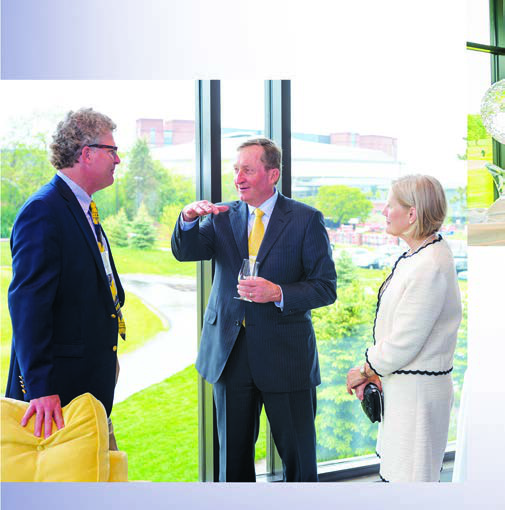
The Richard L. Postma Family Clubhouse was dedicated on May 20, 2017. The completed facility contained 23,000 square feet, with a grill, pro shop, meeting space, and a second-floor ballroom accommodating 200 people. Its views took in the course and Michigan Stadium. A photograph from the dedication catches Postma talking with architect Mike DeVries, Ruth beside him.
That range of responsibilities also helps explain why a single title can give a misleadingly small account of his career. US Signal, Macatawa, and Arcadia required different teams and different forms of expertise. Following the projects reveals more than treating the organizations as a list of affiliations. The work was spread across companies, while its Michigan connections remained visible.
His broader business responsibilities continued across different kinds of work. Wintrust’s 2025 biography listed chairmanships at TurnKey Network Solutions, R.T. London, Arcadia Bluffs, and Postma Corporation. Telecommunications infrastructure, furniture, and hospitality make an unconventional collection on a résumé. Each nevertheless involves a practical relationship with the people who use what the business provides.
The clubhouse offers a fitting place to leave him. A law student once played this course with friends; a later gift helped replace its aging facilities. Between those visits came company building, board meetings, network miles, and a bank’s repair. The next golfer who walks through the door can use the building without knowing any of that. It has a job to do.