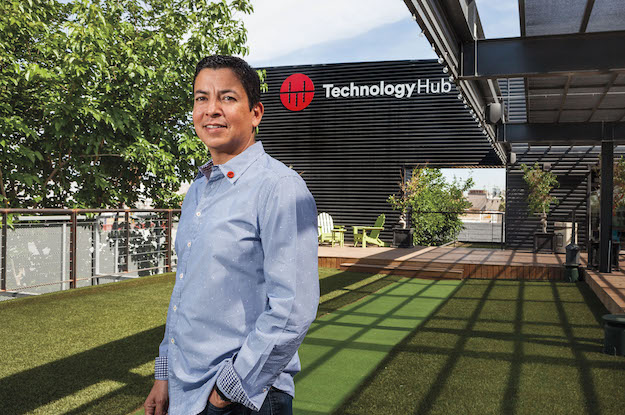
The U.S. consulate in Ciudad Juárez had a fairly unambiguous purpose: people came hoping to go somewhere else. Ricardo Mora and his partners gave the old compound a different assignment. They made it a place where people could start something, find collaborators and have a reason to stay. A building associated with departure became an address for local ambition. Its heavy doors survived the career change.
Mora had known the neighborhood long before he knew what an innovation campus might be. As a boy, he lived nearby and rode his bicycle along Avenida López Mateos. Born in El Paso and raised in Juárez, he would come to describe himself as bicultural. The geography of his childhood eventually became the geography of his businesses: two cities, two countries, a working life threaded through both.
That makes the consulate an unusually apt building for his story. Mora has sold food, built telecom businesses, worked in venture investment and led a chamber of commerce. Across those occupations runs a persistent interest in what happens when people on opposite sides of a dividing line start doing business together.
The salsa survived the business
His early career had less to do with pitch decks than with deliveries. Mora delivered Domino’s pizzas. When his mother’s salsa-bottling business failed, he used the remaining salsa in a hot dog stand. He expanded to three locations, sold them and moved into telecommunications. There is a pleasing economy to that beginning: the family business closed, but its inventory still had somewhere to go.
Food remained in the portfolio. His later ventures included Taco Tote franchises in the Phoenix area, while RM International brought together business interests spanning the United States and Mexico. He earned a business administration degree from the University of Phoenix. By the time he started talking about an innovation campus, he had experience with the less glamorous questions that keep businesses occupied: customers, operations and expansion.
By 2017, his ventures ranged across more than ten startups, including restaurants, telecommunications, information technology and investment funds. The variety helps explain the kind of place Technology HUB became. Its co-founder had reasons to care about a young company’s next sale as well as its next idea.
A consulate learns to host
Technology HUB took possession of the former consulate in 2014 and opened its first phase in 2015. Mora’s fellow founders were Rudy Vázquez, Rubén Rivera and Fermín Reyes. Their backgrounds covered manufacturing, finance, telecommunications and software. The campus was a joint undertaking, with different kinds of operating experience gathered under one roof.
The property’s previous life provided some eccentric raw material. Bulletproof doors remained. Art replaced metal detectors in the lobby. Old pay-phone booths became electric-car charging points. A former bomb shelter became a meditation room. Few office conversions can offer quite such an economical account of changing priorities.
The familiar address also brought an unfamiliar sales problem. In 2020, Mora described the difficulty of persuading traditional businesses to understand the value of sharing a campus. Renting a room was easy enough to explain. Paying to be near other people’s ideas required more work. He wanted tenants to see the possibility of introductions, collaborations and relationships with larger companies.
The building gave that argument a physical form. People could come for a desk or a meeting and encounter organizations they might otherwise have approached separately. Mora’s own account of the project emphasized trust. The architecture could create proximity; getting people to use it was a continuing job.
The customer is across the river
Mora’s view of the border was shaped by ordinary repetition. In 2019, he described a social circle in which roughly half the people crossed regularly, as he did. His businesses straddled the two markets. When crossings slowed and shipments backed up, the consequences reached companies and customers on both sides.
For an entrepreneur working that way, a border is both a daily procedure and a business constraint. A delayed component matters to the factory waiting for it. A local supplier needs a route to a buyer, even when that buyer operates only a short distance away. Geographic closeness does surprisingly little paperwork on anyone’s behalf.
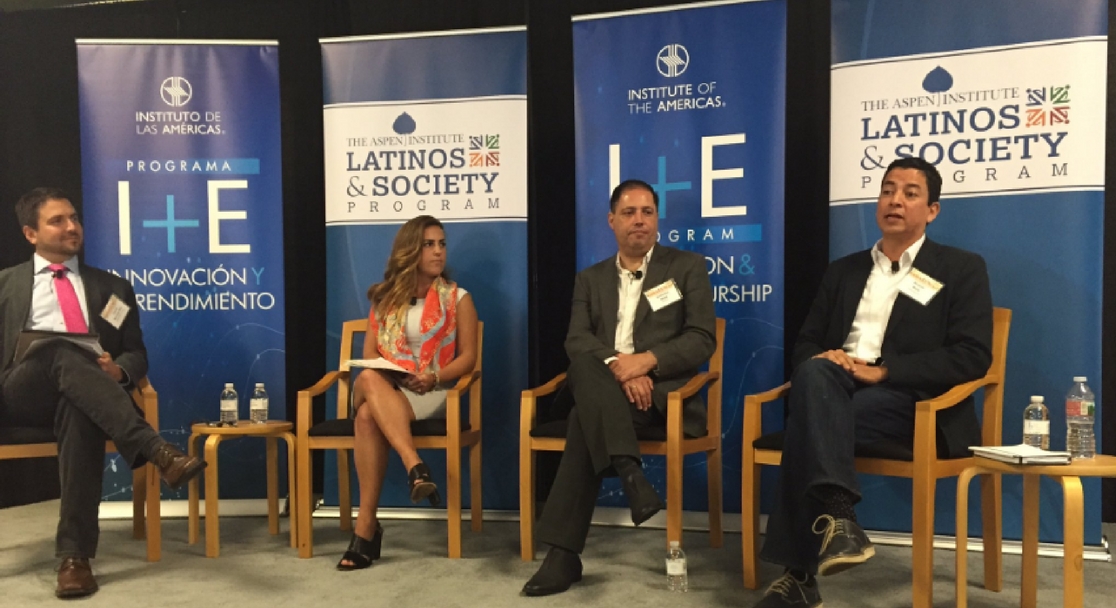
Mora brought that practical perspective into public conversations about the region. At a September 2017 forum organized by the Aspen Institute’s Latinos and Society Program and the Institute of the Americas, he joined Regina Bernal and Guillermo Mejía Duclaud on a panel about an inclusive border economy. He discussed Technology HUB alongside Saba Investments and Fab Lab Juárez, connecting business formation with capital and technical skills.
It was a broader proposition than office space. A company might need a prototype, an investor, a customer or a trained employee. Bringing those possibilities closer together was the campus’s underlying wager.
Twelve weeks to reach the purchasing desk
The Bridge Accelerator gave the wager a specific commercial task. Technology HUB and Pioneers 21 created the binational supplier-development program in 2019 with support from Microsoft TechSpark. Its purpose was to help regional businesses win more work in the industrial supply chain. The opportunity already existed in nearby manufacturing operations; local companies needed help reaching it.
Microsoft committed $1.5 million to extend the initiative after its pilot. The early pilot generated 52 purchase orders worth about $1.5 million and 33 new jobs. Those figures describe an early cohort’s results, rather than a measure of the entire campus. They also offer a useful test of the idea: introductions had produced transactions.
The program ran for 12 weeks, combining instruction with access to people who buy for larger businesses. By 2022, sessions covered subjects including marketing, investment fundamentals, innovation and technology trends. Participants finished with a Demo Day, pitching to manufacturing executives and competing for investment capital. The curriculum acknowledged that winning industrial work involves several skills at once.
Mora explained the purpose simply: “that’s why it’s a bridge because we’re making this connection.” The name was useful in a region already familiar with actual bridges. This one sought to shorten the distance between an established small business and a corporate purchasing department.
His own 2022 guest column stressed keeping sourcing in the region over the long term. NMSU’s Arrowhead Center contributed modules, including financing and access to capital markets. That detail matters. A business can meet a buyer and still need money to deliver the order. Mora’s network of collaborators was trying to address what happens after the handshake.
Early program results. These are historical pilot figures, not current totals.
Room for the next generation
The work extended beyond companies ready to sell. Mora served as president of the board of Fundación Axcel, known as FUNAX. The organization shifted toward technology education in 2016 and opened Fab Lab Juárez in 2017, supported by Flo Networks and Fab Lab El Paso.
That brought a different audience into the same orbit: young people and adults learning to use digital tools. Mora’s public writing included an August 2022 article about teaching entrepreneurial skills to youth. The concern fits beside supplier development. One effort helps an existing business reach a market; the other gives someone more ways to enter working life.
There was room for play, too. The Tera building acquired a slide from its second floor. During a 2019 leadership visit, members of the U.S. consular team toured the repurposed compound and went down it. A former consulate is an excellent place to discover that official business can occasionally involve a slide.
The detail is more than office decoration. The campus asked visitors to reconsider a place they thought they understood. Workshops, art, fabrication equipment and that improbable descent gave the building several ways to make the introduction.
Tools & technical skills
Space & collaborators
Supplier development
A different office, the same crossing
In August 2024, Mora accepted the chief executive role at the El Paso Chamber, beginning work on August 19. The appointment followed a national search lasting nearly 90 days and drawing more than 300 applicants. He resigned as Technology HUB’s CEO to take the position, while remaining one of its co-founders.
His background matched the Chamber’s stated interest in binational commerce, manufacturing and workforce development. “Strengthening binational commerce is key to our region’s prosperity,” he said when his appointment was announced. The new office put him in a different institution, with a familiar economic map.
He also brought a set of regional connections. He had held board or advisory roles with Desarrollo Económico de Ciudad Juárez, Funax-FabLab Juárez, NMSU’s Arrowhead network and the University of Texas at El Paso’s Development Board. These affiliations placed him among the business, education and nonprofit organizations involved in the region’s growth.
By September 2025, his agenda included automation in cross-border trade and a hoped-for return of trolley service between El Paso and Juárez. His ambition involved the movement of goods and people alike. Even a career associated with technology kept returning to an old regional problem: how to make it easier to get from here to there.
“Strengthening binational commerce is key to our region’s prosperity.”
RICARDO MORA / AUGUST 2024
The bridge is still on the agenda
In September 2026, Mora announced that he would leave the Chamber on December 31 to concentrate on expanding an existing business. He said he intended to remain an active member. The planned departure fits a career in which running companies and organizing the business community have repeatedly overlapped.
He was still making the case for cross-border commerce in October. On October 14, he appeared with transportation executive Royal Jones and wholesale-grocery executive Paul Dipp to oppose the planned removal of commercial traffic from the Bridge of the Americas. Their concern was the effect on regional trade. Years after the accelerator began, a physical bridge had returned to the center of his work.
Mora has also voiced a more distant ambition: a billion-dollar company growing out of the Juárez campus and staying on the border. He presented it as a dream. The daily work beneath that aspiration is easier to picture: a business learning to pitch, a student trying a fabrication tool, a supplier meeting someone authorized to place an order.
The old consulate offers a compact expression of that ambition. Mora once passed it on his bicycle. Later, he helped give it another use. A familiar building could hold different possibilities, provided somebody was prepared to open the doors.
Keep the conversation crossing
Work, interviews and public appearances.