Somewhere inside a software company, an engineer pulls a Docker image at 11:43 p.m. She reads the installation guide, returns to GitHub, checks two issues and invites a colleague into the experiment. Nobody books a demo. No lead-scoring bell rings. In the conventional sales funnel, nothing has happened. In reality, a small buying committee may already be forming.
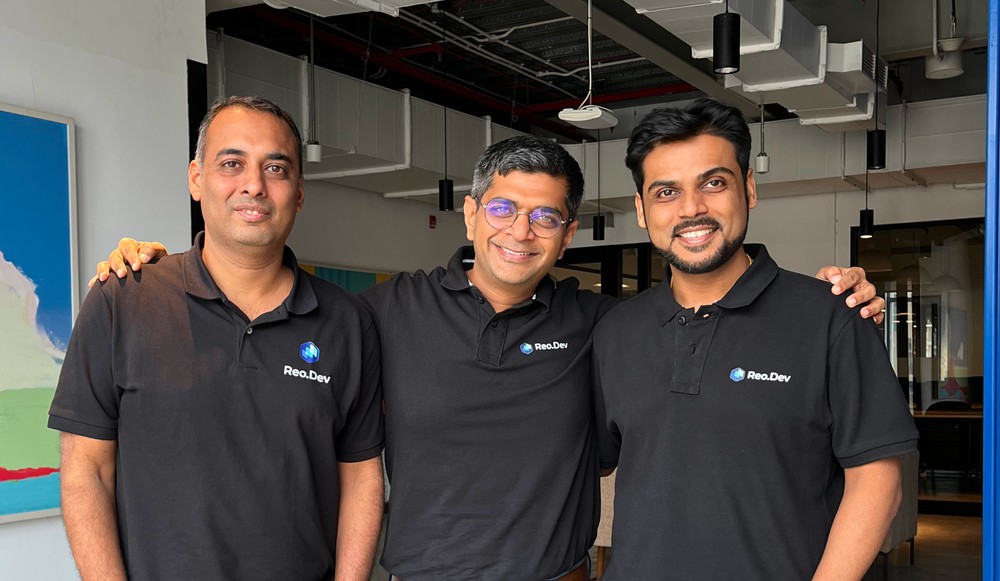
Reo.Dev exists because the difference between those two accounts of reality is expensive. Founded in 2023 by Achintya Gupta, Gaurav Jain and Piyush Agarwal, the company collects technical activity from the places developers actually work - repositories, package managers, documentation, communities, product telemetry and, now, AI agents - then connects it to companies and likely buyers. Its customers are not developers. They are the sales, marketing and revenue teams trying to understand developers without annoying them.
The short version
- What it does: turns developer behavior into ranked accounts, people and next actions.
- Who buys it: DevTool, infrastructure, AI and commercial open-source companies.
- What is different: the evidence comes from technical use, not merely ad clicks or form fills.
- What it costs: custom, demo-led annual subscriptions; Reo.Dev publishes no list price.
- What to copy: measure the behavior closest to value, then give sales a reason and a moment to act.
The first thing that failed was the form
Gupta had encountered the problem while selling a developer product. Technical buyers were busy evaluating - inside Discord, GitHub and documentation - while the revenue stack waited politely for an email address. The founders' change of mind was subtle but consequential: website traffic was not the funnel. It was one window onto a much larger room.
That is the intellectual move behind Reo.Dev. A GitHub star alone is weak evidence. A star followed by documentation visits, package installation and repeated product activity from several engineers at the same company is different. Reo.Dev resolves those fragments into profiles, maps them to accounts, sorts activity into stages such as exploring, evaluating, building and deployed, and sends the result to the tools a revenue team already uses.
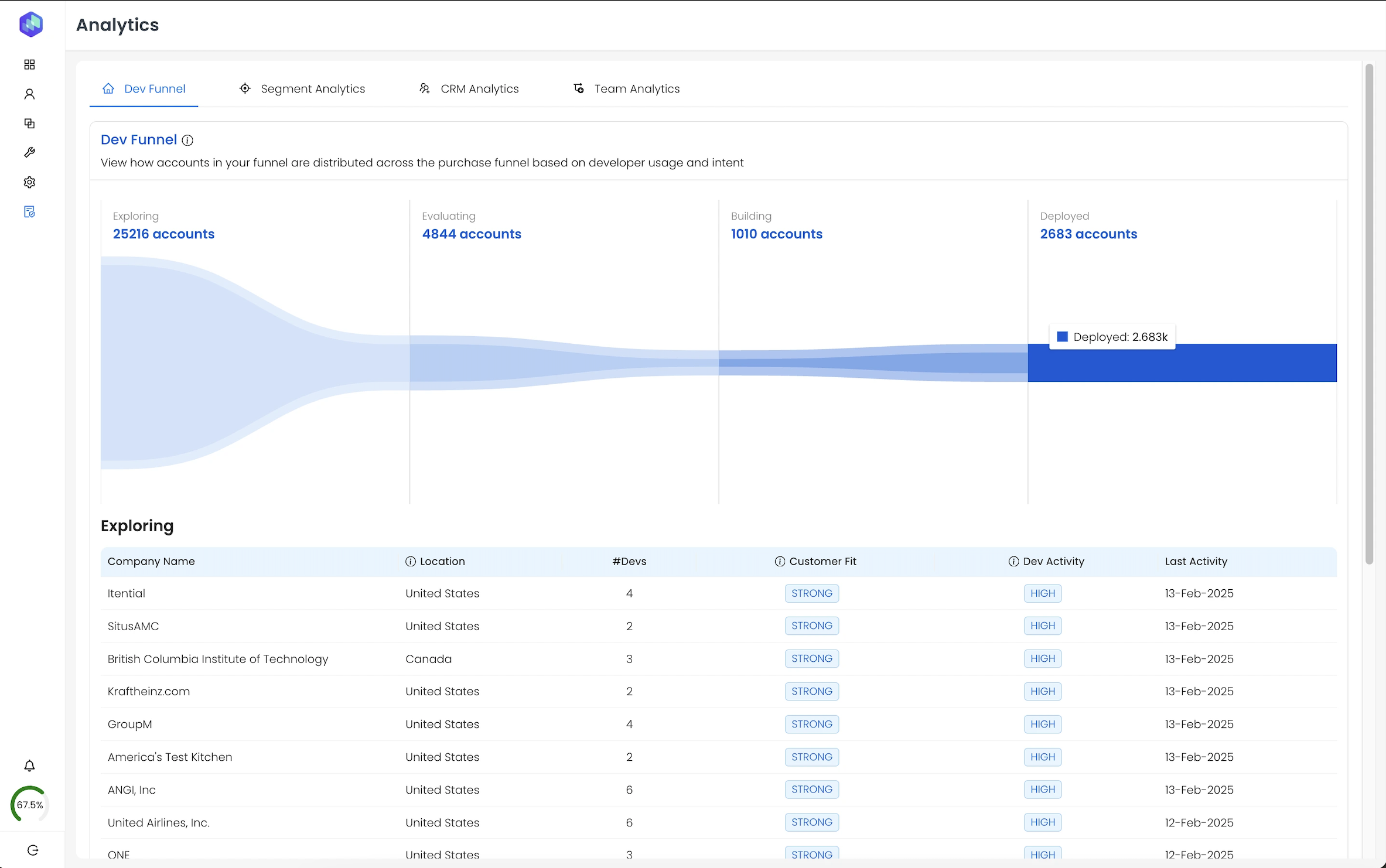
A graph with a sales quota
By July 2026, Reo.Dev said its Developer Knowledge Graph had passed 100 million technical profiles, mapped across more than 3,000 technologies and 250 technical functions. The platform advertised 150 million intent signals across 20 million companies. Scale matters here because identity resolution is the product's hinge: a package install is commercially dull until it can be related, with reasonable confidence, to an organization, a technical champion and an economic buyer.
The product then sits between several familiar categories. It resembles buyer-intent platforms such as 6sense, but watches developer-native sources. It overlaps with Common Room's community intelligence, Koala's website intent and Clay's flexible enrichment, yet is narrower in audience and deeper in technical signals. Reo.Dev is not a CRM and not quite an analytics package. It is a translation layer between adoption and revenue.
The customer list is unusually legible for a young enterprise company: NVIDIA, LangChain, ElevenLabs, Couchbase, Nebius, n8n and Temporal appear among the names. Reo.Dev's published customer stories make a more persuasive case than the logos. DataHub attributed $1.01 million in one quarter's pipeline to accounts Reo surfaced. Unstructured said those accounts represented 40 percent of its deal pipeline and helped increase meetings by 20 percent. Aporia reported twice as many meetings and 70 percent better return on advertising aimed at Reo-built audiences.
“We know developers want to save time. Buyers want to save money. Reo.Dev lets us identify and message both - at the right time.”
Orlando Nieves · RevOps Lead, Unstructured
What they actually did
Unstructured's implementation is the useful, unglamorous version. The team tagged Docker pulls, GitHub engagement, CLI executions and site activity as “true developer activity,” piped those segments into HubSpot, separated practitioners from decision-makers and changed the message for each. Its account executives used the activity before calls. Its revenue-operations team fed Reo.Dev data into a data lake and displayed internal adoption in Power BI during “build versus buy” conversations.
In other words, the software did not close a deal. It changed the order of operations. First establish that real technical work is occurring. Then find the humans around it. Then contact them with evidence that makes the conversation useful. The old motion began with a list and searched for a reason. This one begins with a reason and builds the list.
Selected customer-reported outcomes
Unstructured: share of deal pipeline from surfaced accounts. Fluree: month-over-month increase in signups. Aporia: increase in advertising return. These are different customer-reported measures, shown together for scale rather than comparison.
Then the buyer stopped being human
The newest wrinkle is the Agent Intent Gateway. Developers increasingly ask an AI assistant to read documentation, compare tools or call an API. The vendor may never receive the page view that once betrayed interest. Reo.Dev's gateway, built around MCP, records what an agent asked, when it asked and - where attribution permits - which account the activity belongs to. The signal is no longer “someone read the authentication guide.” It may be “an agent repeatedly asked how this API handles enterprise authentication.”
That shift helped frame the company's $11.3 million Series A in July 2026, led by Elevation Capital with Heavybit, India Quotient, Foster Ventures and Uncorrelated Ventures participating. The round followed a $4 million seed led by Heavybit and a $1.2 million pre-seed led by India Quotient. Reo.Dev said the Series A brought its announced total to $15.3 million. The money is meant to scale the signal graph and the agent-led product at the moment software evaluation itself is moving inside assistants.
The copyable part is not the database
A smaller company cannot copy a 100-million-profile graph. It can copy the sequence. Instrument the behaviors closest to product value. Group several weak signals before treating them as intent. Separate the user from the buyer. Put the context inside the CRM or Slack rather than adding a lonely dashboard. Measure meetings, pipeline and conversion against a holdout, not merely the number of accounts “identified.” Finally, make the outreach acknowledge the likely problem without revealing a creepy inventory of everything the developer did.
The price of Reo.Dev itself is less transparent. It sells through booked demos and paid work orders, generally on renewable 12-month subscriptions; no public list price is posted. Reviews on G2 praise timely signals and responsive support, while some smaller customers call the price high, ask for a startup plan or monthly option, and describe reporting or the interface as unfinished. That is a useful correction to the case-study glow: intent data earns its keep only after a team can operationalize it.
There is also an epistemic limit. Developers research tools they never buy. Open-source usage can come from students, consultants, competitors or weekend projects. Identity matching can be wrong. Reo.Dev's own terms warn customers to verify probabilistic output and use it lawfully. A signal is a reason to look more closely, not permission to declare that an account has raised its hand.
That may be the company's most interesting lesson. Revenue software has spent years making it easier to speak. Reo.Dev is trying to make teams better at listening. The buyer who never knocked was not hiding. She was installing the product.