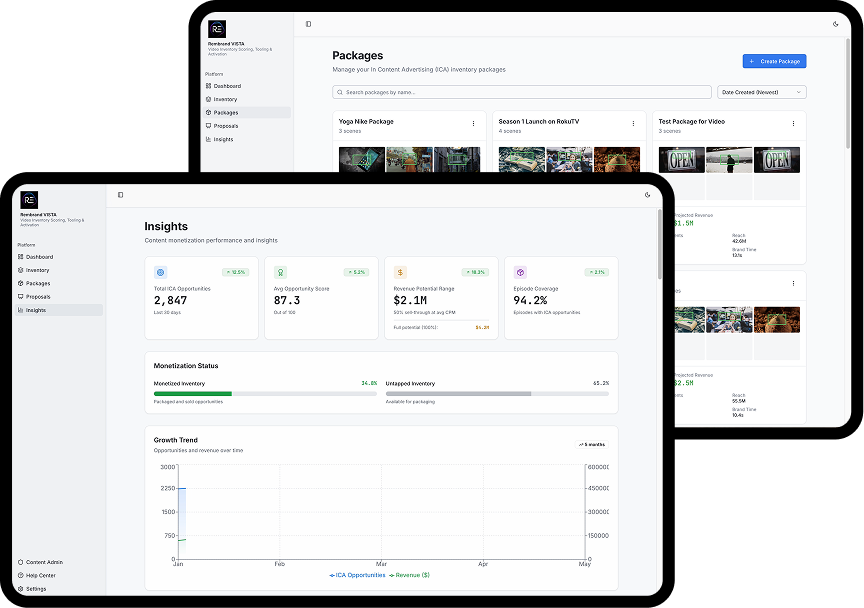
Somewhere, right now, a streaming show is being watched by a stranger who will not skip a single ad. There are no ads to skip. The brand is on the wall behind the actor. It is also on the can in his hand. Neither was there during filming. Rembrand put them in afterward, and the stranger did not notice the seams. That is the entire pitch, and it is also the entire problem.
Advertising has spent two decades trying to win back attention it lost to the remote control, then the DVR, then the skip button, then the entire idea of premium content people pay for so they don't have to watch ads. Rembrand's answer is unsentimental: stop trying to win attention back. Take a different door in. Put the message inside the thing the viewer is already paying attention to.
If you can't beat the skip button, render around it.- The Rembrand thesis, in one sentence
01 / THE PROBLEMThe 30-second spot is wearing thin
Consider the modern viewer. She watches eight hours of video a day across five surfaces. She pays for three of those surfaces specifically to avoid being interrupted. She fast-forwards through the rest. She has been trained, gently and over years, to treat advertising as a tax on her time. The industry, charmingly, still calls this "an engaged audience."
Brands have noticed. CTV budgets are climbing - but so are completion rates that nobody really believes. CPMs are inflating in a market where everyone privately suspects half the impressions are background noise. Influencer marketing helps, until the influencer pivots, ages out, or posts something regrettable. Traditional product placement, the old Hollywood game, is slow, expensive, and impossible to A/B test. You cannot programmatically change the soda on James Bond's bar cart.
Until, of course, you can.
The ad break isn't dying. It's already dead. The market is just waiting for someone to admit it.- Paraphrasing what every adtech founder says off the record
Omar Tawakol is the kind of founder who looks like he was built in a lab to keep founding things. He built BlueKai, an audience data platform, and sold it to Oracle for somewhere north of $400 million. Then he built Voicea, a voice-AI assistant, and sold it to Cisco. He sits on the board of The Trade Desk, which gives him a front-row seat to every uncomfortable conversation programmatic advertising is currently having with itself.
In 2022 he started Rembrand with a small founding bench: Abdelrahman Mohamed out of Meta's AI org, David Wiener from Voicea and Cisco, and Ahmed Saad. The conceit is simple to state and ferocious to build: train a model that understands scenes the way a film crew does - geometry, lighting, surfaces, narrative context - and then let advertisers slot real, brand-safe products into those scenes after the fact, at internet speed.
The investors agreed it was a reasonable bet. Greycroft and UTA.VC led an $8-9 million seed in early 2023. L'Oreal joined. So did Good Friends, the venture firm built by the founders of Allbirds, Warby Parker and Harry's - a group whose entire careers were spent learning how hard it is to get a product into a consumer's eyeline. In January 2025 a roughly $23 million Series A pushed total capital to about $31 million.
Sold one company to Oracle. Sold the next to Cisco. The third is the one designed to outlive both buyers.- On Omar Tawakol's pattern
03 / THE PRODUCTA foundation model for the things in a frame
Strip away the marketing and the stack is approximately three problems stacked on top of each other. First, scene reconstruction: the model has to look at a flat video, build a 3D understanding of the space, and figure out which surfaces will hold a placement without breaking physics. Second, rendering: the inserted product or signage has to inherit the right lighting, motion blur, and lens character. Third, governance: the system has to refuse to put a soft drink in a scene about addiction, or a luxury brand in a scene about violence. Rembrand calls this last layer brand-safety checks. Most of the engineering is here.
The output ships in three packages. In-Content Advertising handles virtual signage, billboards and on-screen displays. Virtual Product Placement handles physical products - bottles, boxes, devices - rendered onto kitchen counters and coffee tables. Spaceback Content Ads, picked up in the 2025 merger, recycles top-performing social videos into CTV-ready spots. They share the same model. They share the same measurement stack. They share the same uncomfortable question for the incumbents: if the ad was always inside the content, what exactly was the ad break for?
What you can actually do with it. Run a denim ad inside a creator's vlog. Drop a coffee brand into a scripted comedy. Light up a stadium's virtual perimeter board with different sponsors for different markets. Re-render last quarter's hit show with this quarter's sponsor.
The numbers Rembrand likes to quote
// Self-reported performance vs. standard video ads
Source: Rembrand company materials. Self-reported, not independently audited. Read accordingly.
05 / THE PROOF225 brands and a habit of buying competitors
A startup pitch sounds the same in every category until the customers show up. Rembrand says it has 225+ global partners - a number a polite skeptic might trim, but not by an order of magnitude, given how visible the work is. L'Oreal is a customer and an investor, which is the kind of vote of confidence that doesn't bother to be subtle.
More telling is what Rembrand has been doing with its balance sheet. In mid-2025 it bought the US operations of Mirriad, a UK-listed virtual-placement company that had been wrestling with the same problem for longer. Then it announced a merger with Spaceback, which had built a parallel platform for content-derived ads. Buying your competitors is one way to grow. Another way to read it: Rembrand is trying to be the last company standing in a category that hasn't decided yet whether it wants to exist.
If the in-content ad market is real, Rembrand wants to be the only phone number in it.- The simplest reading of two acquisitions in one year
The cap table reads like a brand summit. Greycroft, UTA.VC, L'Oreal, Good Friends - whose LPs invented the modern DTC playbook. Rembrand didn't raise from one industry. It raised from three.
06 / THE MISSIONMake the ad part of the story
Rembrand's stated mission is "video ad experiences that work. Based on content. Powered by AI." It is a sentence engineered to fit in an investor deck, and it is also, beneath the packaging, an argument about how attention works in 2026. Interruptive advertising assumed the viewer would tolerate a small toll on the way to the content. That assumption is gone. The toll booth is bypassed. The road has been re-routed. The brand that wins now is the brand that was already part of the scenery.
This is not a revolutionary insight. James Bond has been drinking branded vodka since the 1960s. ET had Reese's Pieces. What's new is the cost curve. Until very recently, putting a product in a scene was a six-month negotiation between three agencies and a director who hated the idea. Rembrand is trying to make it a query.
Product placement used to be a phone call. Rembrand is making it an API.- The structural shift
07 / WHY IT MATTERS NEXTThe programmable frame
The interesting question isn't whether Rembrand wins this category. It's what happens to video itself if the category wins. If every frame in every show is, in principle, editable after the fact - if the can on the table can be a different can in Berlin and Bogota - then video stops being a finished artifact and becomes a substrate. A canvas. Something more like a webpage than a film print.
That is a quietly enormous claim. It implies a new layer of measurement, a new set of guild conversations about creator consent and actor likeness, and a new round of arguments about authenticity in an era where authenticity is already on life support. Rembrand will not settle any of these debates. But it is one of the companies forcing them into the open.
Skeptics have honest objections. Self-reported metrics, however impressive, deserve a raised eyebrow until third parties confirm them. Two acquisitions in one year can be consolidation or indigestion - we'll know in a couple of quarters. The category itself still has to prove that buyers want to spend at scale, and that creators and rights-holders want to share their frames. None of these are settled.
What is settled is that the stranger on the couch is not going back to watching ads. She is watching a show. There is a can on the counter. She'll remember the brand by Tuesday. She won't remember it was rendered.
She didn't see an ad. That's the point.- The kind of victory adtech has been chasing for fifty years
08 / THE BENCHWho is actually building this
CEO / Co-Founder
Omar Tawakol
BlueKai (sold to Oracle). Voicea (sold to Cisco). Board, The Trade Desk.
Co-Founder, AI
Abdelrahman Mohamed
Previously Director of AI at Meta. The reason the model knows what a counter is.
Co-Founder, Product
David Wiener
CPO at Voicea, GM for AI at Cisco. Knows how to ship to advertisers.
Co-Founder
Ahmed Saad
On the founding bench from day one.
09 / SEE FOR YOURSELFLinks, profiles, paper trail