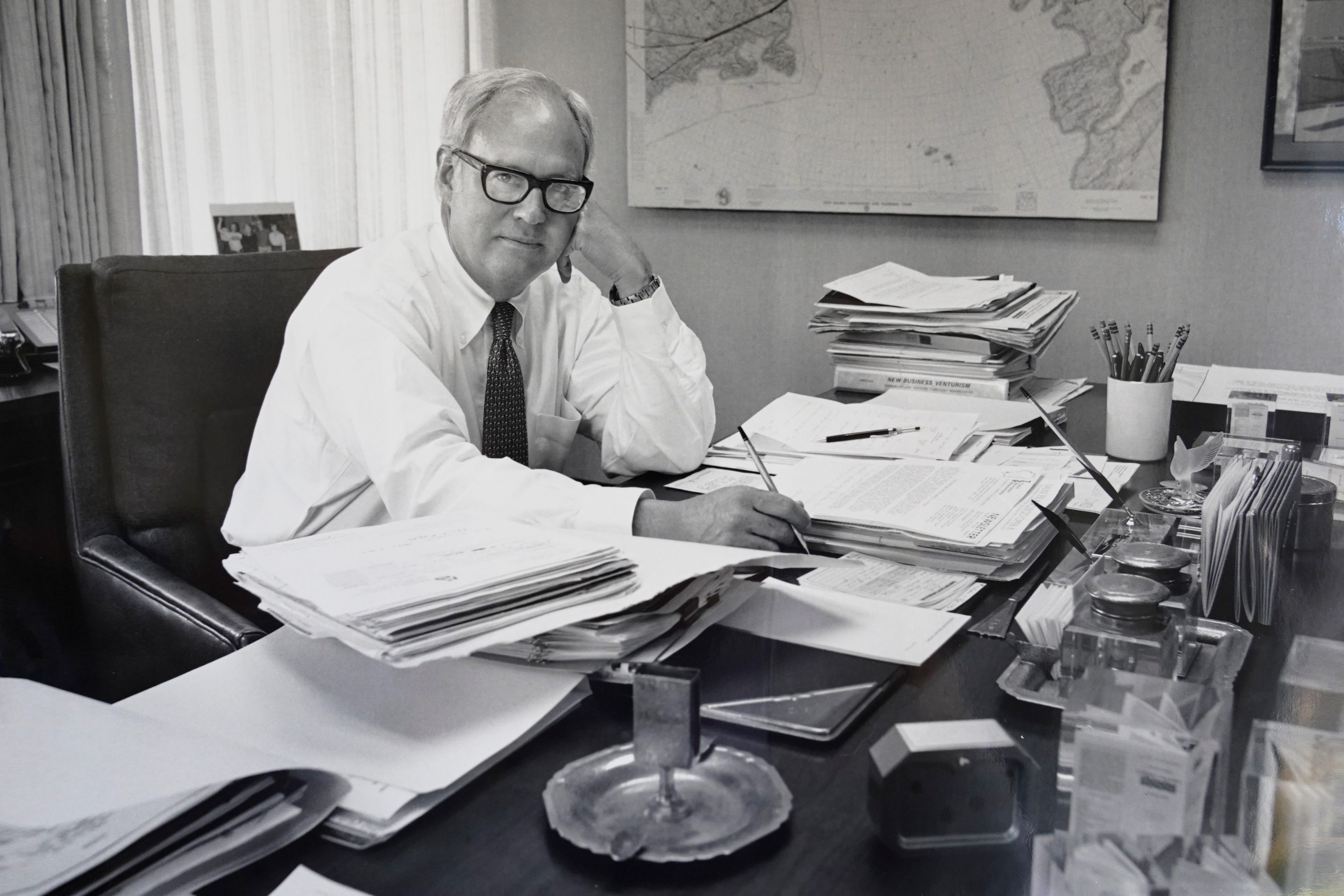
The Story
The man who invented institutional venture capital
In 1952, a 26-year-old insurance analyst at Fireman's Fund sat across from the founders of a company called Ampex Corporation and wrote a personal check for $20,000. Not because his boss told him to. Not because there was a template for it. Because he looked at what audio tape technology was going to do to recording and knew - with the certainty of a Stanford-trained engineer - that this was the trade of a lifetime.
The check returned $1 million. Reid Weaver Dennis spent the next seven decades doing that at scale.
To understand what Dennis built, you have to understand what Silicon Valley looked like before him. In 1974, when he founded Institutional Venture Associates, there was no institutional venture capital. Pension funds didn't back startups. Insurance companies didn't write checks to engineers in garages. The money was personal, private, and scarce. The infrastructure didn't exist.
Dennis didn't just join venture capital. He invented the institutional version of it - the model every major VC firm runs today.
He walked into six insurance companies and convinced them to write checks. Total raised: $19 million. That number sounds modest until you learn it represented nearly half of all private venture capital raised in the United States that year. One man. Six phone calls. Half an industry.
By the end of that decade, IVA's assets had reached $180 million.
"It doesn't make any difference who your daddy was and it doesn't make any difference where you went to school."
- Reid Dennis
The engineering mind behind the money
Dennis studied electrical engineering at Stanford before adding an MBA - a combination that gave him something rare in finance: the ability to understand what the technology actually did. When he looked at Ampex, he wasn't guessing about the market. He was reading the physics of the opportunity.
That same pattern repeated across his career. Early positions in Acurex, American Microsystems, California Microwave, and Coherent Radiation - companies that were building real things in a time when Silicon Valley was still figuring out what it was. Dennis understood them because he understood circuits before he understood cap tables.
He spent 22 years at Fireman's Fund and American Express running their early venture programs and managing publicly-traded mutual funds. Those years weren't a detour. They were the foundation. He learned institutional capital from the inside before he took it outside.
1974
Year IVA was founded - before the term "venture capital" was in common use
$19M
First fund - nearly half of all U.S. private VC that year
400+
Companies invested in over his career
97
Years lived - from talking pictures to streaming
The Firm
From $19 million to $7 billion - without losing the plot
In 1980, two partners left and Dennis renamed the firm Institutional Venture Partners. The rebrand was administrative. The philosophy stayed exactly the same.
IVP's model was disciplined in a way that felt almost boring compared to the swashbuckling of other early VC firms. Dennis wasn't chasing moonshots. He was picking people. He believed - and argued publicly, persistently, against the prevailing wisdom - that if the market was real, the team mattered more than the slide deck. You could build a great company with the right people in a big enough market. The wrong people would fail regardless of the opportunity.
"If the market's big enough, I'll change the people. Well, changing people is painful... you can do very, very well by betting on the best people."
- Reid Dennis, UC Berkeley Oral History, 2009
He said this in 2009. He'd been saying it since 1974. The consistency wasn't stubbornness - it was the kind of confidence that comes from watching the pattern play out across 35 years of data.
The portfolio that proves the point
The names accumulate in a way that makes the breadth of his eye remarkable. Seagate Technology - the company that put a hard drive in every desktop computer. Juniper Networks - the company that routes the internet's backbone. Polycom - the company that put video conferencing in every boardroom. TiVo - the company that taught America to pause live television. Netflix - the company that ended video stores and then ended broadcast schedules.
He backed them all before anyone agreed that they were inevitable. That is the job, done correctly, across five decades.
Fund Scale Over Time
Notable Investments
The portfolio
From audio tape to streaming. From disk drives to data centers. Dennis backed the physical layer of Silicon Valley before backing the digital one.
Netflix
Seagate
TiVo
Polycom
Juniper Networks
LSI Logic
Excite
Ampex
@Road
Dust Networks
Stratus Computer
Sequent Computer
Exabyte Corp
Collagen Corp
Measurex
Coherent Radiation
Career Timeline
Seven decades, one philosophy
1926
Born in San Francisco, California - the same year Warner Bros. released the first synchronized-sound feature film
1948-1950
Completes B.S. in Electrical Engineering and M.B.A. at Stanford University
1952
Personal investment of ~$20,000 in Ampex Corporation while working at Fireman's Fund Insurance - returned approximately $1 million
1952-1973
Leads venture programs at Fireman's Fund and American Express; manages six publicly-traded mutual funds; backs Acurex, AMI, California Microwave, Coherent Radiation, Measurex, Ultek
1974
Founds Institutional Venture Associates - raises $19M from six insurance companies, representing nearly half of all U.S. private venture capital that year
1980
Renames firm to Institutional Venture Partners (IVP) after partner departures; launches $22M Fund II
1980-2000
Active GP across Funds I-X; backs Seagate, Juniper, Polycom, TiVo, Netflix, and 200+ others; 85+ portfolio IPOs
2000
Receives NVCA Lifetime Achievement Award
2010
Transitions to Strategic Partner as Fund XIV raises $1B - the firm's first billion-dollar fund
2024
Passes away on March 14 in Portola Valley, California, at age 97 - married to Peggy for 76 years, survived by four children, eleven grandchildren, seventeen great-grandchildren
The Person
Opera, lithographs, and steam engines
The venture capitalist who backed Silicon Valley spent his evenings at the opera. Not as a patron in the polite sense. Dennis served on the San Francisco Opera Association board for 37 years and chaired it for 14. That's not a hobby. That's a second career.
He was married to Margaret "Peggy" Dennis for 76 years. Four children. Eleven grandchildren. Seventeen great-grandchildren. At the time of his death, his family had grown large enough to fill a small auditorium - which, given his opera involvement, seems fitting.
The collectibles he chose say something. Not Picassos or blue-chip art. He collected original 1850s lithographs of the San Francisco Bay Area - images of the city before the Gold Rush changed it - and scale models of steam engines. A man who backed the future's leading edge kept his office anchored to the physical past. He was also a licensed pilot.
He was born in a world of talking pictures and died in a world of streaming. He backed the companies that did the converting.
In 2000, at age 74, Dennis told a reporter that the internet had "only just scratched the surface" of what it would become. He was not someone who confused the present moment for the finish line. He watched the valuation bubble of the late 1990s with explicit skepticism - "there's just no rational connection between price and value" - and said it publicly while most of his peers were celebrating. He was right, and was right on schedule.
His meritocracy was genuine. "It doesn't make any difference who your daddy was and it doesn't make any difference where you went to school." This wasn't a slogan. This was the operating principle of a man who had watched engineers without connections build companies that outlasted dynasties. He bet on people, not pedigree.
Fun Facts
The details that don't fit the bio
✈
He was a licensed pilot - because when you back the physical world, you want to see it from altitude too.
🎭
37 years on the SF Opera board. 14 as Chairman. That's longer than most VC funds last.
🗺
Collected original 1850s Bay Area lithographs - images of San Francisco before it became the city he helped define.
⚙
Collected scale models of steam engines - the original disruptive technology - alongside books on California history.
💍
Married to Peggy for 76 years. In a world obsessed with exits, he held one investment forever.
📺
Born the year silent film ended. Backed Netflix before streaming was a word anyone used. He saw the whole arc.
Further Reading
Explore more