In August 2016, someone on a water-industry discussion board asked whether anyone was using LoRa sensor networks to manage water supplies. Raymond Zheng replied the next morning. His company had already used the radio modules in smart water meters, he wrote, and had completed a few cases. He offered to send the case studies. It was a small exchange, far removed from the ceremonial handshakes that would later accompany his work. A question arrived. He had something to show.
That is a useful place to meet Zheng, the co-founder and chief executive of Hangzhou Laison Technology. His business concerns devices most people encounter only when a bill becomes disagreeable. A water meter enjoys none of the social advantages of a new phone. Nobody queues outside a shop for one. Yet the decisions surrounding that modest object lead into questions about municipal income, payment habits, maintenance, and the price of replacing a city's infrastructure.
Zheng's public work follows those connections. He appears at product launches, speaks to visiting delegations, writes about meter design, and makes the case for different ways to fund installations. The thread running through these activities is the difficulty of getting several things to work together. Water must be measured. Customers must be able to pay. A utility must understand its accounts. Someone nearby must know what to do when the equipment needs attention.
The discussion-board exchange also supplies a welcome measure of scale. Before talking about citywide programmes, there were a few cases worth emailing to a colleague. The distance between those two situations matters. An installation can demonstrate that a device works. A city asks whether an entire arrangement will keep working, year after year, across many thousands of customers. Zheng's career in public view has increasingly occupied that larger question.
The bill has its own plumbing
In a letter dated December 15, 2021, Zheng set out a problem that purchasing departments could easily miss. Some water companies, he wrote, bought accurate smart meters without establishing digital payment systems. Others faced accumulated debts with little prospect of recovering them. He urged utilities to improve service, billing, and financing together. The proposed Laison package joined prepaid meters to its LAPIS payment platform and remote-reading software, with instalments intended to reduce the initial financial burden.
There is a very ordinary difficulty beneath the terminology. A good reading does not automatically produce a settled account. Between the measurement and the money sit a customer, a payment channel, and the utility's own records. If any of those connections fails, the precision of the meter offers limited comfort to the accounts department. Zheng's attention to that sequence makes his work as much a matter of organisation as of manufacturing.
His January 2023 discussion of Laison's offering named mobile payment services including M-Pesa, Airtel, and MTN. He also described a photographic system for mechanical meter readings, introduced in response to readings being estimated without site visits. That example is refreshingly unglamorous. Sometimes the useful addition to a billing process is a picture proving that somebody actually looked. Technology earns its place by resolving a particular operational irritation.
Laison's international work gave this argument a commercial setting. At an April 2022 visit by former Zhejiang vice governor Liming Liang, Zheng presented the company's development and overseas applications. The company reported exports to more than 30 countries and nearly 100 million yuan in new contracts during 2021. Those were company-reported contract figures, rather than a measure of his personal wealth. They indicate the size of the enterprise behind his increasingly broad brief.
- 01 / MeasurePrepaid smart meters
- 02 / ConnectReadings + payment systems
- 03 / SustainFinancing + local service
A launch with a financial pun
On March 31, 2022, Laison opened its Global Sales Center. Zheng and deputy general manager Clark Dai spoke at the ceremony, attended by the overseas marketing teams. The centre was intended to connect the company with utilities and other partners abroad. Six weeks later, another company announcement recorded a product launch in Hangzhou. Zheng gave a brief speech; Dai introduced the equipment in detail. The division of duties is visible without needing to invent a conversation behind the scenes.
The new meter series was called Parise, explained by the company as “Pay Rise.” Even water-meter manufacturers are entitled to a pun, though the finance department may be its most appreciative audience. The announced features included a choice of communication methods, prepaid or postpaid operation, remote monitoring, and ten years of consumption-data storage. The design also addressed outdoor installation. A name may make an entrance; the specification has to stay outside in the rain.
For Zheng, the launch sits within a longer concern with connections. The company had established a joint laboratory with Zhejiang University of Technology in November 2021, and he attended the ceremony with representatives from both organisations. The collaboration focused on research and talent training. Across the laboratory, the sales centre, and the launch stage, his documented activities place him between technical development and the relationships required to put products into use.
The second direction of the conversation
In May 2023, Zheng explained why prepaid meters needed two-way communication. Payment alone could improve collection, but readings and alarms returning from the network could help utilities investigate abnormal consumption and leakage. He also argued that collecting data could create more valuable work in management and maintenance. His emphasis was on what staff could do with information once it reached them.
This is the distinction that makes his argument interesting beyond the water industry. A transaction answers a narrow question: has a customer bought credit? A communicating device opens a continuing exchange. The utility can receive information and respond. Those are different responsibilities, and selling the first does not settle the second. Software, procedures, and people have to turn an incoming signal into a useful decision.
Zheng's September 2023 writing became more exacting about reliability. He called for scrutiny of battery-life claims, protection of individual components against water, suitable network connections, and local maintenance support. His point was that successful installations depended on more than the meter's headline capabilities. Those concerns are hardly cocktail-party material. They are, however, the questions that become urgent after the installation team has left.
A long battery-life figure looks clean on a slide. In operation, conditions and communication choices complicate it. A network connection is similarly easy to name and harder to sustain in the place where it is needed. Zheng's checklist treats the sales promise as the beginning of a technical conversation. The practical test is whether the equipment and its support arrangements suit the utility buying them.
“Looking for Global partners to boom local manufacturing is also an important task of LAISON in 2023.”
Raymond Zheng · 2023 partner letter
Confetti, then the work in Harare
Zheng's February 2023 letter to global partners identified local manufacturing as a priority. He described support for assembly operations with partners in South Africa and the sharing of equipment, drawings, technology, and components. The ambition was to help more partners manufacture locally. That adds another relationship to the business: the organisation responsible for assembling and supporting equipment close to the customer.
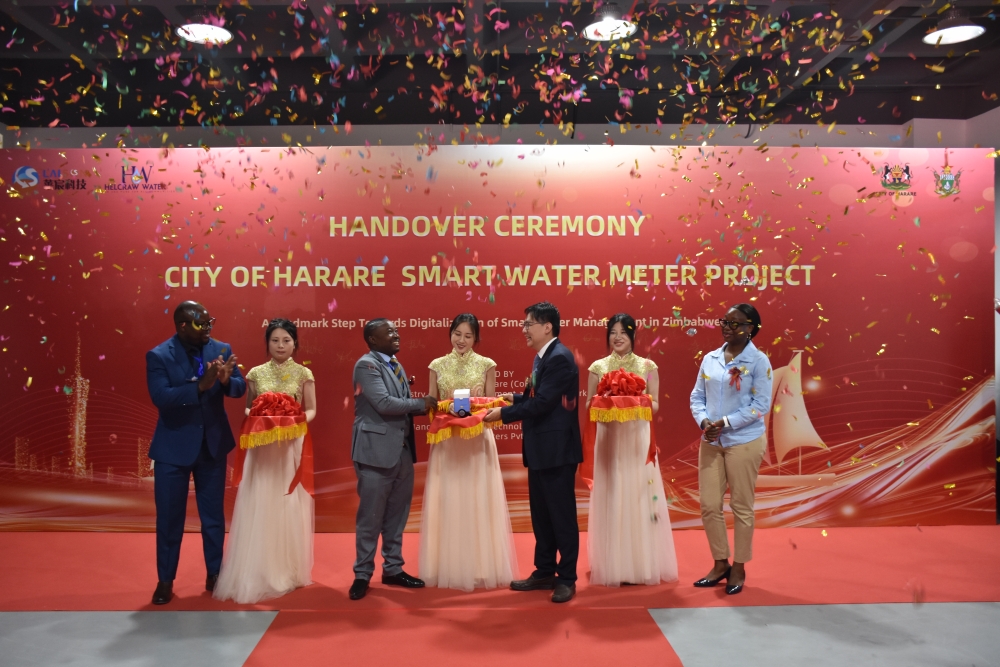
In August 2025, a delegation led by Harare mayor Jacob Mafume visited China and Laison's production plant. The visit included a ceremony handing over the first batch of smart meters for the Harare project. Zheng, identified as chairman, spoke about improving the city's water operations. A photograph shows him at the handover beneath a shower of confetti. Water infrastructure has its moments of theatre, even when the next act is installation.
By May 2026, he was also documented on a Harare project inspection with Zimbabwe's minister of local government and public works, Daniel Garwe. Zheng described an integrated offering covering metering, remote data management, mobile payments, and digital management tools. The broader programme combined metering with pipeline rehabilitation. Its proposed expansion included more than 650,000 smart meters; that figure described a programme plan, rather than completed Laison installations.
The distinction matters because a handover and a functioning city network are separate milestones. A ceremony can mark equipment changing hands. The subsequent task involves many organisations and many kinds of work. Zheng's role in these events brings his earlier argument into view at municipal scale: the meter is one part of an arrangement whose usefulness depends on the rest. The photograph captures a beginning, with unusually generous stationery from the ceiling.
A monthly fee enters the picture
In January 2026, Laison announced a white paper on Metering as a Service. Zheng's accompanying public comment described replacing large initial meter purchases with monthly service fees, linking financing to operational performance, and building local capacity through training. The proposal extended the financing concern he had raised years earlier. It also placed continuing service and measurable results nearer the centre of the commercial offer.
That change asks a different question of a supplier. Delivering equipment is a defined event. Maintaining an arrangement that performs over time involves an ongoing obligation. The company's stated approach ties technology, finance, and service together, with indicators intended to track results. Whether such an arrangement succeeds must be judged through the actual work and the agreed measures. A business model can organise accountability; it still needs people to fulfil it.
Seen across a decade of public activity, Zheng's story moves from offering examples of a radio module in use to discussing how utilities might pay for and maintain whole metering systems. The objects remain modest. The web of responsibilities around them has grown. His documented aspirations concern local manufacturing, utility operations, and the capacity to sustain improvements beyond an initial purchase.
There is a pleasing lack of glamour in that destination. Better accounts, useful readings, trained maintenance teams, and payments that reach the right system are difficult things to put on a commemorative plaque. They are also the things his work repeatedly returns to. For Raymond Zheng, the business of counting water has become a business of connecting obligations. The meter can keep the tally. The people around it have to make the numbers mean something.