The expensive thing was not always the medicine. Sometimes it was the search. A pharmaceutical company needed a specialist, a researcher, or an adviser. The request moved through consultants, recruiters, regulatory teams, old databases, and the names everyone already knew. Weeks disappeared. The spreadsheet became a habitat. Rayan Ghandour had seen this habitat from the inside, and he began to suspect it had been mistaken for a law of nature.
Ghandour was working in PwC’s pharmaceutical and life-sciences practice. His remit covered collaboration and compliance, including the delicate arithmetic of paying medical professionals fairly while staying inside regulatory rules. He was recognized within the firm as the top consulting analyst in the United States for work on automation in pharmaceutical compliance. The distinction mattered less than what the work exposed: a recurring industrial ritual with too many hands, too many disconnected systems, and surprisingly little search.
He had studied chemistry and economics at the University of Chicago, an academic pairing that now reads like foreshadowing with unusually tidy handwriting. Chemistry asks what a system contains. Economics asks how its scarce parts move. Ghandour found his company in the awkward join between the two: a market full of expertise, and an allocation mechanism still powered by reputation, proximity, and patient email chains.
The prototype before the platform
Five years before G LNK entered Y Combinator, Ghandour was in London with his friend and flatmate Alexander Gregoriades, one 3D printer, and a plan that promptly became impractical. It was 2020. They wanted to produce masks for NHS staff, but the necessary materials were scarce. Rather than worship the first idea, they spoke with NHS workers and changed the object.
Face shields were also needed. The two friends researched, designed, and adjusted a model with three fit settings instead of one. The feature was not ornamental; staff would wear the shields for long stretches, so comfort and stability belonged in the specification. After another week of optimization, the printer could finish one in less than 45 minutes. Their operation, called 3D Against Covid, produced about 15 a day and shipped them in batches. More than 380 reached frontline workers.
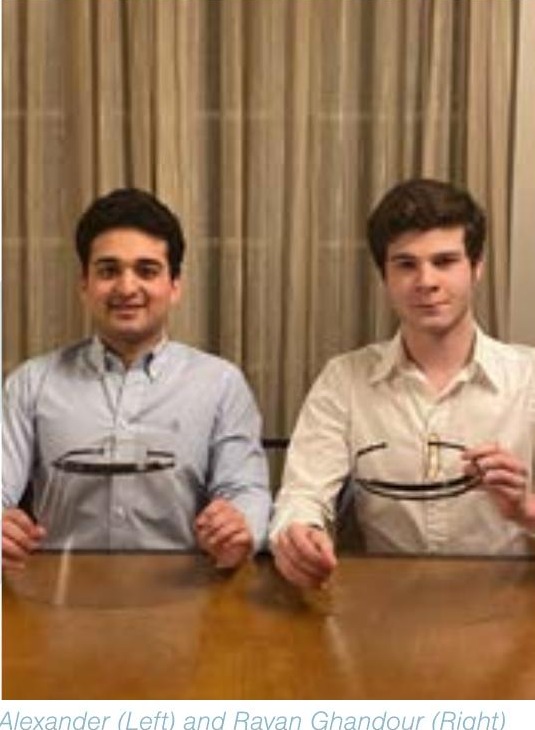
The episode is useful because it resists the mythology that all founders are born in a pitch deck. Here the founder behavior was plain and domestic: encounter a constraint, interview the user, alter the design, shorten the cycle, deliver the thing. Ghandour did not yet have an enterprise platform. He had a printer on a table and the valuable habit of refusing to confuse an initial plan with the actual problem.
A company hiding in the handoffs
By 2024, the physical prototype had become an organizational one. Ghandour co-founded G LNK with Raouf Abujaber, a friend he had known for more than a decade. Their professional bond had deepened while both were researchers at the University of Chicago. Then their résumés diverged in a productive direction. Ghandour accumulated knowledge of life-sciences workflows. Abujaber worked on machine-learning research and neural-network architectures. One knew why the process hurt. The other knew what a different technical shape might look like.
G LNK joined Y Combinator’s Winter 2025 batch with a proposition that sounds obvious only after someone says it aloud. A life-sciences team should be able to describe the professional it needs, search a large body of clinician and research data, evaluate relevance, calculate compensation, make contact, and track the engagement without assembling a small parade of vendors.
At launch, the company described a database of more than 3.2 million profiles. A Y Combinator post soon put the number above five million. G LNK’s current website says its commercial intelligence platform covers more than 9.2 million clinician profiles. The numbers describe growth, but the more interesting claim concerns visibility. A larger graph can reveal the qualified person who sits outside the habitual shortlist.
The politics of a blank search box
In a 2025 essay for Forbes Technology Council, Ghandour made his argument larger than procurement. Expert discovery, he wrote, still favors institutional prestige and professional proximity. The consequence is a narrow cast of familiar figures receiving invitations while relevant work elsewhere remains hard to see. His alternative is contribution plus context: use publications, trials, real-world information, and other signals to locate a person because the work fits the question.
This is where an apparently dry enterprise product acquires a point of view. Search is never merely a filing cabinet with better manners. Ranking decides which names arrive first. The first names receive emails. Emails become meetings, panels, research partnerships, and budgets. A model built to widen discovery can alter the guest list, even if the interface consists of little more than a white field and a blinking cursor.
Ghandour’s language is careful on one crucial point. The purpose is not to replace professional judgment. It is to find people whom the old machinery overlooks. That distinction gives G LNK a more grounded place in the AI carnival. The software does not need to play scientist, physician, or executive. It needs to be a diligent scout, a fast analyst, and a compliance clerk who never misplaces the folder.
The verbs make the product
G LNK is easier to understand as a sequence of verbs than as a pile of AI nouns. Find. Evaluate. Pay. Contact. Record. Each verb once belonged to a different desk, database, or outside firm. The company’s practical ambition is to arrange them into one line, so information gathered at the beginning still has meaning at the end. The profile that justifies a selection should connect to the rate that justifies a payment and the record that later satisfies a review.
This is the less cinematic side of vertical software, and often the part customers actually buy. A clever search result is useful. A result that survives the next six steps of work is infrastructure. Ghandour’s years in consulting supplied a close view of those handoffs, where context tends to evaporate and an innocent copy-and-paste becomes somebody’s Friday afternoon. His advantage is not simply that he knows the vocabulary. He knows where the workflow changes owners.
The company’s public evolution reflects that widening frame. Its Y Combinator launch emphasized expert identification, compensation, outreach, and compliance. The current site presents sales intelligence, market analytics, and a compliance hub to pharmaceutical, biotech, and medical-technology teams. The blank search box remains, but it now opens onto prescribing information, organizational relationships, market signals, and payment records. G LNK is moving from answering “who fits?” toward answering the questions that follow: where the opportunity sits, why a person matters, and what a defensible engagement should look like.
That expansion creates a useful discipline. Every added dataset must earn its place by improving a decision, not merely decorating a dashboard. Enterprise products are perfectly capable of turning complexity into colorful complexity. Ghandour’s original complaint was that the process took too long and relied on too many disconnected parties. The scorecard is therefore mercilessly ordinary: fewer searches repeated, fewer facts re-entered, fewer weeks lost between question and conversation.
Rooms, tables, and networks
There is a pleasing tension in Ghandour’s latest public work. He is building software meant to search millions of professional profiles, while also co-founding The Pharma Hundred, a private dining society limited to one hundred people across London and New York. Its dinners seat four to eight around one table, without a stage or slides. The database is vast; the dinner is deliberately tiny.
The two projects are not opposites. Discovery and trust operate at different scales. Software can help identify the right person. Conversation decides what two people might make together. Ghandour appears interested in both pieces of the bridge: the system that finds a relevant mind and the room where candor becomes possible.
An applied impatience
The through-line in Ghandour’s short public record is not disruption, a word that has suffered enough. It is applied impatience. Forty-five minutes is better than a longer print cycle. One workflow is cleaner than five vendors. Searching evidence is fairer than recycling the same names. A useful system should reduce the distance between a need and the person able to answer it.
There are hazards, of course. Data can be incomplete. Rankings inherit the values of their designers. Compliance cannot be reduced to a decorative green tick. The credibility of G LNK’s premise will depend on whether its search is transparent enough to examine and disciplined enough to deserve a regulated customer’s trust. Ghandour’s consulting background gives him an intimate view of those constraints. It does not make them disappear. It makes them impossible to plead ignorance about.
What he has built so far is a bet on better allocation: more relevant expertise, found sooner, with less administrative theater in between. The bet began neither with AI nor pharma, but with the older craft of looking carefully at a bottleneck. Sometimes it produces a face shield. Sometimes it produces a company. The elegant part is knowing which object the problem is asking for.