Biology was rude to Raviv Pryluk. He had been trained as an engineer, in a world where inputs and outputs maintained a professional relationship. Build the model correctly, mind the constraints, and the machinery should behave. Then he entered neuroscience and encountered living systems, which can receive the same treatment twice and answer differently. The insult was also an invitation. Variability was not a flaw in the problem. It was the problem.
That lesson now sits beneath PhaseV, the clinical-development software company Pryluk co-founded in 2023 and runs from the Boston area. The company works on decisions that arrive with awkward timing. A trial protocol must be designed before its evidence exists. Sites must be chosen before their performance is known. Endpoints and sample sizes are fixed while biology remains magnificently uninterested in being fixed. PhaseV uses simulation, causal machine learning, and adaptive methods to let teams explore more of those uncertainties before they become expensive facts.
The fashionable noun is AI. The more revealing verb is decide. Pryluk's public test for useful technology is practical: can experts understand the reasoning, challenge its assumptions, and determine whether the recommendation improved the outcome? In a field with regulators, statisticians, clinicians, operators, and commercial teams around the same table, opacity is not sophistication. It is a meeting that will run long.
The first crossingWhen the system stopped behaving
Pryluk studied aerospace engineering at the Technion, earning bachelor's and master's degrees. His early research included air-defense allocation: how a system should deploy limited resources against multiple incoming threats when time is short and information is incomplete. The subject belongs to a different world from drug development, but the intellectual furniture is familiar. There are constraints. There are probabilities. A decision has consequences, and delay is itself a decision.
He spent more than 15 years across defense and technology, including leadership roles in the Israel Defense Forces and Israel Aerospace Industries. Yet his academic direction turned toward computational neuroscience at the Weizmann Institute of Science. The pivot was considerable. The engineer accustomed to designed systems began studying evolved ones.
His doctoral work examined neural and emotional states in social interaction. Papers bearing his name appeared in Cell, PNAS, Nature, eNeuro, and Neuron, covering neural coding, gaze, expectation, and facial expressions. He received Weizmann's John F. Kennedy Prize for outstanding doctoral researchers. The publication list looks eclectic beside missile-allocation algorithms. Look again and it is a long inquiry into signals: what information a system contains, how that information is encoded, and what a decision-maker can honestly extract from it.
“An algorithm can extract as much as exists in the data.”Raviv Pryluk, discussing data and models
It is a useful sentence because it declines to worship the algorithm. Models do not mint evidence. They organize, test, and sometimes reveal what the evidence can support. That restraint would matter later, when the systems in question were clinical trials and a beguiling pattern could be mistaken for a dependable result.
The operating yearsA village arranged around the problem
In 2021, Pryluk joined Immunai, the biotechnology company mapping the immune system with single-cell data and machine learning. He led discovery and validation work, operations, analytics, and multidisciplinary groups. The titles changed; the organizational question endured. How do you get people with different technical languages to solve one complicated problem together?
His answer was to organize around the work rather than the profession. A group could include functional-genomics scientists, machine-learning engineers, computational biologists, and software engineers. Each discipline brought a different instrument. No single one got to pretend it was the orchestra.
This became part of the PhaseV design. Pryluk and co-founder Elad Berkman did not begin with clinical trials by accident. They conducted a criteria-driven search for a problem with substantial practical impact where their experience in engineering, machine learning, and neuroscience might matter. Clinical development presented a severe bottleneck: promising biology still had to survive the way a trial was designed, run, and analyzed.
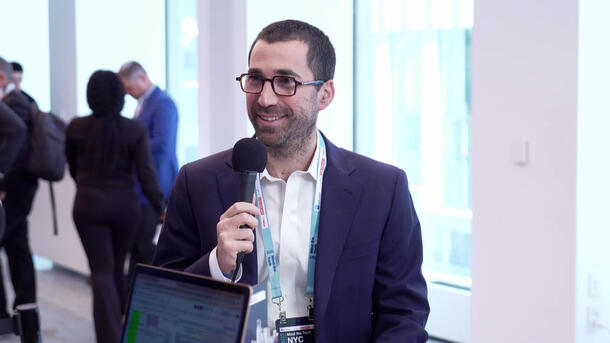
The company they formed with scientific co-founder Dan Goldstaub sits at the seam between software and a regulated research process. Its tools simulate alternative trial designs, search for treatment-response differences among patients, support endpoint selection, and guide operational choices such as site selection and monitoring. Larger organizations can license the software; smaller ones can use technology-enabled services. The underlying argument is that advanced methods should not require every biotech to build an advanced-methods department of its own.
The wagerA protocol that knows how to listen
A conventional trial can resemble a long railway journey planned before departure. Route, stops, and timetable are set. Adaptive design adds switches, but crucially, it does not permit the driver to improvise. The possible changes and the statistical rules governing them are specified in advance. As data accumulates, the trial may alter enrollment, drop an ineffective arm, adjust allocation, or focus on a subgroup when the evidence meets those rules.
Pryluk's contribution is not the invention of adaptive trials. It is an attempt to make their options easier to simulate, compare, explain, and execute. The work demands an odd pairing of flexibility and discipline. Change can be rational only if the conditions for change were rigorously defined. Otherwise adaptation is merely hindsight wearing a lab coat.
Causal machine learning addresses another problem. Average treatment effects can conceal meaningful differences between patients. A therapy may help one subgroup and do little for another, leaving the combined result unimpressive. Finding responders after the fact is dangerous because enough slicing can make almost any pattern appear. PhaseV's research focuses on methods intended to identify heterogeneous effects while testing stability and controlling error. In plain English: look for the people who benefit, but do not let wishful thinking choose them.
That insistence on validation recurs in Pryluk's interviews. He talks about held-out datasets, external data, statistical tests, and repeated simulated scenarios. It is less cinematic than a robot discovering a cure overnight. It is also closer to how trust is earned in clinical development, one checked assumption at a time.
A company gets its fuelFifty million dollars, then the difficult part
PhaseV announced a $50 million Series A in May 2025, co-led by Accel and Insight Partners, with participation from Exor Ventures, LionBird, and Viola Ventures. The round brought disclosed funding to $65 million. The planned uses were orthodox: expand the product, deepen commercial partnerships, and grow in the United States and Europe. Capital could buy engineers and reach. It could not buy acceptance.
Clinical development is conservative for reasons better than habit. A bad consumer recommendation is annoying; a bad trial decision can waste years, money, and scarce participants. Pryluk does not dismiss this hesitation. His answer is legibility: software should show tradeoffs to physicians, statisticians, data scientists, and business teams in terms each can interrogate. The model must be vertical, grounded in the decision's full context; verifiable, so experts can inspect the reasoning; and validated against evidence and credible alternatives.
By 2026, his attention had moved further into trial execution. In public discussions of real-time monitoring, Pryluk pointed to the unglamorous gap between data being collected and data becoming clean enough to analyze. Blood tests, imaging, site reports, and operational records arrive in different formats. Before anyone enjoys real-time insight, somebody must map, standardize, and validate the stream. Speeding the pipe does little if it delivers mud.
“Quick wins - that's the first thing.”Raviv Pryluk on making real-time review stick
The phrase is revealing. PhaseV's ambition is broad, but Pryluk's adoption strategy is incremental: prove value in an early phase, in one therapeutic area, then extend it. Build an ecosystem among sponsors, regulators, research organizations, and technology providers rather than a private island inside one large company. Practical AI, in his formulation, is defined by the decisions it improves.
Aerospace engineering degrees at the Technion.
Doctoral research in computational neuroscience at Weizmann.
Operations and analytics leadership at Immunai.
PhaseV is founded.
A $50 million Series A brings disclosed funding to $65 million.
The focus expands toward continuous monitoring and analysis-ready data.
The long courseEndurance without the mythology
Outside work, Pryluk runs long distances and has completed full marathons and triathlons. It is tempting to turn this into an immaculate metaphor, so let us resist only slightly. Drug development does resemble endurance sport: preparation happens out of view, the course punishes vanity, and heroic starts are less valuable than measured adjustments. The charming difference is that a marathon runner generally knows where the finish line is.
Pryluk's career is often described through its pivots, but the continuity is more interesting. Aerospace systems, neural circuits, immune data, and clinical trials all force decisions under complexity. The tools change. The respect for constraints does not. At each crossing, he has moved closer to biology without surrendering the engineer's desire to model what might happen next.
PhaseV now has the resources and industry relationships to test its thesis at larger scale. The test will not be whether its simulations are elegant or its AI is advanced. It will be whether trial teams make better choices, whether those choices withstand scrutiny, and whether useful therapies navigate clinical development with less avoidable waste. That standard is stern. Pryluk, having spent years learning that living systems do not owe engineers consistency, seems to prefer it that way.