In January 2023, Oramed reported that its U.S. Phase 3 trial of oral insulin had missed both its primary and secondary endpoints. For a company trying to replace an injection with a pill, this was an awkward answer to an expensive question. Yet the trial had produced something besides disappointment: patient data. The question became whether that data contained a pattern the overall result had obscured. The answer could influence whom a future study would enroll and what it would be designed to establish.
- Find candidate responders hidden inside a trial-wide result.
- Simulate the next study before committing patients and budget.
- Connect that design to recruitment, analysis and documents.
PhaseV’s analysis identified subgroups that appeared to respond. Oramed’s February 2024 shareholder letter described differences involving age, body mass index and baseline HbA1c, a measure of blood sugar. It reported a placebo-adjusted HbA1c reduction exceeding one percentage point in subsets, and said the findings encouraged plans for another U.S. trial with a different protocol. PhaseV credits sensitivity testing and false-discovery analysis with checking the signal.
That is a reason to investigate, not a retrospective approval. A subgroup found after a trial ends still needs convincing confirmation. But it explains PhaseV’s wager: a disappointing average may contain people worth studying more carefully.
02An average has terrible bedside manners
PhaseV builds decision software for pharmaceutical companies, biotechnology sponsors and contract research organizations, or CROs. Its specialty is heterogeneity: the inconvenient fact that people carrying the same diagnosis can respond differently to the same treatment. Response Optimizer examines clinical variables and biological signals to identify candidate responder groups and biomarkers. The purpose is a more specific development decision.
Causal machine learning supplies the intellectual machinery. Rather than merely predicting an outcome, the analysis tries to estimate how treatment changes outcomes for different patients. A variable associated with improvement is not automatically a variable that explains benefit from the drug. PhaseV’s workflow explicitly includes clinical knowledge, subgroup detection, validation and robustness checks.
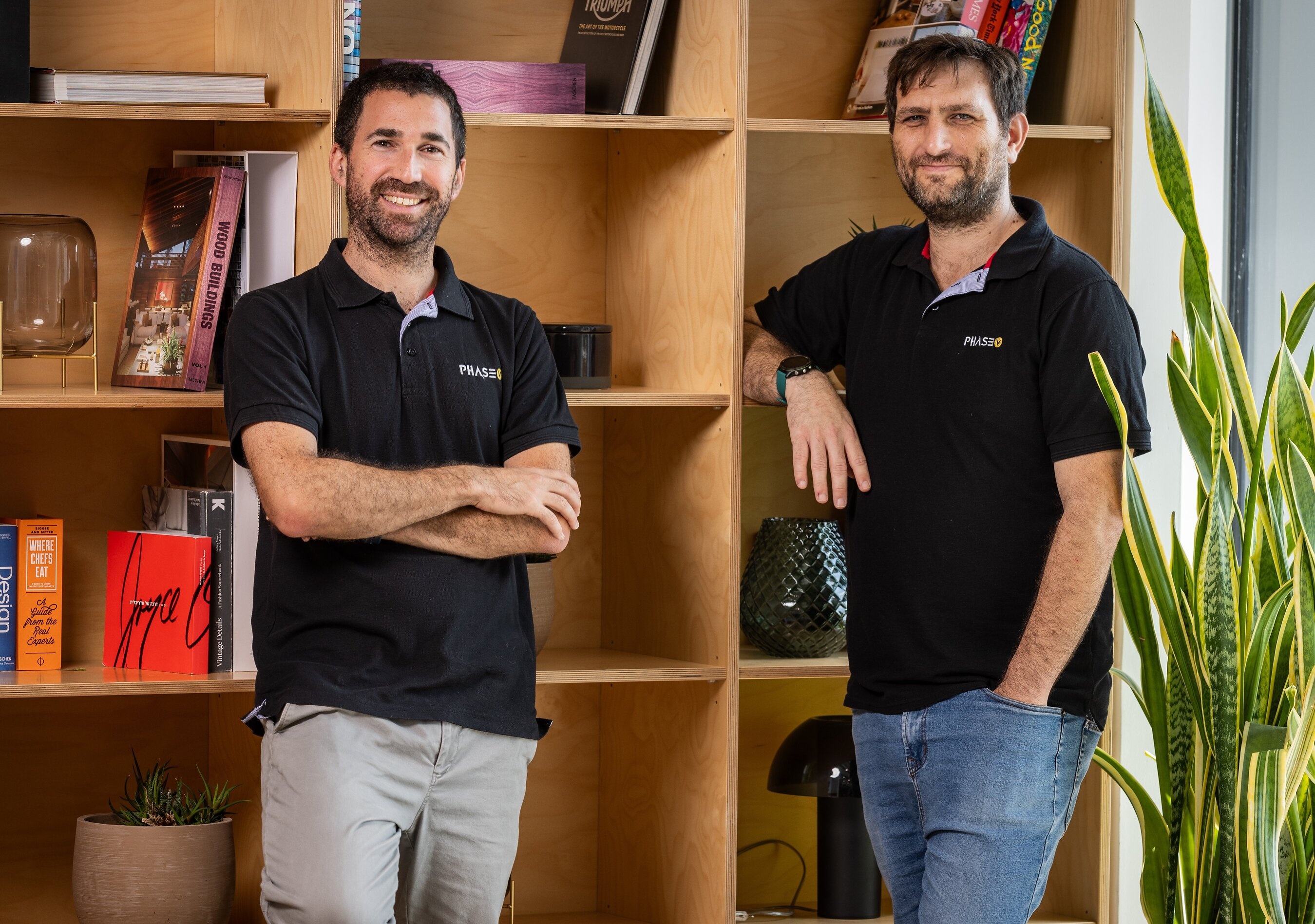
The founding team reflects that mixture. CEO Raviv Pryluk trained in computational neuroscience and worked at Immunai. CTO Elad Berkman previously led data science at transportation company Via. Scientific co-founder Dan Goldstaub brings drug-development experience from Teva and Merck. Optimizing a transport system and interpreting a trial are different occupations; both punish casual assumptions about variation.
03Rehearse the trial before recruiting the patients
Trial Optimizer turns those questions into simulations. Teams compare fixed, adaptive and Bayesian designs, examining sample size, statistical power and the timing of interim analyses. PhaseV says its software runs millions of simulations in minutes. Its product description emphasizes preserving power and Type I error constraints, the safeguards against missing a real effect or declaring a spurious one.
The practical appeal is rehearsal. A team can examine alternatives while changing a design still costs less than changing a live study. In an infectious-disease case described on PhaseV’s website, simulations informed a Phase 3 redesign with a reported 10-15% smaller sample. Portfolio Optimizer extends the exercise to disease biology, using causal graphs to explore biomarkers, possible combinations and which indications to pursue.
The company advertises reductions of up to 50% in development costs and 40% in trial duration, alongside a greater than 30% improvement in probability of success. These are company-reported results from particular collaborations. They are not promises for every study, and an estimated probability of success is different from an observed approval rate. The distinction belongs in any buying decision.
Company-reported maxima. Bar lengths compare stated percentages, not expected results.
04The patient exists. Can your site recruit them?
A beautifully simulated trial can still struggle to find participants. ClinOps Optimizer addresses site selection and monitoring, considering patient characteristics alongside enrollment, progression and dropout. Its February 2026 addition, Enrollment Lab, uses real-world electronic health records to examine eligibility and competition before a protocol is locked. Tightening a criterion can shrink an accessible population; another sponsor may already be recruiting the same people.
This gives operational teams a useful question to ask earlier: where can this particular study actually happen before expensive commitments harden? The Crohn’s & Colitis Foundation partnership supplies access to IBD Plexus data for research into inflammatory bowel disease. Alimentiv, a specialist gastrointestinal CRO, pairs its clinical expertise and execution services with PhaseV’s adaptive-trial technology. Data access and people who know the disease are part of the proposition.

05A spreadsheet-sized problem with an enterprise price
PhaseV sells software licenses and technology-enabled project services. There is a refreshingly concrete price signal: its AWS Marketplace listing shows 12-month contract options of $50,000 for exploration access, $70,000 for one Phase 1 or Phase 1/2 optimization, and $120,000 for one Phase 2, Phase 3 or combined Phase 2/3 optimization. A five-trial bundle is listed at $500,000. Those are listed options, not the cost of running the clinical trials themselves.
The business has attracted $65 million in disclosed funding: $15 million announced in October 2023, followed by a $50 million Series A in May 2025. Accel and Insight Partners co-led the latter, with Viola Ventures, Exor and LionBird participating. In September 2026, PhaseV reported work on more than 100 clinical programs for more than 50 global sponsors, including ten of the world’s 20 largest pharmaceutical companies.
It competes in an established market. Cytel’s East Horizon offers statistical trial design and simulation; Unlearn uses patient digital twins to improve trial analysis. Sponsors can also retain their own statisticians and custom code. PhaseV’s positioning is the connection between subgroup analysis, trial design, portfolio choices and clinical operations. Buyers should judge that connection against the specific task they need done.
06The next bottleneck wears a document title
In March 2026, PhaseV launched AI Conductor, moving further into the paperwork and statistical programming surrounding a study. It connects protocol authoring, analysis plans, case report forms, standardized datasets and reporting. Version comparisons, permissions and an audit history address a mundane source of friction: multiple teams editing documents that must agree with one another.
RAVIV PRYLUK / MARCH 2026“Our AI doesn’t work in isolation.”
On the launch of AI Conductor
The lesson readers can copy is procedural. Examine who benefited; test alternative designs; check whether eligible patients are accessible; keep the resulting decisions consistent across documents. This approach depends on relevant data, defensible assumptions and clinical review. Poorly matched historical records or an unstable subgroup can make a persuasive simulation misleading. PhaseV’s promise is useful precisely where teams can challenge its reasoning. A second look earns its keep when it produces a better question for the next trial.