The first customer arrived after cold call number 546. Josh Sabol remembers the number because his founder story comes with receipts. There were 727 days between leaving his job and announcing that HealthKey had joined Y Combinator's Winter 2025 batch. There were 23 months without a paycheck, $52,779 in business expenses placed on a personal credit card, five product iterations, three applications to YC and one interview. Startup folklore loves a lightning bolt. Sabol offers a ledger.
The ledger tells you how he thinks. His career has moved through data-center equipment, grocery self-checkout, restaurant accounting, a vast cloud supply chain and, now, the clerical maze of clinical-trial recruitment. The nouns change. The verbs barely do: map, rank, automate, verify. He keeps returning to systems where important work hides in handoffs and documents, then asks what software can remove without removing judgment.
A career in invisible machinery
Sabol studied mathematics and business at Arizona State University, a pairing that looks almost suspiciously well suited to his later work. His early résumé moved from actuarial analysis at CNA National to business analysis at Owens & Minor, then product operations at Cisco. On his personal site, he describes the Cisco chapter with cheerful compression: he “built some data center networking equipment.” The understatement is part of the charm. Complex systems enter his biography as things to be taken apart and made legible.
He also kept founding things. Harvest'N, an urban-farming startup, appeared in 2016. Spreely followed in 2017, built around self-checkout for grocery stores. Neither became the neat origin myth that profile writers crave. They did something more useful: they extended his education in finding customers, shaping a product and learning how elegant machinery collides with the untidiness of actual operations.
At Plate IQ, now Ottimate, he became the first product manager. The company made accounting and payments software for food businesses, another world thick with invoices, exceptions and repetitive administrative work. Sabol says the business grew tenfold during his tenure. He then moved to Amazon Web Services, helping automate a supply chain he describes as roughly $20 billion in scale. The numbers grew. The operating instinct stayed put.
By 2023, he had left AWS and returned to the founder's side of the table. An early project called Outlier.Care gave way to the work that became HealthKey. The present company serves doctors' offices that conduct clinical research. Those sites receive detailed eligibility rules for each trial, then search their own records for people who may qualify. Much of that search has traditionally been manual. The task asks skilled teams to read dense records against criteria that can turn on a particular stage, measurement or note.
“This is the story of never quitting.”Josh Sabol, on HealthKey's YC acceptance
Five versions and a sharper question
HealthKey did not begin with its current product perfectly framed. Sabol says the team went through five distinct iterations. The crucial stretch was six months spent working closely with early customers. The eventual question became narrower and better: can software compare a site's existing records with complicated trial rules, produce a ranked list of possible candidates and show the evidence that supports each match?
The product's two-step design is worth noticing. First, the system connects with a clinic's electronic record software and compares available material, including documents, with encoded eligibility criteria. Then a research professional reviews the suggested candidates and the highlighted evidence. Automation performs the exhausting search; a person retains the consequential decision. The division of labor is less theatrical than “AI changes everything,” and much more likely to survive contact with a workday.
HealthKey also made a revealing pricing choice. Clinics pay when they successfully identify qualified candidates. The company therefore has to attach its fee to an observable result, not merely access to a dashboard. In a sector cautious about new software, that alignment does quiet persuasive work. The sales pitch becomes a shared wager: if the tool produces no usable outcome, the customer is not asked to applaud the algorithm anyway.
The underlying business problem is substantial. Research sites can earn between $20,000 and $100,000 for each enrolled participant, depending on the study. In HealthKey's published example, a urology practice with more than ten locations had four coordinators spending three hours each morning searching records. Across 11 trials, missed enrollment targets represented $1.4 million in missed revenue. Those figures belong to the company's case study, but they explain why a narrow workflow can support a serious business.
The rejection ledger
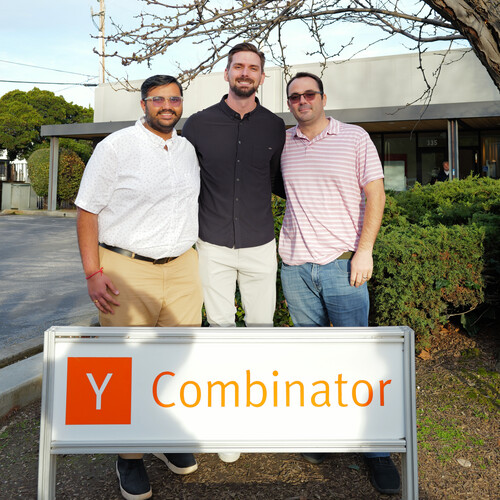
The temptation is to read YC acceptance as the plot twist that validated everything before it. Sabol's own accounting points elsewhere. Three applications produced one interview and one acceptance. Between them came the calls, the product changes and the months beside customers. The application improved because the company improved. Rejection became a form of unpaid product management: uncomfortable, ambiguous and occasionally useful.
He has been unusually plain about the cost of that interval. Twenty-three months without a paycheck is not a slogan. Neither is moving more than fifty thousand dollars of company spending through a personal credit card. These details should not be converted into a universal founder recipe. Risk tolerance differs, luck matters and endurance is not proof of correctness. Their value is documentary. They restore time and friction to an outcome usually reduced to “accepted into YC.”
The most transferable habit is simpler: count attempts. “Tried sales” is a foggy sentence. “Made 546 calls” can be examined. It creates questions. Were the prospects wrong? Was the message muddy? Did the script improve? The same discipline applies to five product versions and three applications. A count turns discouragement into a series. A series can reveal whether anything is changing.
Sabol's public bookshelf suggests the habit extends beyond work. He logs books by date, format, status, notes and rating. The range moves from sales manuals and product strategy to economics, Harry Potter and sprawling science fiction. Some classics receive two stars. Some wizarding installments receive five. It is endearingly unpolished data: preferences preserved without a publicist sanding off the awkward opinions.
His personal introduction is equally direct. He says he is interested in “automation, small teams, and GTM/distribution.” That trio neatly captures HealthKey. Automation is the product. A ten-person team is the vehicle. Distribution was the wall he met with hundreds of phone calls. Many founders prefer to talk about vision because distribution involves the indignity of asking strangers to care. Sabol has made the asking part of the story.
Evidence, with a human at the end
There is a nice symmetry between the company and the career. HealthKey scans a large body of messy information for candidates, ranks what looks promising and presents the supporting evidence to a professional. Sabol's path has been a similar search through possible companies. Grocery stores, urban farms, accounting departments and cloud infrastructure supplied clues. Several products were discarded. One working thesis emerged.
The thesis is not merely that AI can read documents. Plenty of software can make that claim. HealthKey's more practical bet is that evidence must arrive beside the recommendation. A research team does not only need a name. It needs to understand why that name appeared and decide whether the case holds up. Trust is built in the space between suggestion and verification.
That is also a useful description of Sabol's public persona. He does not simply announce persistence; he itemizes it. He does not present a frictionless march through prestigious employers; he leaves the abandoned projects on his website. He does not call himself broadly curious; he publishes the books, dates and ratings. The evidence makes the portrait more credible and, conveniently, more human.
There is another lesson in the way he publishes. Most professional biographies flatten time. Jobs become a line of logos; experiments vanish when they fail to become companies; the rough months disappear between two dates. Sabol's site keeps the smaller artifacts around: a case-interview assignment, product templates, notes on SQL and spreadsheets, old projects and a list of goals. It resembles a garage with the door left open. You can see what was built, what was shelved and which tools remain within reach. For an operator, this is more revealing than a polished declaration of principles. The pattern becomes visible without being announced. Numbers sit beside stories. Commercial books share a shelf with fantasy. A founder who spent years reducing operational mess has allowed his own archive to remain a little messy. Good profiles depend on that friction. A life arranged too perfectly begins to read like packaging, and packaging rarely tells you how anything actually works.
“Interested in automation, small teams, and GTM/distribution.”Josh Sabol's personal site
HealthKey remains an early company. It was founded in 2025, joined YC that winter and is listed with a team of ten in Austin. The hard questions now are the ordinary ones: integration, accuracy, customer trust, sales and whether a compact organization can serve increasingly complex research operations. Acceptance is not the ending. It is a change of terrain.
Still, the record so far offers something cleaner than inspiration. A founder can treat persistence as a measurable operating practice. Stay close enough to customers for the product to change. Price around an outcome the buyer can see. Preserve human review where judgment matters. Keep the failed versions visible long enough to learn from them. And when the first customer finally answers, remember the number.