Software is supposed to be weightless. Rao B. Telidevara’s career comes with a building. In Chennai, a glass-fronted development centre appears in a Qatalys company presentation with a remarkably direct credit: built by its CEO, Rao Telidevara, in 2008. For a business that sold work across borders, here was something that could be photographed from the pavement.
It is a useful place to begin with the Qatalys founder and former chief executive. A list of companies gives you his range. The Chennai building gives you a scene: trees, reflective windows, a street, and the premises behind an offshore delivery operation. The cloud, it seems, occasionally requires a rather substantial ground floor.
Telidevara’s professional life connects American customers, Indian software teams and property development. His public profile places him in the Dallas-Fort Worth area. Green Cascades names him as managing director. A Quantum business portfolio identifies him as President-North America. These are different organizations and different responsibilities, held together by a career that has repeatedly crossed geography and business disciplines.
Before the building, an engineering education
His educational route begins at Engineering College of Kakinada, identified in his biography with JNTU-K. It continues with an MS at Colorado State University and an Executive MBA at Southern Methodist University. The Quantum portfolio specifies computer science for the master’s degree; his public professional profile dates his time at SMU’s Cox School of Business to 2002-2003.
Engineering, computer science and business make a practical combination for someone whose work has involved both technical teams and customers. The qualifications belong to separate stages of study. Read together, they show the academic breadth behind a career that would include software companies, a delivery centre and real estate responsibilities.
His biography also lists Tata Institute of Fundamental Research, Oil & Natural Gas Corporation, John Deere and IBM among his professional associations. Those names span research, energy, machinery and computing. The range is worth preserving without turning each name into a miniature legend. There is already enough variety in the list.
The executive degree also places formal business study within an already developing professional life. His SMU dates, 2002-2003, fall after the 2000 entrepreneurship award listed on his profile and before the Chennai centre’s 2008 date. The sequence gives three different views of the same period: recognition for business activity, further study and the delivery infrastructure associated with Qatalys. They are useful markers because each names something specific. An award, a course of study and a building have different purposes; together they give the early 2000s chapter of his career more texture than a succession of executive titles alone.
A smaller detail reaches further back. Telidevara lists Air Force Technical training with India’s National Cadet Corps during college, dated June 1981. It sits alongside later business credentials, an early technical experience in a résumé that would eventually stretch from Kakinada to Texas. His listed languages are Telugu, English and Hindi.
- KakinadaEngineering College
- Colorado StateMS, Computer Science
- SMU CoxExecutive MBA · 2002-2003
Four names, several kinds of software work
VisualSoft, Qatalys, QSource Global and DynamicsQ appear in his Green Cascades biography under founder and promoter associations. The list is more revealing than a single job title. It places him across a group of technology businesses and practices, rather than confining his professional story to the company most often attached to his name.
VisualSoft also appears in a colleague’s recollection. Phil Leamon describes first meeting Telidevara there in India and working with him over subsequent decades. His account centres on teams, customer requirements and delivery. The vocabulary is workmanlike. For an industry fond of naming the future before lunch, that is a pleasingly useful emphasis.
“on time and within budget”
Phil Leamon, describing Telidevara’s customer focus
Qatalys offered several ways to organize that work: on-site, off-site, a combination of the two, and offshore development centre support. It also described managed services, professional services and on-demand arrangements. Each arrangement answers a practical question about who does the work, where they do it and how the customer engages the team.
The company’s enterprise capabilities included application services, infrastructure management, quality engineering and mobile development. DynamicsQ was presented as its Microsoft Dynamics 365 practice, covering implementation, customization, migration, licensing, training and support. These were services with a life beyond the initial installation. A system still needs attention after the presentation has been put away.
The service menu also gives the customer several starting points. One organization might need an application built; another might need testing, infrastructure support or migration. The brochure puts those activities beside one another rather than presenting a single product as the whole business. For a profile of its former CEO, that is useful context: Qatalys offered a collection of technical capabilities, organized through several delivery arrangements.
That makes the delivery relationship central to understanding Telidevara’s Qatalys chapter. The work included building applications and supporting the systems around them. Customers could require development, staffing, integration or maintenance. The range explains why the company’s description of its business extended well beyond a single piece of software.
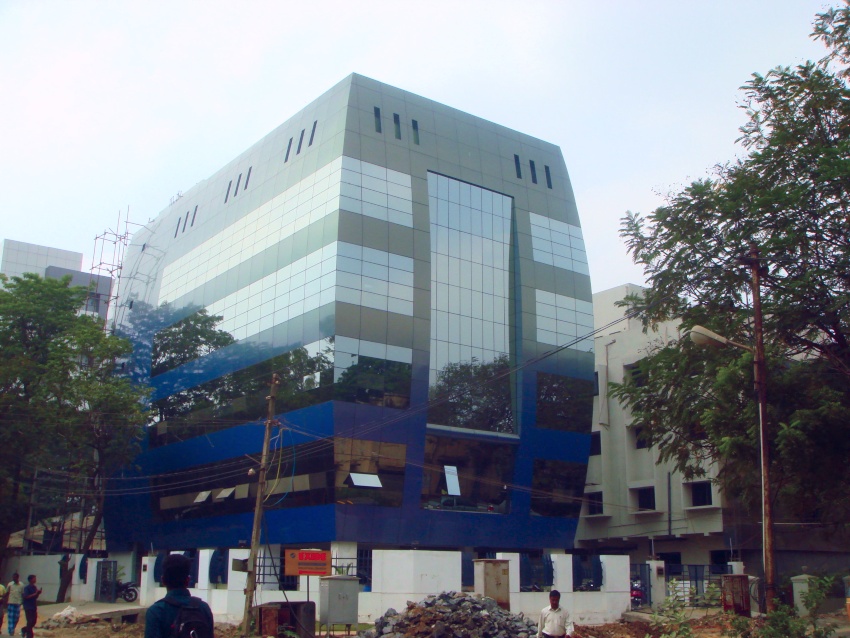
Chennai, 2008: an address for offshore work
An offshore development centre can sound like an abstraction until someone points to the windows. The Chennai photograph brings the Qatalys operation back to ordinary scale. Whatever the contract language, a delivery team works somewhere. The building is the physical setting for a business whose customer relationships could extend far beyond its immediate neighbourhood.
Dr. Anilesh Seth’s description of Telidevara’s work supplies the human arrangement. He recalls US headquarters, development centres in India and Telidevara remaining the customer’s principal interface. That account puts one person between geographically separated parts of the operation. It also emphasizes lasting customer relationships and a willingness to share commercial risk.
There is an obvious challenge in such an arrangement. A customer needs confidence in work being performed elsewhere; a delivery team needs a clear understanding of what is expected. Seth’s recollection describes Telidevara taking a visible role in that relationship. Responsibility had a person attached to it, as well as a company name.
The distinction matters because offshore work is often described chiefly through location. Here, the more interesting subject is the relationship connecting the locations. Leamon’s emphasis on customer delivery and Seth’s emphasis on a trusted interface point towards the same part of the job: keeping the commercial promise connected to the team doing the work.
The year Qatalys assigns to the Chennai centre built by its then CEO.
The property chapter was already taking shape
Green Cascades gives the story another physical setting. It describes a real estate business operating in India across land acquisition, development, property management and investment. Its leadership biography names B. Rao Telidevara as managing director and lists his technology-company associations alongside his education. The software history travels with him into the property business.
The company’s own chronology begins with its promoter acquiring land in southern India in 2000. It records a Chennai land acquisition in 2005, construction beginning on the Siddharth Building in 2006 and the building opening in 2008 with IT and aviation businesses as tenants. Those are company milestones, and they show property activity developing alongside the technology story.
The shared Chennai date is a useful point of comparison. Qatalys credits its offshore centre to Telidevara in 2008; Green Cascades dates the opening of Siddharth to that year. Each account gives the year a concrete significance. The parallel also shows why a profile limited to software job titles would leave out a substantial part of his professional setting.
Later Green Cascades milestones concern tenants and development projects. Its chronology records long-term leases at Siddharth involving NTT Data in 2014 and NTPC in 2021. It also records a 2023 rebranding of the Hanuma building as Scion, with HDFC added to the tenant roster. The business story continues after construction, through occupancy and the management of assets.
Its stated 2025 milestones include villas at Golden Beach Residences and plot sales near Vizianagaram. These belong to the company’s project chronology. For Telidevara’s profile, their relevance is the breadth of the organization he is listed as leading: commercial premises, residential development and land sit within the same property chapter.
A North American responsibility
The Quantum portfolio dated November 2025 lists B. Rao Telidevara as President-North America. It places VisualSoft, Qatalys and QSourceGlobal among his previous associations. His technical education appears there too. The combination makes the connection explicit: the person identified with these software businesses also appears in a real estate advisory and management team.
His public professional profile separately lists Quantum Alternatives Inc and describes him as a real estate and infrastructure executive. Together with the Green Cascades biography, those details establish that property and infrastructure are part of his professional identity. Qatalys remains an important chapter, while the later organizational affiliations broaden the picture.
What makes the story interesting is its physical continuity. There are customers and delivery teams, software practices and office space, buildings and tenants. The Chennai centre sits at the intersection. It gives a visible form to a career that can otherwise disappear into titles. In Telidevara’s case, one of the useful questions about software turns out to be a property question: where will everyone work?