The phone rang while Randall Hom was making a salad. It was dinner service at Back to Back, the wood-fired pizzeria and natural-wine bar he opened with his sister Monica in San Francisco's Nob Hill. A guest wanted an answer. A cook had a task in hand. Somewhere between the leaves and the receiver, the seed of a company announced itself with the tact of a smoke alarm.
Hom knew every missed call could mean a reservation, a takeout order, a private event, or a future regular. He also knew the questions had a tedious habit of repeating themselves. Hours. Tables. Dietary details. Directions. The calls arrived when the room needed its staff most, forcing a choice between the guest standing at the counter and the guest waiting on the line.
The irritation was not theoretical. Hom had already spent years making software easier to use. He studied design at the University of California, Davis, where his work crossed print, motion graphics, web, interaction, and research. He moved through product-design roles at Betterworks and Flexport, then worked on Ready Meals at Instacart. He understood interfaces. At Back to Back, he met an interface no app designer controls: a crowded room, a hot oven, and a telephone with excellent timing.
“I'd be making a salad and then having to answer the phone, and it just bugged me nonstop.”Randall Hom on dinner service at Back to Back
A family room with a second act
Back to Back is already a return story. Hom and Monica are third-generation San Franciscans. They had both lived in New York before coming home to open a restaurant in 2022. The Nob Hill space carried family history: their mother had briefly operated a restaurant there in the 1980s. Decades later, the siblings filled it with vinyl records, natural wine, and pizzas blistered in a wood-fired oven.
For Hom, becoming a restaurateur had once seemed like a pipe dream. Then a pandemic-era vacancy turned the dream into payroll, priorities, and a thousand decisions that all believed themselves urgent. He has said he is always making lists and shuffling tasks around. Running a dining room made prioritization less like productivity advice and more like weather.
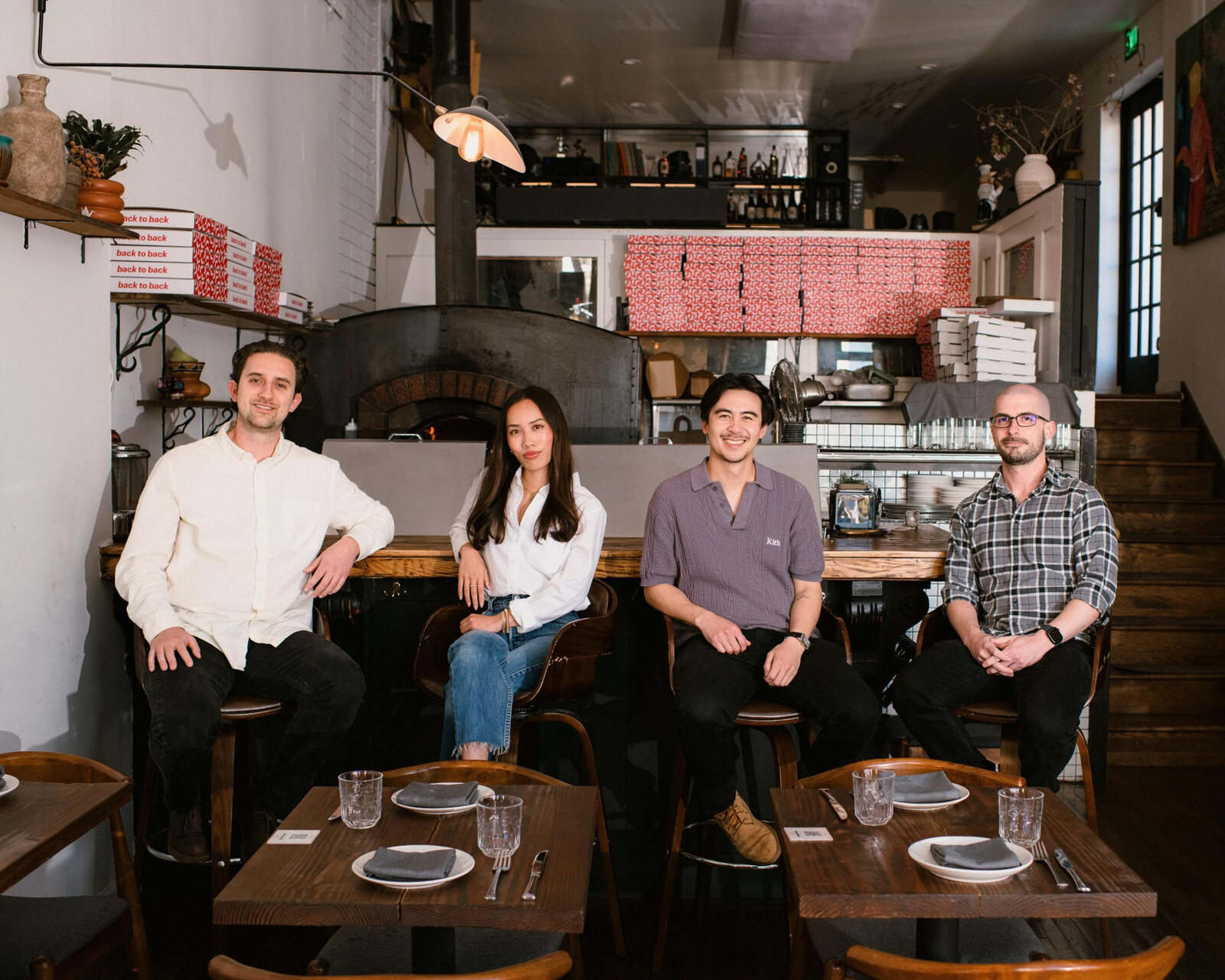
The restaurant also changed the stakes of his design work. In software, a confusing interaction can be studied and revised. During service, confusion arrives hungry. A missed call disappears. A manager gets pulled from the floor. A caller who wanted to book twelve seats may simply try somewhere else. Hom had moved closer to the consequences, and the distance between problem and feedback had collapsed to the length of a phone cord.
The friend you call about the calls
Hom reached out to Brendan Wood, a longtime friend and AI engineer. Wood had been building AI applications at Lindy, and the pair created a prototype that could answer restaurant questions in a natural voice. Back to Back became the first place to try it. Hom described hearing the system take those calls as “almost a euphoric experience.” The phone could ring without commandeering the room.
The prototype traveled a short, telling route through San Francisco hospitality. Trick Dog and Flour + Water became early testers. These were working restaurants, not a controlled demonstration. Callers interrupted, changed topics, arrived late, and asked the odd little questions that make scripted automation sound like a hostage note. If the system could survive that, it had a chance.
Early adoption also depended on a kind of credibility that cannot be downloaded. Hom could sit with an owner and talk about covers, labor, interruptions, and the strange emotional arithmetic of a missed call because he had worked the same shift. One independent operator later said she connected with him immediately because both came from family-run restaurants. The product had an AI voice, but its sales conversation spoke fluent operator.
One early call became part of Hostie lore. Andrew Brackin, a partner at Gradient Ventures, phoned Flour + Water because he was running late for a reservation. Hostie handled the request. Brackin was impressed enough to find out what he had just encountered. The accidental demonstration helped lead to a $4 million seed round, announced in April 2025.
There is an appealing precision to that sequence. The investor did not first meet the product in a pitch deck. He met it as a slightly late diner. Hostie made its case by doing the job it had been built to do.
A voice with limits
Hostie grew into a virtual concierge that handles calls, texts, reservations, takeout questions, guest inquiries, and private-event leads. It connects with the reservation and point-of-sale systems restaurants already use. The routine goes to software; unusual requests can go to a person. The arrangement is less a robot maître d' than a very patient layer between a guest's first question and the dining room's finite attention.
The company has allowed some theatrical flourishes. A French voice has answered for wine bar Amelie. The Stinking Rose, a restaurant famously devoted to garlic, has used a vampire voice. This is software wearing a little costume, but the joke has a serious design point. Hospitality has a tone. A restaurant does not want to sound like every other restaurant simply because the same technology picked up.
Trust also requires disclosure and an exit. After Hostie learned that California's call-transcription rules could create a compliance problem, it changed the opening message so callers are told the system is taking notes. If a caller asks whether it is a robot, it says so. If someone wants a human, the call can be transferred. The lesson was awkward but useful: a good concierge should not hide the guest's choices.
Hom's argument for restaurant AI depends on this boundary. The point is not to automate the moment a server recognizes a regular or a host rescues a difficult evening. It is to keep repetitive communication from crowding those moments out. Technology earns its place by protecting hospitality's scarce resource: human attention.
The phone becomes a platform
By the time Hostie announced its Series A in July 2026, the modest nuisance at Back to Back had become a national operation. The company said revenue had grown tenfold over the previous year and that hundreds of restaurant partners were using the platform. Obvious Ventures led the $12 million round, joined by Gradient, Scribble Ventures, Burst Capital, Behind Genius Ventures, and restaurant operators. The financing brought Hostie's publicly reported total to $16 million.
Those figures are company-reported, and they describe more than call volume. They show how a narrow entrance can open into a broader system. A guest's first contact may become a reservation, an order, an event inquiry, or a record of what people repeatedly want to know. For an operator, the phone stops being a nuisance at the edge of the business and becomes legible.
Hostie's next chapter includes deeper integrations, direct takeout ordering, stronger onboarding, and more partnerships across hospitality technology. Its advisory circle includes veterans of OpenTable, Resy, and Yelp, while its investor list mixes venture firms with restaurant operators. That combination mirrors Hom himself: software fluency on one side of the table, restaurant consequences on the other.
The operator remains in the product
The most reusable part of Hom's story is not the round size or the novelty of a conversational voice. It is the route he took to the problem. He spent years learning how to design products, then worked inside a business where every design decision met a customer immediately. The overlap gave him a useful form of impatience. He knew the nuisance personally, and he had the vocabulary to turn it into a system.
His advice from restaurant life is plain: stay close to the people you serve, prepare more than you think you need, and build teams you can rely on under pressure. He has also written about leading with empathy and trust. These ideas can sound soft until the dining room fills. Then they become operating instructions.
Back to Back still spins records and serves pizza in the family building. Hostie now answers conversations for restaurants across the country. The two businesses are joined by a question Hom first faced with a salad in progress: who deserves your attention when everyone needs it at once?
His answer is a division of labor. Let software take the repeatable interruptions. Let people keep the judgments, the recoveries, the welcome, and the room. A restaurant phone will always ring at the wrong moment. Hom's bet is that it no longer has to win.
“Stay close to the people you serve.”Randall Hom on the lesson he carries from restaurants into startups