In 1993, Rajesh Rajan knew the software better than he knew how to make himself heard. The youngest member of an IBM delivery team working on USDA payroll and farm insurance systems in Kansas City, he remembers being inclined to stay in the background. Technical competence had brought him into the room. Speaking up required another kind of practice.
His team leader, Sandy, had nearly forty years at IBM. She gave him responsibility for presentations, reviewed what he produced, explained her changes, and had him implement them. Then she encouraged him to present the parts he had worked on. Within a year, he says, he had become functional and technical leader for both systems.
Rajan still connects that experience to how he wants people to work at Integrative Systems, the technology services business he founded and leads. It is an origin story with an unusually practical souvenir: a manager’s edits. Plenty of careers have been altered by a red pen. This one benefited from an explanation beside it.
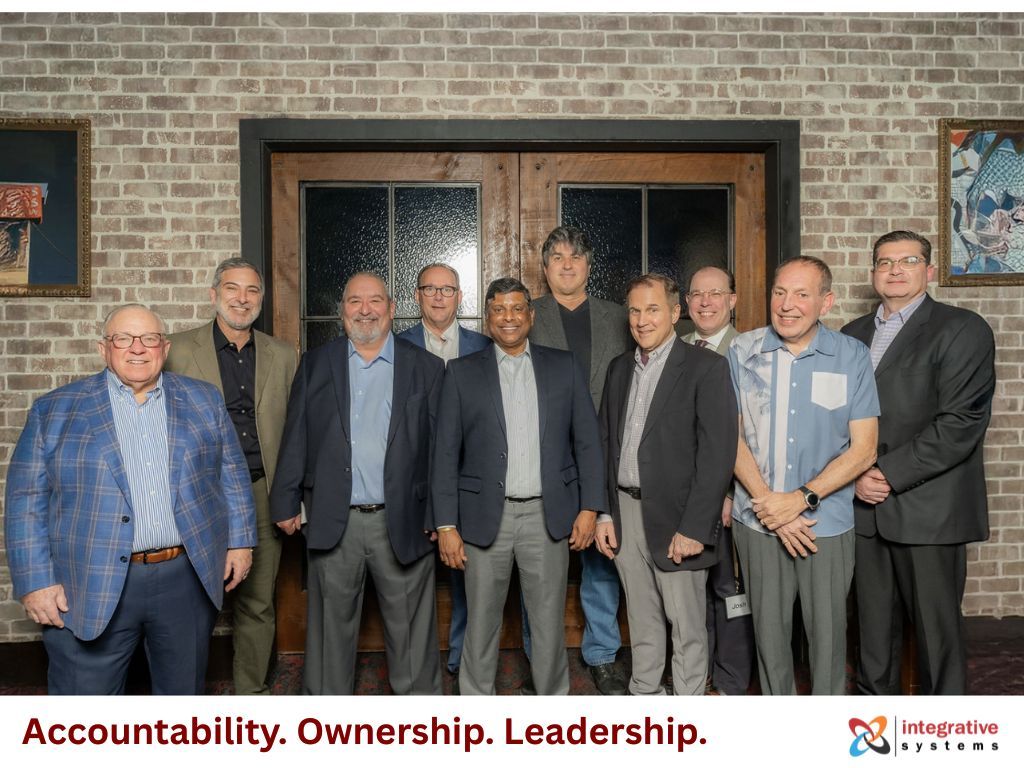
An idea with a payroll
Rajan’s working world contains IBM i systems, Microsoft applications, infrastructure, data, and back-office operations. These are the parts of a company that tend to attract attention when something stops working. The most successful day may offer very little material for a speech: the system works, the information arrives, and someone else can get on with a sale.
That setting gives his interest in people a business context. A services company sells the work of people who need to understand another organization’s habits and constraints. Customers bring a problem; the team has to learn what the problem means in the customer’s working day. Technical skill and a useful conversation have to occupy the same desk.
In his 2020 anniversary message to the India operation, Rajan named three values: fairness in behavior, transparency in practices, and consistency in decisions. He also described hearing from former employees with pleasure. His account of the company leaves room for relationships that continue after someone’s last working day.
The commercial aim was equally direct. He wanted customer success to come before the company’s own interest, arguing that this was a foundation for long-term profitability. He described plans for senior management teams in India and the United States, with responsibility for smoother operations and a more manageable working life for employees.
“I have always thought of Integrative as an idea more than an organization.”
Rajesh Rajan · 2022 anniversary message
An idea still has to meet the obligations of an organization. Someone has to allocate work, recruit colleagues, answer a customer, and decide what to do when a plan meets an inconvenient fact. Rajan’s language becomes more interesting at that level. Fairness is a decision somebody experiences. Consistency can be tested on a Tuesday.
The view from one floor up
In 2021, Integrative announced a larger office in Pune. The new space was on an upper floor of the same building in Magarpatta City, with the move taking effect on August 20. For an expansion announcement, it was a pleasingly modest journey. The organization was growing; the address did not need an adventure.
Rajan said his first thought during the search had been to limit the relocation’s impact on employees and clients. Finding enough space in the same location suited that aim. He expected the office to improve operating efficiency and help the business keep pace with customer needs.
The detail matters because expansion has two audiences. Outside a business, more space can stand for confidence. Inside it, a move introduces questions about access, coordination, and the mechanics of getting work done. Rajan’s explanation began with the people who would have to live with the change.
There is no need to turn a floor plan into a philosophy seminar. It is enough to notice where he placed his attention. The same founder who writes about protecting a shared idea also described growth through its effect on existing relationships. An upstairs office gave him a concrete way to discuss continuity.
A bigger office.
The same building.
A shorter list of disruptions.
Growth requires somewhere to put responsibility
By his 2022 India anniversary message, Rajan had more to organize. He reported that the team had grown from 140 to 210. He also acknowledged the loss of colleagues during a period of resignations. Growth, in this telling, included departures as well as arrivals. A hiring total alone would have made a tidier story.
He described leaders meeting every fortnight to discuss how the company worked and managed its people. A culture and team initiative sought to understand coworkers’ professional and personal aspirations. He also discussed using the Predictive Index to inform recruitment and help colleagues understand different communication styles.
Rajan had set a threefold growth objective relative to the preceding year. That was a target, and should be read as one. What gives the ambition substance is the accompanying attention to hiring, leadership routines, and coordination. A bigger organization needs ways for people to understand what others are trying to do.
Seventy more people.
More work for the organization, too.
Responsibility becomes a practical bottleneck as a team expands. If every judgment has to travel back to the founder, the founder becomes a very expensive queue. Rajan’s interest in ownership addresses that ordinary management problem: people need enough context and authority to move work forward, and enough contact with colleagues to avoid moving in incompatible directions.
In September 2022, as Integrative marked another Inc. 5000 appearance, Rajan dedicated the recognition to the team. He said the business had doubled its employee base across its India and US operations and added customers while broadening its services. His emphasis was on what customers gained from working with that team.
By 2026, Integrative had six listed appearances: 2020, then every year from 2022 through 2026. Its 2026 position was No. 4,003, with 60% three-year growth. Those figures describe a company’s revenue growth record. They sit alongside the more personal account of how its founder thinks about building the organization behind the work.
Six listed appearances. Each year is a company recognition.
New tools, familiar questions
In August 2026, Rajan turned to a newer technology conversation: how businesses should use AI. He argued for beginning with desired business outcomes and understanding the customer’s operations, priorities, and constraints. Adoption speed by itself was an insufficient guide. The useful question was where the technology could improve the business.
He described practical opportunities: faster development cycles, less repetitive manual effort, better accuracy, and quicker delivery. Human expertise remained central to his account. Experience, judgment, and knowledge of a customer’s domain would guide the solution. It is a position that gives the experienced colleague a continuing job description.
That outlook fits his emphasis on working as an extension of a customer’s team. The customer understands the business from inside; the technology partner contributes its own technical and strategic capabilities. The challenge is to make those kinds of knowledge useful to each other before deciding what a new tool should change.
- 01Understand the businessOperations, priorities, constraints
- 02Choose the outcomeValue guides the technology decision
- 03Keep expertise involvedHuman judgment guides delivery
The continuity is revealing. A career spent connecting business needs with technology does not have to begin again whenever the vocabulary changes. There will be new capabilities to assess and different implementation problems to solve. The obligation to understand the work survives each product announcement.
A career beyond the job description
Rajan’s education spans computer science and the University of Chicago Booth School of Business. His professional interests include business and IT strategy, operating models, global sourcing, project portfolios, and technology cost planning. Taken together, they describe the territory between a technical proposal and the business decision needed to approve it.
His professional profile places cost optimization beside project governance and modernization. That combination matters in a business where a technically attractive project still has to justify its budget and its disruption. A founder discussing software with another executive needs to understand what the proposed work will cost, who will own it, and how the organization will judge the result.
Rajan’s company works across applications, infrastructure, and back-office processes. That range brings several kinds of responsibility into the same relationship. A customer may need help maintaining a system while also deciding what to improve next. For the person leading the services business, the challenge includes making room for both demands: the work that keeps today running and the decisions that shape tomorrow’s workload.
His interests also extend beyond enterprise technology. He is a member of The Climate Reality Project and gives presentations about climate change and solutions. That activity brings another audience into the picture: people who need to understand a complicated subject well enough to consider what to do about it.
Communication runs through these parts of his life. The early presentation needed an explanation he could stand behind. The customer relationship needs shared understanding. A growing team needs decisions people can act on. Even the office move required attention to the experience of the people affected by it.
A founder can put values into a message quite quickly. Making them useful takes longer. A colleague needs responsibility; a client needs an answer; a team needs a way to compare notes. These are small occasions on which the stated idea of a company encounters the people expected to carry it.
Rajan’s account of Sandy offers a good place to leave the story. Someone experienced took time to explain a change, then left the work in his hands. Years later, he still remembers both parts. There are worse ambitions for a company than becoming the place where someone else gets that chance.