Rajesh Rajagopalan once led a discussion that ran out of time before anyone could agree. The subject was where to keep the data in a business process. It was October 2020, at a Camunda Unconference, and the participants had brought their own experiences, objections and inconvenient exceptions. A Miro board collected the argument. Consensus would have to wait.
There are less flattering ways for an executive to describe a meeting. Rajagopalan treated it as a good use of an afternoon. He had learned from the other practitioners. The disagreement had helped people look more closely at their assumptions. The answer depended on the system in front of them.
It is a useful opening to a career that now reaches from cloud engineering into the design of organizations. The PeerIslands co-founder, who went on to become its CEO, is now President & CTO of Winter. He is asking larger questions about AI and work. The appetite for a practical problem remains recognizable.
Before the copilots, the plumbing
His education began with a degree in computer science and engineering at Coimbatore Institute of Technology. His professional history includes Cognizant, where an April 2019 white paper identified him as a Director of Projects in the Intelligent Products & Services practice. His remit included IoT services delivery, building capabilities and developing solutions.
The paper, which he co-authored with Thariq Hameed, concerned smarter facilities management: buildings whose equipment, data and operating systems could work together. Its concerns were concrete. Disconnected controls made it difficult to understand what was happening across a property. Integration could turn scattered information into something an operator could act upon.
That earlier work gives his later interest in enterprise AI some useful context. Long before a conversation could begin with a prompt, there were devices, applications and people attempting to coordinate a response. A system could collect information beautifully and still leave somebody with the unpleasant task of making it useful.
His own technical archive stays close to such details. There are pieces on microservices, GraphQL, feature flags and data-processing architectures. Their titles have the plain confidence of workshop labels: here is the part, here is the problem, here is how you might approach it. Nobody has dressed the spanner for a gala.
In November 2021, he published a tutorial about building a custom Terraform provider. The example addressed provisioning storage across cloud platforms through a simpler interface. It included code, configuration and the difficulties a developer should expect. For the Go development involved, he described spending a few days with Jon Bodner’s Learning Go.
That admission is an appealing detail in a technology leader’s biography. Learning appears as part of the job. His blog’s brief self-description, “Learner for life”, has a practical companion in the implementation notes.
“Learner for life”
Rajesh Rajagopalan’s personal blog
The corner office still has dependencies
By the time of the 2020 Camunda account, Rajagopalan was described as a Managing Partner at PeerIslands, heading its Cayman operations. The work involved helping customers build cloud-native applications and handle the awkward design decisions that accompany them. His responsibilities joined engineering with the business of delivering it.
PeerIslands became the setting for a wider leadership role. As co-founder, President and CTO, he helped build the company before announcing his move into the CEO position in January 2025. In that announcement, he set out priorities around customers, engineering practices, PeerAI product development and expanding the company’s reach.
The announcement also contained a personal acknowledgment. He thanked Sowri Krishnan, whom he described as a mentor in his professional and personal life. A change of title provided a moment to name someone who had helped him reach it. Corporate announcements can be crowded with abstractions; a specific debt of gratitude is easier to remember.
His description of the company put considerable weight on polyglot developers: people able to work across languages and technical environments. That preference fits a career whose written record crosses architecture, infrastructure and data. A client’s difficulty seldom arrives neatly packaged inside a single specialty.
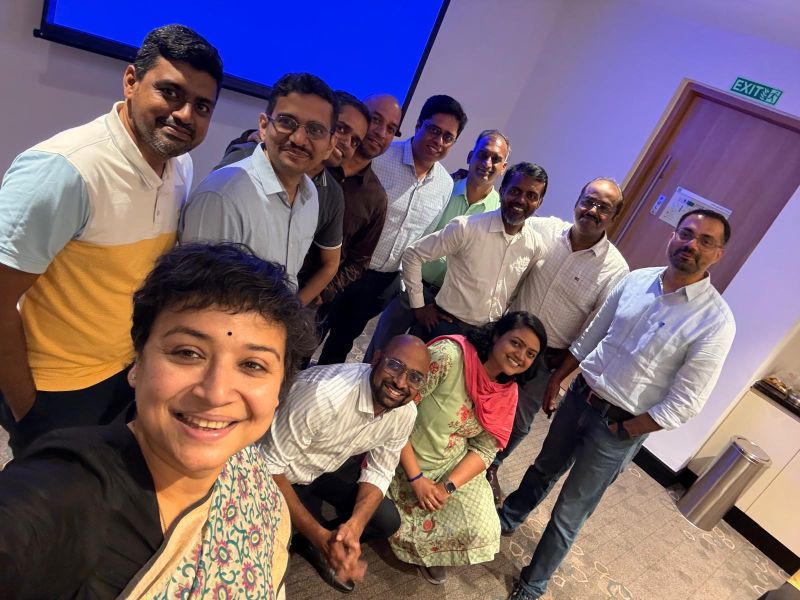
A PeerIslands account of an India leadership meeting put some ordinary substance behind the company-building language. The discussion covered recruitment, capabilities, revenue plans and operating discipline. These are the unglamorous companions of technical ambition. Even a very good architecture needs colleagues who know where the business is going.
An old database meets a new set of tools
PeerAI gave the company a way to bring generative AI into modernization work. In an article co-authored with Anandaraman Sivanandan and Ray Hassan, Rajagopalan explained an approach to moving systems from Sybase to MongoDB. The task involved both the database and the applications depending on it.
The described sequence began by examining code and database structures, mapping relationships and business logic. It proceeded into domain models, refactoring and generating modernized code. Testing compared the changed system with the older environment. A migration had to preserve behavior while changing the machinery that produced it.
For a reader outside engineering, that is the essential complication. A mature application contains accumulated business choices. Replacing its database is rather like renovating a railway station while trying to preserve every passenger’s connection. The attractive new concourse is only one part of the assignment.
- 01AnalyzeCode, schema, dependencies
- 02ModelThe business logic within
- 03GenerateRefactor for the target system
- 04ValidateCompare behavior and results
Conceptual sequence from the PeerAI modernization approach. No performance scale implied.
There is also a published invention record. Rajagopalan is among the named inventors on US application US20250156384A1, concerning a migration platform for legacy databases using a large language model. Filed in November 2024 and published in May 2025, it names PeerIslands Holdings as the original assignee.
Its status matters: this is a published patent application. Its presence adds a specific piece of engineering work to the biography, alongside the tutorials and leadership responsibilities. It also makes the migration interest unusually tangible. There is a technical proposal to examine as well as a business proposition to describe.
Who remembers why it works this way?
His writing about AI extends beyond generating code. In 2023, he examined workforce adaptation through the comparison with the Industrial Revolution, discussing the need to reskill as kinds of work change. By December 2024, he was exploring the transition from cloud-native companies toward AI-native ones.
Those subjects put learning on both sides of the organizational chart. Engineers face new tools. Leaders have to decide how work should change around those tools. Buying a capability leaves quite a lot of management still to do.
In March 2025, he turned to institutional knowledge: the unwritten rules and pattern recognition people acquire through practice and mentorship. His examples included debugging approaches, preferred design patterns and the peculiarities of legacy systems. He explored how generative AI might help retain and transfer that experience.
There is a human concern inside the technical proposition. An experienced colleague often understands the exception before anyone else notices it. Instructions alone may leave out the reason for a choice. Preserving that context becomes part of modernization, especially when the people who hold it move on.
By February 2026, his argument about developer value had shifted explicitly toward directing agents. He emphasized clarity of intent, architecture, orchestration, validation and governance. He questioned whether familiar delivery rituals and narrow divisions of responsibility still suited a world where AI could produce implementation rapidly.
The responsibility in that argument remains demanding. Someone must determine what should be built and whether the result is acceptable. More output makes those decisions more consequential. The engineer’s judgment receives a larger assignment.
Winter, and the work between the systems
PeerIslands subsequently entered a merger and rebranding into Winter. Rajagopalan’s reflections on the transition emphasized small teams, trust and ownership. His current role is President & CTO. The company’s stated purpose connects strategy and execution so organizations can adapt as conditions change.
Winter describes a platform called The Protean, bringing agent orchestration, copilots and reusable tools into an execution layer. Its own account places engineers beside strategists and architects. The ambition reaches into how an organization responds, learns and changes its course.
Rajagopalan’s June 2026 essay gives that ambition a sharper diagnosis. He distinguishes technical debt from process debt and organizational debt. Aging systems encourage manual workarounds; those workarounds, in turn, produce coordinating roles and structures. A company can replace its infrastructure while carrying those arrangements forward.
The systems that need changing.
The workarounds built around them.
The structures built to manage those workarounds.
He argues for examining the decisions that keep work moving and redesigning the operating model around them. It is an argument with practical stakes: a technology milestone can be completed while an employee still performs the same reconciliation or carries the same context between disconnected systems.
The thread back to that unconference is easy to follow. Where does the information belong? What depends on it? What happens when the assumed source is unavailable? The questions have grown to include teams and decisions, but they still require attention to the actual work.
Rajagopalan’s story lives in that expanding field of attention: a programmer learning another language, a partner comparing experiences with peers, a founder thanking a mentor, an executive reconsidering what modernization should accomplish. The next useful answer will have to survive the same test as the earlier ones. Somewhere, somebody has to use it.
Follow the work
Writing, projects and public profiles.
- Winter
- GitHub
- Personal technical blog
- Twitter / X
- Stack Overflow
- Cognizant: Embracing Smarter Facilities Management
- The Camunda unconference account
- Building a custom Terraform provider
- His PeerIslands CEO announcement
- PeerAI: Sybase-to-MongoDB modernization
- Migration platform patent application
- Reshaping Work
- The Journey From Cloud Native To AI Native
- On preserving institutional knowledge
- From Writing Code To Directing Agents
- Escaping The Modernization Trap
- PeerIslands leadership gathering
- Winter: company and approach
- Forbes Technology Council profile