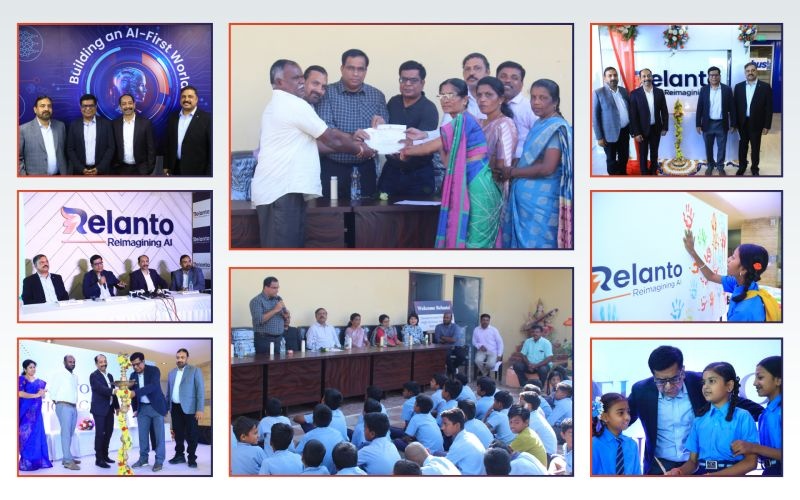
At an office inauguration in Bengaluru in February 2024, Rajan Gaur had something more interesting to report than a new workplace. Children and staff from Neraluru Government School had come to join the ceremony. Relanto, the company he co-founded and runs, was opening an AI-First Lab. It was also committing to a computer lab for their school. The future had arrived with two different sets of equipment requirements.
One lab would bring customers, technologists and academic institutions together to develop AI applications. The other would help children gain access to computers. Relanto Cares, the community initiative announced alongside the office opening, carried a company pledge of $1 million. That figure was a commitment to a global programme, rather than a price tag for the school project. The distinction matters: a large promise and a particular classroom are different kinds of responsibility.
Gaur’s own account of the event made room for the visiting pupils and teachers. He described the AI lab as a “global hub for AI Idea Exchange” and named the school where Relanto had committed to build the computer lab. For a business selling a technological future, it was a useful pairing. Some people needed a place to experiment with what computers might do next. Others needed a place to begin.
A founder with a long apprenticeship
Gaur reached that inauguration after a career spent inside the business of technology services. Before Relanto, his roles included account management at HCL Technologies, a director and client partner position at Cognizant, and a vice presidency covering the technology industry at UST Global. He subsequently led technology incubation at Syntel and became a partner at Enquero. The progression placed customers, commercial relationships and new technology close together. Account management and client partnerships involve the relationship around a technology engagement; incubation concerns what might become a new business. His subsequent role as a founder brought those strands into one organisation, with responsibility for building the team as well as explaining the proposition to customers.
The dates provide some perspective. His Cognizant tenure ran from 2007 to 2014. UST Global followed from 2014 to 2016, Syntel from 2016 to 2017, and Enquero from 2017 through the end of 2020. In January 2021, his career turned to Relanto. This was entrepreneurship after years of helping established organisations buy, implement and manage technology. The apprenticeship had been conducted in the places where a promising presentation eventually encounters an operating business.
His education includes the Indian Institute of Technology Delhi, which appears on his public LinkedIn profile. He is based in the greater Seattle area. Relanto’s ambitions, however, have always travelled further. Founded in 2021, the company brought together advisory work, enterprise planning, data and digital implementation. Gaur’s title was CEO and co-founder; the work around him required several kinds of expertise, and the early leadership appointments show how deliberately the company assembled them.
- 2007-2014Cognizant · Director & client partner
- 2014-2017UST Global, then Syntel · Industry leadership & incubation
- 2017-2020Enquero · Partner
- 2021Relanto · CEO & co-founder
Three appointments, one revealing problem
In March 2022, Relanto announced Prakash Hariharan as chief planning officer, Ahmer Inam as chief data and artificial intelligence officer, and Nadia Dessouki as chief sales officer. Gaur linked their appointments to customers accelerating data-driven innovation and changes in corporate performance management. The combination tells its own story: planning expertise, AI expertise and customer relationships were being built into the same leadership team.
That is a revealing starting point for an AI business. Planning is where a company tries to make its intentions agree with its numbers. Sales is where those intentions meet customers. Data determines how much either side can know. Putting these responsibilities together suggests a business organised around the connections between systems and people. Gaur was describing Relanto as an adviser and partner to customers, with the personnel to carry that relationship into implementation.
The founder’s public vocabulary has grown more specific since then, but that underlying problem remains recognisable. A company may have plenty of information and still struggle to act on it across departments. It may buy capable software and still have processes that make cooperation difficult. Relanto’s later work gives Gaur a way to address that awkward territory between an investment being approved and an improvement actually being felt.
The school lab gets a second chapter
The Bengaluru opening in 2024 put a physical location around the company’s research ambitions. At IBC Knowledge Park, the AI-First Lab was intended to support collaboration, incubation and new intellectual property. COO and co-founder Yeshwant Nayak emphasised research and the next generation of AI solutions. CTO T. P. Vincent described an exchange between industry and academic institutions. Gaur connected the office and lab with Relanto’s next phase of growth.
The commercial map was expanding too. President Shankar Chowhan discussed the company’s presence in Canada, Mexico, the UAE and India. These were parallel commitments: new markets, a place to develop technology, and a community programme aimed at reducing the digital divide. They put several obligations on a young company at once. Expansion requires delivery; an innovation lab requires useful work; a pledge requires something that happens after the announcement.
In July 2025, Relanto announced the opening of the Digital Dreams computer lab at Neraluru Government School. The school named at the inauguration had acquired a further chapter. It is a modestly concrete detail in a field that often prefers enormous abstractions. The two labs also give this part of Gaur’s story its scale: one concerns the capabilities of enterprises, the other the opportunity for students to learn. Both depend on access becoming practical.
A company pledge toward a global community programme focused on bridging the digital divide.
He keeps returning to the friction
Gaur and Nayak have since put their thinking into a series of essays on what they call Convergence 3.0. Their proposition joins changes in sales with changes in software: agent-supported revenue processes on one side, language models and autonomous agents capable of coordinating work across systems on the other. Their interest lies in how the combination could change sales, finance and marketing, with human judgement remaining part of the design.
The useful part is their insistence on the foundations. In their readiness essay, they identify three places where progress gets stuck: business processes that have not been designed for people and agents to work together, data foundations agents cannot use effectively, and governance built for an earlier operating model. This gives a broad ambition a set of inspectable problems. A leadership team can examine a workflow, a definition or a permission. Readiness, by itself, is harder to put on a desk.
Their companion essay proposes rapid prototyping in 12-week cycles to test assumptions before larger investment. That is a proposed method, rather than a promise that every implementation takes twelve weeks. It fits the wider argument: establish what works, connect the systems involved, and give people a way to refine the result. The excitement is allowed into the room. It has to sit through the practical discussion like everybody else.
When the agent needs a supervisor
On June 17, 2026, Relanto launched R-LiveMeasure, a governance platform developed by the AI-First Lab. The intended job was to monitor and evaluate AI agents as they moved into business operations. Its design includes recording interactions and tool calls, evaluating activity against business context, enabling expert review, and linking performance to business measures. An agent taking action creates a different management problem from software that simply waits for instructions.
Gaur framed the competitive question around governing agents at scale. In product terms, Relanto was trying to supply the records and review mechanisms that make such governance possible. The company says the platform operates within an organisation’s environment, with its interaction data and governance records under enterprise control. These are design commitments, and their value depends on how they work in practice. They nevertheless show the kind of problem Gaur has chosen to pursue.
There is continuity here with his earlier services career. Customers need technology they can incorporate into an organisation with existing responsibilities, permissions and measures of success. The more an agent can do, the more consequential those ordinary arrangements become. Relanto’s laboratory had produced a product concerned with oversight, a pleasingly unglamorous destination for research. A machine entrusted with work eventually needs someone to ask what it has been doing.
“AI is rapidly becoming a significant enterprise operating expense, yet the management discipline around it is still catching up.”
Rajan Gaur · August 2026
And then comes the bill
The next launch brought the economics into view. On August 27, 2026, Relanto announced R-TokenomIQ, a platform for managing AI consumption and expenditure. Its stated capabilities cover usage monitoring, attribution of costs, budgets and policies, optimisation, and security oversight. The premise is straightforward: AI spending can accumulate through prompts, models, workflows and agents, leaving a business to reconcile several partial views of the same activity.
Gaur described a growing operating expense that needed more developed management discipline. The observation brings his current work down to a recognisable executive concern. Someone needs to know where the money went, which team incurred the cost, and what useful work came back. Intelligence bought by consumption introduces a recurring question about value, well after the initial decision to adopt it.
On September 21, Relanto announced OpenAI Select Partner status and connected the milestone to enterprise integration, governed workflows and its Convergence 3.0 approach. Gaur again emphasised accountability. Across these developments, his public priorities form a consistent sequence: give people access, build the supporting foundations, supervise the work and understand its cost. At the Bengaluru inauguration, the pupils visiting the new office supplied an earlier version of that same practical question. What will this technology let somebody do?
Continue with Gaur
- Rajan Gaur on LinkedIn
- Relanto and its leadership
- The Bengaluru lab and Relanto Cares
- The school lab’s next chapter
- Gaur & Nayak: the foundations
- Gaur & Nayak: Convergence 3.0
- Gaur & Nayak: locating the friction
- R-LiveMeasure announcement
- R-TokenomIQ announcement
- September 2026 partnership announcement
- The 2024 launch in the news