Michael Blicher Sørensen has a fairly good reason to be interested in what happens beyond the dashboard. Before becoming an AI founder, he worked in Danish defence and then in security at Meta. His professional territory included intelligence, electronic warfare and the infrastructure of a company whose services reach across the world. Now, as CEO and co-founder of Velatir, he is concerned with a different kind of activity: the AI that employees and software agents are already using inside organisations.
The setting has changed. The question has a familiar shape. What is happening, who understands it, and who has the authority to act? For Sørensen, that question has become a business in Odense. It has also become a useful way of reading a career that runs from military service through corporate security to entrepreneurship. The connecting subject is responsibility, even when the technology makes the work look automatic.
A career spent reading the system
In January 2024, Sørensen appeared on the Grey Dynamics podcast as a global security site lead at Meta. The conversation covered his army background, electronic warfare and signals intelligence, alongside the experience of moving into civilian work. Its topics included building rapport with colleagues and making intelligence useful to the person receiving it. He also discussed deployment to Iraq and working with allied counterparts.
Those subjects give the career a human dimension. Expertise has to travel between people before it becomes useful. An analyst may understand a situation very well and still have work to do in explaining why someone else should care. The podcast’s agenda, with its attention to workplace relationships and the needs of an intelligence consumer, puts that practical problem beside the technical one.
At Meta, his work included technological and security audits across its data-centre infrastructure. That is a particular vantage point from which to enter the AI business: familiarity with the foundations on which digital services depend. A service may look effortless to its user; the responsibility for running it sits with people who must understand considerably more than the user sees.
Recognition came during that period. Sørensen was selected for Berlingske’s Talent 100, and his public response included thanks to mentors, colleagues and friends at Meta. He named the people who had helped him during nearly five years there. In the usual founder narrative, the individual tends to absorb the whole spotlight. His acknowledgement leaves room for the people standing just outside it.
His qualifications reflect the security focus: a master’s degree in International Security and Law, Certified Protection Professional status and ISO/IEC 27001 Lead Auditor credentials. His AI Day biography also described continuing IT studies. Taken together, these are clues to the range of the work: technical systems, organisational rules and the decisions people make where the two meet.
A twin, some friends, and a whiteboard
The founding story contains a more personal connection. When announcing Velatir’s pre-seed financing, Sørensen wrote about the pleasure of building with his twin brother and some of his best friends. The funding mattered, but he located the beginning of the reward earlier, in the people sharing the work. It is an unusually intimate detail in a genre generally dominated by amounts, investors and promises about market size.
Velatir’s four co-founders are Sørensen, CTO Elias Sørensen, COO Christian Møller and CPO Andreas Paulli. Their responsibilities span security, engineering, regulatory work and product development. That division is relevant to the kind of company they are building. A tool intended to govern AI has to make sense to the people who write software, the people who use it and the people who answer for its consequences.
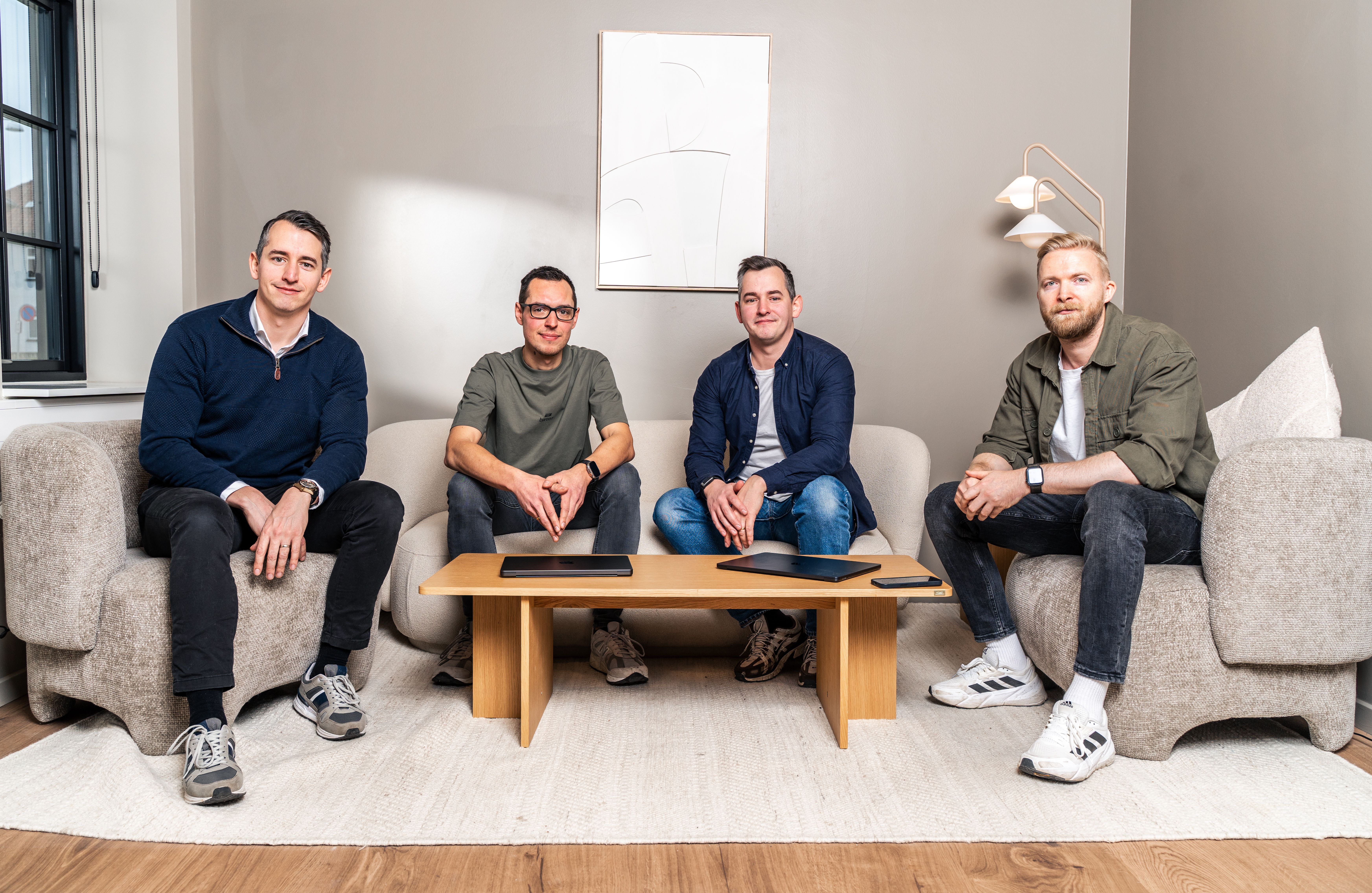
His account of moving into the first office was similarly revealing. After working in a distributed way and meeting as needed, he wanted a physical place for the product conversation. He described people gathering at a whiteboard, pointing at a diagram and reconsidering a user flow. He still saw value in hybrid and remote work. The office was meant to give an unfolding idea somewhere to live on the walls.
There is some pleasing practicality in that image. A company working on AI still needs a place where somebody can point at a drawing and ask a colleague to explain it again. The product may eventually arrive through a browser; its development remains a social activity. Sørensen’s description makes the office move sound like a decision about how the founders think together.
Permission becomes a business
Velatir’s starting point is that AI has already entered companies through everyday work. Employees choose tools; agents perform tasks; different services sit in different parts of the organisation. The company describes its role as providing a structure around that activity, with AI shaped to the organisation using it. In that account, adoption creates an ongoing management task.
Sørensen has described the complication plainly: “Everybody expected AI to improve operations. In reality, it has introduced significant complexity.” His argument concerns the difficulty of overseeing an expanding set of services. A company that understands one approved application may still struggle to follow all the other places where AI touches its work.
“Our mission is to enable any company to become AI-native”
Michael Blicher Sørensen
Velatir sells visibility into use and data flows, together with controls for the organisation. The ambition reaches across employees, devices, browsers, vendors and agents. That breadth is central to the proposition. The company wants management to have a view that follows the activity across systems, rather than requiring a separate understanding of each service in isolation.
Conceptual illustration of the company’s proposition.
The infrastructure choice follows the same concern with control. Velatir says it runs on European-owned and hosted infrastructure. For Sørensen, European competitiveness is part of the ambition behind the business. It is a position with practical implications: the company’s own foundations become part of the product conversation, alongside what customers can see and do once they use it.
The appeal of this work depends on a rather unglamorous requirement: someone needs to know what is going on. Permission is easy to announce in a policy document. Making it intelligible within actual work is a longer assignment. That is the territory Sørensen has chosen for his next chapter, with security experience behind him and a company to run in front of him.
Six months between the rounds
The financing gives that chapter a dated outline. In February 2026, Velatir announced €1.35 million in pre-seed investment led by Ugly Duckling Ventures, with Norrsken Evolve participating. The legal adviser on the transaction described work on its structure, term sheet, investment agreement and governance. Even the paperwork had to address the relationship between the technology and the responsibilities around it.
Announced round amounts. The August package included an EIFO match loan.
By August 20, another announcement followed: €5 million in seed financing. Spintop Ventures joined as a co-lead alongside Ugly Duckling Ventures. Norrsken Evolve returned, while n8n founder Jan Oberhauser and robotics entrepreneur Thomas Visti joined as angels. Denmark’s export and investment fund, EIFO, contributed a match loan. It was a set of relationships extending beyond a single cheque.
The company said the round came together in two weeks. The money was intended for hiring and European expansion. Sørensen’s own announcement also put further engineering and a deeper control layer on the list. Funding provided resources for a familiar collection of operating decisions: whom to hire, which market to enter and what to build next.
Growth was already visible in the company’s accounts of its staffing. A June announcement described a team of 25, up from four in February. It also presented Odense as the base for expansion into other European markets. These dated snapshots show a founder moving into a different scale of management. A founding team can settle matters around a table; a growing employer needs ways for many more people to understand the work.
Who gets the first job?
By October, Sørensen was discussing another responsibility of growth: making room for new graduates. He described plans for student roles leading into full-time work, supported by senior mentors. The company reported 36 full-time employees, including one new graduate. The broader recruitment effort was still being developed, with an intended rollout over the following six months.
In a separate public post, he addressed the tension directly. AI could allow his team to work with fewer engineers, provided they were the right people. But if employers did not give juniors a chance, he asked, where would future experienced engineers come from? He also described Odense as an advantage in the competition for talent.
That question adds something useful to his founder story. He is selling organisations a way to oversee increasingly capable technology while arguing that people still need opportunities to learn. The responsibility reaches into the company itself: the next person with good judgment has to acquire it somewhere, on work that somebody is prepared to explain.
For Sørensen, the next chapter will involve both kinds of permission. Customers need a workable way to decide how AI enters their organisations. New colleagues need a way into the work those organisations still require. The former intelligence officer now runs a business at that intersection, where the software can be fast and the development of people still takes time.