The wealth manager already had a licensed copilot. What it did not have was client data verified as safe for that copilot to use. In Securiti AI’s account of the project, the rollout stalled on a prerequisite that sounds almost insultingly simple: make the data safe first. The company says it sanitized 400 terabytes across 382 data element types before AI use. The customer remains unnamed. Still, the sequence is revealing. Buying the intelligence was the easy part.
- Securiti finds sensitive enterprise data and connects it to permissions, policies and AI systems.
- Its customers are enterprise teams managing security, privacy, governance and AI.
- Veeam completed its $1.725 billion acquisition in December 2025.
That is the useful way into Securiti. The company occupies the space between an organization’s appetite for AI and its knowledge of what it actually owns. A folder can contain customer records, a contract, or someone’s forgotten export of a database. To a business, those are different things. An AI pipeline needs those differences made explicit.
One wealth manager’s rollout, as reported by Securiti. These are case-specific figures.
The filing cabinet came first
Rehan Jalil formed Securiti in 2018 with a team whose experience included Symantec, Elastica, Blue Coat and Cisco. When it emerged from stealth in August 2019, the first product was PRIVACI. Its assignment was privacy operations: find personal information, connect it to the individual it concerned, and help an enterprise handle requests, consent and assessments.
There was a practical reason to begin there. A person could ask a company about their information. The company then had to assemble an answer from scattered systems. Reading a policy did not locate the records. Securiti put discovery and workflow automation together, turning an abstract obligation into a sequence of tasks.

Jalil described the ambition as helping businesses become “responsible custodians of people’s data.” That phrase has aged rather well. A privacy request asks which records belong to a person. An AI deployment asks which records a system may use. Both require a dependable understanding of the data underneath.
Securiti won the RSA Conference Innovation Sandbox in 2020. In 2022, it announced a broader unified data-controls offering alongside a $75 million Series C. Its platform became known as the Data Command Center; current materials call it the DataAI Command Platform. The product’s scope widened around a recurring problem: several departments needed answers about the same information.
Three checkpoints for a chatty machine
The connective tissue is a knowledge graph. In Securiti’s description, it links data objects with sensitive information, permissions, systems, models and controls. The point is context. Knowing that a file contains personal information is useful. Knowing who can retrieve it, and which AI application can reach it, makes that discovery actionable.
Gencore AI, launched in October 2024, carries that approach into AI development. Teams can ingest enterprise documents, classify and sanitize sensitive content, turn material into searchable representations, and track its path through a pipeline. It also offers controls around prompts, retrieved information and responses. A retrieval checkpoint matters because the wrong document can enter the conversation before a model writes a word.
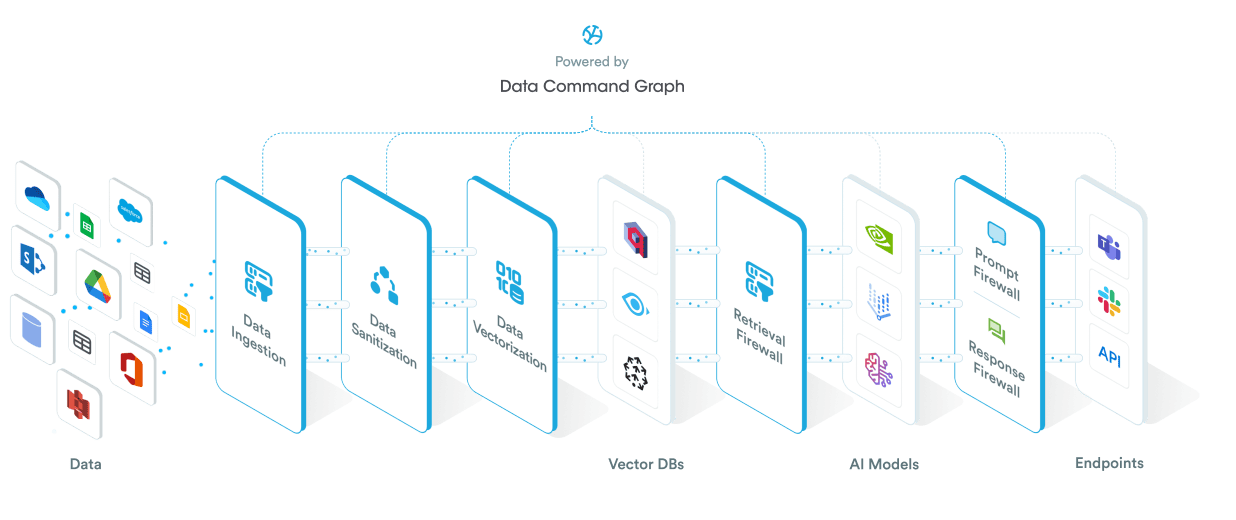
A hypothetical payroll assistant makes the distinction clear. A manager might be allowed to retrieve their team’s records, while another employee is not. The quality of the model’s prose cannot settle that question. Permissions and the retrieval path must carry the decision. This is an illustration of the problem, rather than a claim about a particular customer deployment.
NVIDIA NIM supplies one route to model inference through a Gencore integration. Databricks integrations connect data preparation with Delta tables and Unity Catalog. These partnerships place Securiti alongside existing enterprise infrastructure. Customers can use its controls and preparation tools without making Securiti the maker of their foundation model.
The quality of the model’s prose cannot settle a question about permissions.
The price of knowing what you own
The buyers are security leaders, privacy officers, data teams and people building enterprise AI. Public case studies describe wealth management, manufacturing and very large corporate data estates. The commercial appeal is shared intelligence: discoveries made for one task can support several others. Security can investigate exposure while privacy teams work through requests and AI teams prepare permitted inputs.
Securiti sells enterprise software under customer agreements and order forms. A buyer needs a quote for the relevant scope. The acquisition price is a different number entirely. Its disclosed Series A, B and C rounds total $156 million, with additional strategic investments. Veeam’s $1.725 billion purchase bought the business; it did not establish a customer subscription price.
Its competitive neighborhood includes BigID, OneTrust and TrustArc, with other data-security alternatives such as Varonis and Cyera. Securiti’s pitch is the breadth of its connected controls across privacy, security, governance and AI. That breadth matters most when those functions share difficult data problems. A small organization seeking only a cookie banner has a much narrower buying decision.
A map meets an undo button
Veeam completed the acquisition on December 11, 2025. The logic connects understanding data with recovering it. In February 2026, Veeam announced Agent Commander, intended to combine AI risk detection, protection and precise recovery. The announcement described a future release. Its recovery promise should be evaluated as a product commitment with deployment requirements, rather than assumed from the deal alone.
The copyable lesson is operational. Start with a bounded collection of documents. Identify sensitive information and access rights. Sanitize what needs sanitizing. Then test whether an unauthorized user can retrieve it. Missing connectors, stale permissions or nobody responsible for fixing findings can undermine that process. An inventory needs someone empowered to act on it.
The wealth manager’s stalled copilot is therefore a useful place to end. The obstacle appeared before the exciting demonstration. Securiti’s business depends on making that preliminary work repeatable: knowing what the machine is about to read, and deciding whether it should.
Open the next door
Explore / watch / follow