Raj Darji’s first lesson in management came from watching people turn up to work on his father’s farm. In Ablauva, near Mehsana in Gujarat, Ishwarbhai Darji had workers who wanted to work for him. His son noticed. The explanation was plain: look after the people doing the work, and they look after you. A field had supplied the lesson before a boardroom could invoice for it.
Years later, Darji would found Aarav Solutions, a product engineering and IT consulting business. His personal website still describes him as a farmer at heart. The phrase has some substance behind it. He has repeatedly connected the way he runs his company with the obligations he saw at home: to employees, customers and the community that helped him get started.
Three rooms, six classes, a wider world
His village government school had three rooms shared by six classes. Lessons sometimes moved beneath a tree. Darji later went to Bharuch for secondary schooling, staying where his brother lived, before studying information technology at Sankalchand Patel College of Engineering in Visnagar. He graduated in 2003. The geography of his education kept changing; the need to find the next available opportunity remained.
He had initially considered chemical engineering. Friends encouraged him towards IT, then an expanding field in India. His ambition to study and work in America met a more immediate problem: the family could not fund the roughly Rs 15 lakh he thought he needed. He took a local broadband job. Work with Oracle billing and revenue management eventually provided a professional route to the United States.
His own account places his H-1B journey in 2006. By 2011, he had accumulated American consulting experience and returned to India for visa stamping. An unexpected delay kept him there for more than ten months. He continued working remotely. Somewhere in that prolonged uncertainty, the prospect of starting a business became practical. Bureaucracy had arranged a rather demanding business incubator.
A company with a family name
Darji named Aarav Solutions after his newborn son. The company began in 2012 and was registered in Ahmedabad. His personal account describes the business as entirely bootstrapped, built to preserve his freedom over its values and direction. A name borrowed from the next generation sat above a company shaped by lessons from the previous one.
Bootstrapping makes an attractive word in a founder biography. In practice, it gives ordinary decisions an unusually sharp edge. Recruiting, training and delivering a project all compete for money that must come from somewhere. Darji’s account of Aarav’s beginnings puts his own resources behind the company. His stated purpose was to build an organisation where growth could be shared among customers, partners and employees.
He has also been explicit about the discipline growth requires. On his personal site, he advises founders to plan ahead, pay attention to cash flow, update their systems and keep developing their skills. A solution that worked a year earlier may need replacing. There is something pleasingly agricultural about that view of technology: the conditions change, and yesterday’s work does not exempt anyone from today’s.
The interview question that leaves the résumé
Ask Darji about hiring and the conversation moves beyond technical competence. In a 2022 interview, he described asking candidates what makes them happy and motivated at work, and how they fit into teams. These are revealing questions for a services business. Customers may buy expertise, but colleagues must live with one another’s habits while delivering it.
“What makes you happiest and most motivated at work?”
Raj Darji, describing his hiring questions in 2022
He also described a Centre of Excellence that trained younger consultants in presentation, project management, technical work and other professional skills. Experienced colleagues could learn additional technologies too. The ambition was broader than filling a vacancy. It was to help people acquire the range required to stay useful as the work changed. Training, in this telling, belongs inside the business model.
There is a colleague’s version of that philosophy. Lead engineer Prabha Muthusamy, who joined Aarav in January 2016, wrote in February 2022 about six years at the company. She recalled Darji’s recurring offers of help and the support she received during relocation. Her account dwelt on the continuity of that attention. The memorable detail was its repetition: a founder still checking whether assistance was needed long after the welcome had ended.
Muthusamy described the company as having grown from about 30 people when she joined to more than 180 at the time of her account. Those are historical snapshots, with their dates attached. Her more personal observation concerned what had persisted through the increase in numbers. For an employee, the difference between a declared value and a useful one often arrives in the handling of an ordinary request.
A school project with a long memory
Darji’s interest in rural education has an obvious biographical connection. He experienced limited school facilities, then encountered different resources in the United States. In January 2021, Jadishwar Charitable Trust, supported by Aarav Solutions, launched Sanvid. The initiative began with a school in Jangral, in Gujarat’s Patan district. Computer education would be part of a wider programme of skills for school students.
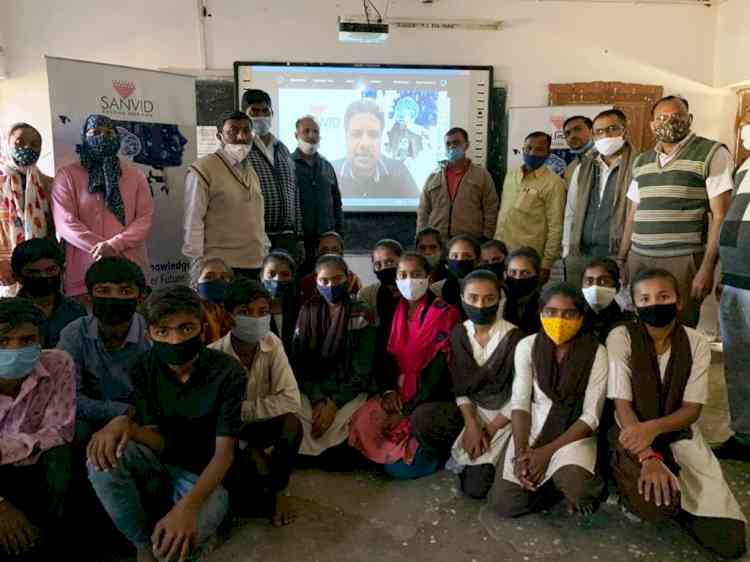
At the launch, Darji set a goal of reaching at least 72 rural schools across Gujarat over seven years, linking the number to India’s 72nd Republic Day. It was a commitment about where the programme should go. The starting point was much more tangible: students, teachers, devices and lessons. Educational ambition becomes interesting when somebody has to make a computer available for practice.
Sanvid’s framework addresses that detail. Alongside technology classes, it describes life skills including spoken English, humanities and financial management. Its Rent O Yantra programme provides for renting devices such as laptops or phones so students can practise. The distinction matters. A demonstration can introduce a skill; access to a device gives a student time to work out what happens after the demonstration ends.
The work also has a family structure. Darji’s wife, Alpa, is responsible for programme design and delivery; his elder brother, Karam, works at the grassroots. Sanvid identifies Raj as the architect of the initiative. Its stated purpose allows for children to gain modern technical knowledge while remaining connected to their rural communities. Opportunity should not require a child to regard home as an inconvenience.
At the crease, another kind of team
Cricket provides a less formal view of Darji’s life in America. He began playing at school and has continued with friends and members of the Indian community in the United States. He prefers the pleasure of playing to an obsession with winning. Even a founder is allowed an afternoon during which the result need not become a quarterly presentation.
He enjoys Test cricket, and watching the World Cup is a family ritual. His admiration for MS Dhoni centres on patience, determination and the journey from a small town. When Darji discusses captaincy, he talks about recognising different abilities, explaining decisions and accepting responsibility for their consequences. The business parallel is his own. A team contains different people before it contains a shared objective.
That cricket circle also became involved in donation and food drives for disadvantaged people in the US. Darji has described discussing ideas for helping others around practice matches. The connection is characteristic: an activity that makes friends also creates a group capable of doing something together. Community, for him, appears to involve a certain willingness to volunteer one’s weekend.
From billing systems to AI that does a job
Aarav’s later work keeps a connection to the billing and revenue systems in Darji’s early career. In February 2025, the company announced the general availability of OmniTel360, combining a customer relationship management front end with Oracle Billing and Revenue Management. Its intended users were telecom operators already running Oracle BRM. The proposal was to connect familiar business machinery more effectively.
In March 2025, Aarav appointed Srikrishna “Kris” Sharma to lead sales and alliances in EMEA on a fractional basis. Darji described the company’s CRM, billing and contract management accelerators as ways for customers to obtain value without large upfront commitments. The announcement put another part of his job in view: pairing the technical work with people who can introduce it to customers in different markets.
Darji’s work also extends to Abluva, where he is listed as a founder and chief executive alongside fellow founder and CTO Amit Gautam. The company focuses on data security. Its leadership page places Darji’s Oracle background beside his name, a small reminder that new ventures can draw on years spent with established enterprise systems. Novelty has a habit of employing experience.
By December 2025, Aarav had announced an AI-powered configure, price, quote chatbot built on Odoo. The stated aim was conversational ordering while retaining business rules for prices and discounts. Its 2026 events programme placed Darji on the team for MWC Barcelona and DTW Ignite, with products addressing billing, quoting and field operations. The work is concentrated on recognisable tasks inside organisations.
The next generation gets a place in the plan
In Aarav’s 2026 technology outlook, Darji argued that the value of AI would depend on how effectively it was embedded, governed and coordinated in enterprise work. It is a more demanding ambition than collecting tools. A company has to make the technology operate reliably among the systems and people already there. His recent public agenda follows that practical concern.
He received Times 40 Under 40 recognition in 2022. Yet the details that give his story its shape are less ceremonial: a father whom workers trusted, a school with too few rooms, a recurring offer of help, a device a student can borrow. Across businesses and education, Darji keeps returning to the conditions that let other people participate. The farm lesson has travelled quite a distance. It still has work to do.