Consider a customer’s name. An application collects it. Another needs it for billing. A third uses it to answer support questions. The name is ordinary; the arrangements around it are complicated. AnonTech’s proposition begins with that distinction. Its ViziVault platform asks organizations to move personal information into an encrypted vault and let applications request controlled access. Privacy becomes a question of how the software is built.
- The product: an encrypted vault, application API and management console.
- The buyers: organizations handling sensitive customer, patient or employee information.
- The entry point: PrivScan, a privacy assessment advertised at $4,999.
The Albany company, founded in 2019, calls this combination “PrivSec,” joining privacy and security in one compressed word. There is a practical thought beneath the branding: rules about personal information become more useful when they influence the systems storing and serving it. ViziVault is AnonTech’s attempt to put those rules in the information’s path.
Co-founders Jason Horth and Stephen Graham came from technology leadership roles: Horth at Conduent and Graham at OptionSoft Technologies. AnonTech’s own account emphasizes experience with software engineering, enterprise platforms and compliance. That background helps explain the product’s focus on infrastructure. The company describes a recurring frustration with securing sensitive information, then answers it with a different arrangement for storing and accessing it.
The $4,999 map
Before the vault comes a less glamorous exercise: locating what a company already holds. AnonTech advertises PrivScan as a one-time $4,999 service. Its sequence is straightforward: consult the governance, security and technology teams; scan data assets with IT; then deliver findings and an action plan.
The offer includes an evaluation of personal-information use and potential technical, operational and regulatory gaps. That makes the assessment a useful clue to the business. AnonTech sells software, but also the expertise needed to understand where it might fit. Its consulting work includes implementation assistance and technology modernization.
Consultation → Data scan → Action plan
Assessment service. Separate from ViziVault platform pricing.For a buyer, the distinction matters. An assessment has a defined deliverable. Putting an API into applications is an engineering project. The listed assessment fee is a starting cost, not a total cost of changing how an organization handles information. Integration, internal ownership and deployment choices belong in the same purchasing conversation.
A vault with two front doors
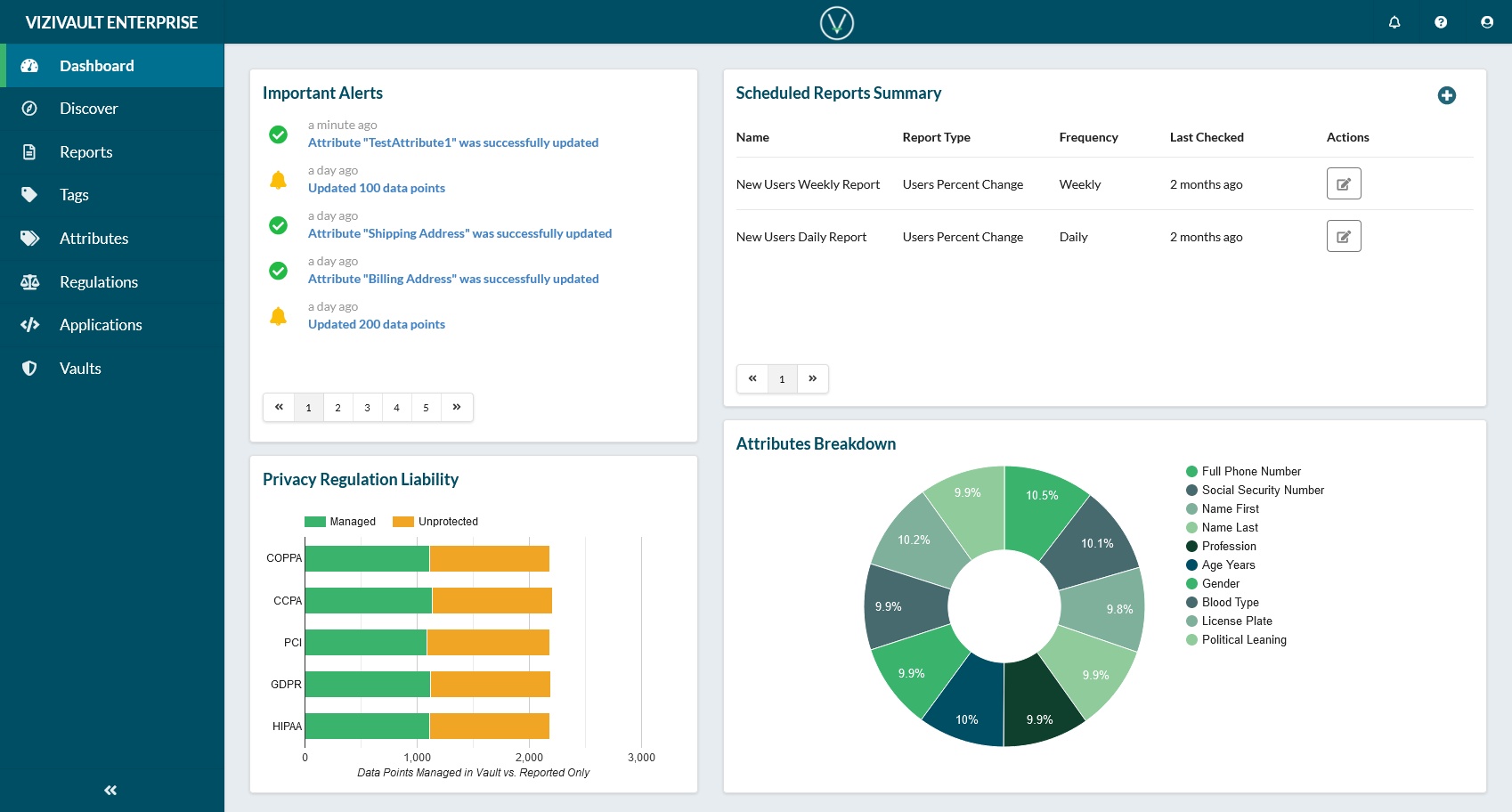
ViziVault serves two groups who approach the same data differently. Developers get an API for storing, retrieving and managing information. Administrators and privacy staff get ViziVault Enterprise, the console for inspecting data, permissions and activity. The product places application behavior and organizational oversight alongside each other.
The developer side is unusually tangible for a privacy pitch. Public repositories contain libraries for Java, Node.js, Python and C#. There is also a spreadsheet-loading utility and a Helm chart for deploying the platform. These are concrete integration materials a technical team can inspect, rather than a request to accept a diagram on faith.
The documentation’s quickstart starts with ten sample data subjects. It walks through connecting a vault, supplying application and cryptographic keys, creating attributes and loading information. Its useful detail is the separation of encryption and decryption: an application can be arranged to create data without having the same ability to read it back.
That distinction gives the architecture a practical shape. A collection workflow and a retrieval workflow need different permissions. Keeping those permissions deliberate is part of the implementation, not something a dashboard can decide afterward. The quickstart explicitly asks developers to consider how they secure private keys in production.
Enterprise console: inspect information, permissions and activity.
Conceptual illustration of the documented product architecture.On the administrative side, the documented dashboard distinguishes information secured in the vault from information it merely reports on. It also breaks down activity by geography and application. That distinction is useful: knowing about a record and controlling its storage are different forms of visibility.
The rule is only as good as the signal
Inside ViziVault, rules can inspect incoming information and take actions. The documentation describes adding regulatory metadata, sending notifications and preventing storage. Each rule has a name, a condition and an action; an optional execution order determines how it relates to other rules. This is where a policy becomes a software instruction.
One caveat deserves more attention than a feature list usually receives. Geographic constraints use the IP address of the request storing the data. Proxy servers can make that geography inaccurate. A rule may execute exactly as configured and still work from an imperfect account of where the request originated.
“Stop managing data privacy. Solve it.”
AnonTech’s website pitch
The caveat makes the pitch more interesting. Automation depends on the quality of its inputs and the boundaries of its coverage. Centralized controls are useful when applications actually route information through them. Copies and workflows outside that route require their own attention. That is an architectural implication of the model, rather than a documented customer failure.
The work behind the promise
AnonTech positions ViziVault across finance, ecommerce, healthcare and education. Those are target markets, with different information needs and compliance obligations. The company describes role-based access and logging for organizations handling sensitive records. Its proposition reaches engineers, administrators, privacy officers and management, each needing a different view of the same information.
Distribution adds another piece. IBM Cloud lists ViziVault as a third-party service, with a November 2024 catalog update. A separate self-managed IKS listing describes a Helm chart. AnonTech also links to Red Hat Marketplace. These channels establish routes to the product; they do not, by themselves, establish adoption or security outcomes.
Deployment can be hosted, on-premise or hybrid. That flexibility matters when an organization needs its sensitive information to remain within its own infrastructure. In the broader privacy market, ViziVault’s defining emphasis is the combination of storage and controlled application access. Evaluating it means considering a data architecture change alongside governance tooling.
A reader can borrow a useful exercise from the product: trace one personal field from collection to storage to retrieval. Identify who needs to write it, who needs to read it and which copies sit elsewhere. Then test a small workflow with synthetic information. AnonTech’s interesting question is how many places that field really needs to live.
Explore the vault
Website · PrivScan · Product documentation · GitHub · Blog
LinkedIn · X · Facebook · Instagram · YouTube
Watch the product demos↗ 101 · The ViziVault EcoSystem05:30↗ 102 · Key Elements and My First Rule08:49↗ 103 · Dashboard and Discover07:37