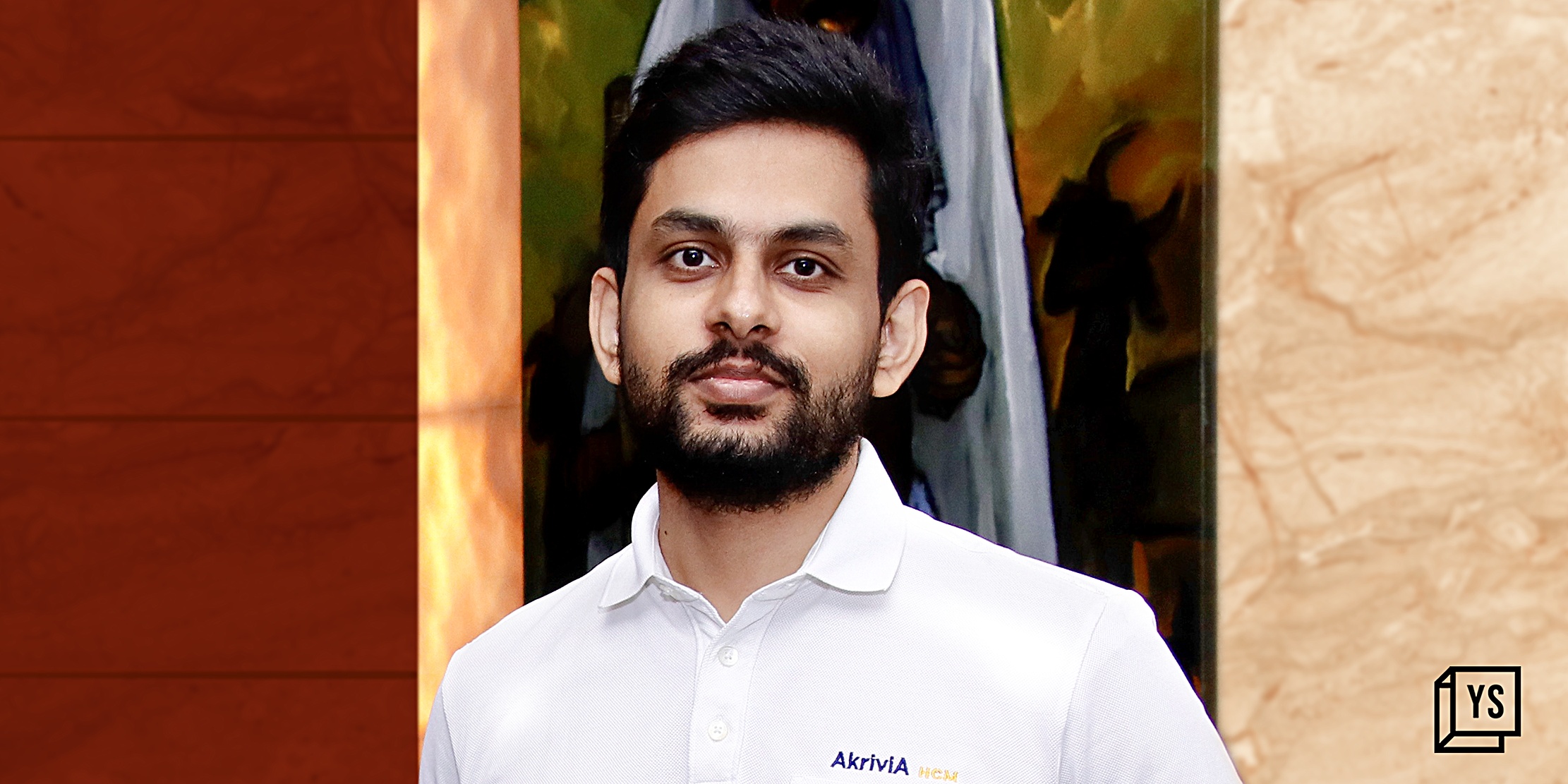
Rahul Varma Kalidindi’s business began with machines. In 2016, he co-founded Akrivia Automation with his father, Raghu Kalidindi. The early work involved custom industrial projects; manufacturing analytics emerged as a product opportunity. Before the employee record, there was the factory floor. It is a useful beginning for someone now occupied with the mechanics of working life.
The route there passed through two engineering institutions. He studied mechanical engineering at Raghu Engineering College and went on to a master’s degree at UC Berkeley’s College of Engineering in 2015-16. His undergraduate years were 2009-13. This is an engineering education in the literal sense: machines, systems and the business of making things function.
- 2009-13Raghu Engineering College
- 2015-16UC Berkeley
- 2016Return to India
After returning to India in 2016, he helped establish infrastructure for advanced laboratories at the educational institutions associated with his family. His college biography describes an interest in practical competencies and the distance between academic preparation and industrial work. The laboratories give that interest a physical address. An idea about better preparation becomes considerably more useful when a student can try something with their hands.
A separate piece of engineering work appears in India’s patent application journal. An application published in October 2020 names Rahul as applicant and inventor for an automated self-precision validation accelerometer and a system for machine diagnosis. The distinction matters: a published application records a proposed invention, rather than establishing that a patent was granted. It is also a specific trace of his work with industrial technology. Long before a discussion of employee engagement needs an elegant phrase, a machine presents the engineer with a rather less negotiable demand: measure what is happening, and make the measurement useful.
His career has continued to run along those two tracks: building software for enterprises and supporting the education of people who might one day build such software. Neither activity guarantees the success of the other. Together, though, they explain why learning and work recur in his public conversations. A qualification gets a person through one door; the next problem is usually waiting inside.
A factory floor, then an office full of forms
For a founder moving from industrial automation into human capital management, the vocabulary changes rather dramatically. Machines give way to managers. Production data gives way to employee records. The familiar challenge is the sequence: something needs to happen, information has to travel, and a person is left waiting when the connection fails.
By September 2019, Rahul was discussing AI and employee engagement on a People Matters panel. Fellow panellists included PhonePe’s Manmeet Sandhu, GE South Asia’s Sheebu David and UpsideLMS founder Amit Gautam; Seema Arora Nambiar of McDonald’s India chaired the conversation. The topic was how automation could improve the experience of people inside an organisation.
That early appearance matters because it places his interest in workplace AI well before today’s enthusiasm for autonomous agents. A stage appearance is a modest fact, but a dated one. It gives the story a little ballast. Rahul was already participating in a discussion about how employees encounter technology, alongside people responsible for making large organisations work.
His preferred canvas became the employee lifecycle. Recruitment, onboarding, development, pay and departure are separate departments of the same human story. Software vendors call this “hire to retire”, a phrase with the tidy confidence of a filing cabinet. The actual journey is untidier. A new starter wants clarity; an experienced colleague wants a chance to learn; a departing employee wants the paperwork finished.
The small indignities of enterprise software
In a March 2022 discussion, Rahul described an HCM platform spanning more than 20 modules. He also emphasised something less glamorous than the number: customers should be able to maintain their own HR systems with limited help from the vendor. Configuration and a usable knowledge base were part of the proposition. Buying software should not require acquiring a permanent dependency along with it.
“Very easy to configure settings” was how he described one area of focus. That is an unshowy ambition. It asks a product to behave sensibly when the salesperson has left the room. There is a particular courtesy in allowing the customer to make an ordinary change without convening an extraordinary meeting.
The product testCan a team make an ordinary change without an extraordinary meeting?
An editorial question prompted by Rahul’s focus on configuration
The same practical scale appears in the examples he gave in December 2023: recruitment updates sent to candidates, document submission before a new employee arrives, and self-service for leave and expenses. Each is a small encounter with an employer. Collectively, such encounters decide whether the organisation feels prepared or perpetually surprised by its own employees.
There is wit, if an accidental kind, in the size of the problem. Enterprise software can promise to transform an organisation while a colleague is still trying to discover who approves a request. Rahul’s examples bring the discussion back to those moments. A useful product has to survive the ordinary working day, with its missing documents, unanswered messages and perfectly reasonable impatience.
A global product needs a local introduction
Expansion brought another sort of engineering problem: trust. In February 2023, Rahul was pursuing markets in the Gulf and Southeast Asia through local channel partners. Akrivia had signed four in the Gulf Cooperation Council markets and three in Southeast Asia. He argued that unfamiliar businesses were harder to win over without a local participant.
The detail punctures the fantasy that a cloud product floats above geography. A sales conversation still takes place somewhere. Buyers have familiar practices, particular requirements and people whose judgement they trust. A product can travel over the internet in an instant; a reputation usually prefers a slower form of transport.
At the same time, Rahul discussed an intention to seek at least $30 million in Series A funding, with profitability as a planned precursor. His stated preference was “less dilution with more control”. Those were ambitions expressed in 2023. They show how he framed the trade-off between money and decision-making at that point, rather than establish that a funding round subsequently closed.
The work of implementation also has names attached. Akrivia’s announcement that B4U Network had gone live with its HRMS thanked Rahul and Nikhil Bhat Inanjai for guiding the project, alongside a wider delivery team and B4U colleagues. It is a useful glimpse of the founder’s role beyond the strategy conversation. Somewhere between a contract and a functioning system, individual people have to do the work.
Learning belongs inside the working day
In April 2022, Rahul identified workforce planning, skill gaps and continuous learning as connected problems. He argued that people analytics could help organisations understand both the composition of their workforce and its learning needs. The appeal was practical: training could be aligned with what people and the organisation actually needed next.
That position has a natural connection to his educational work. A college teaches people before their first substantial job; workplace learning has to reach them while the job is changing. Treating the two as separate worlds leaves an awkward interval in which a person is expected to acquire new abilities by administrative magic.
His February 2023 advice to HR leaders included investment in the skills of their own teams. New technology and data analytics, he said, required upskilling and reskilling. This is a pleasingly inconvenient point for a software business to acknowledge. A purchase order cannot do the learning on the customer’s behalf. The people who use a system still need the confidence and judgement to make it useful.
On 26 August 2023, Rahul was listed as an industry member at Raghu Engineering College’s academic council meeting. That is a more prosaic setting than a conference stage, and perhaps a more revealing one. Curriculum, institutions and business have to meet in actual rooms, or their virtual equivalents. The connection becomes meaningful through participation rather than through a slogan about the future.
The next generation gets 24 hours
In October 2025, the connection took the form of Hackverse 1.0 at Raghu Engineering College. The college credited Rahul, identified as its vice-chairman and Akrivia HCM’s CEO, with title sponsorship and support. The event brought together 120 teams and roughly 550 participants for a 24-hour hackathon.
The participants worked on ideas across finance, education, AI and sustainability. Mentors helped them refine prototypes; judges considered innovation, feasibility and societal impact. These are students getting a compressed introduction to a founder’s predicament: an idea is delightful company until someone asks whether it works. Twenty-four hours is a brisk way to make that introduction.
It also gives his interest in practical education a recent, concrete expression. Supporting an event does not make the sponsor the author of the students’ achievements. It creates time, space and an occasion for the students to attempt something. That distinction gives the episode its value. The young engineers get to be the protagonists of their own projects.
Akrivia’s current public direction extends into agentic AI, with a stated ambition to connect payroll, people analytics and HR functions in a unified platform. It remains an ambition to be judged through the experience of using the product. The most persuasive test is close to the one Rahul’s earlier examples invite: can somebody finish a necessary task with less friction?
There is a consistent interest running from laboratories to employee systems to student prototypes: helping people get on with work. The settings vary, and the problems resist being made tidy. A machine needs useful data. An HR team needs usable software. A student needs a chance to build. Rahul’s story is most interesting at that practical scale, where a large idea must learn some manners and make itself helpful.