Before Stax had a global footprint, Rafi Musher had a kitchen and two roommates. The business began in Boston's South End, migrated to a sunroom in Brookline, and then occupied the basement of a two-family house in Somerville. There, through a long Massachusetts winter, its founder worked alone. The early corporate real estate portfolio was also his domestic life.
A friend, Aaron, passed along some advice: establish a routine. Leave the house for coffee, then come back to work. Musher's version involved the Japonaise Bakery in Brookline and baguettes. Eventually, when the basement and the business demanded more time, he substituted a getting-dressed-and-making-breakfast ritual. A company needed an opening time, even when its proprietor had never left home.
The detail is useful because Musher's career can otherwise disappear into the language of transactions. He founded Stax in 1994 and built a consulting business around questions that investors needed answered before committing money. Alongside it, he developed another set of questions: how do you put people, research and capital to work on problems that a successful company alone cannot solve?
A business built for the impatient
Stax began its private equity practice in 1996. Its work put Musher beside executives and investors weighing acquisitions, expansion, competitive threats and eventual sales. He had studied communications and advertising at Boston University, earning a bachelor of science. His professional terrain became the less glamorous, consequential space between a persuasive business story and the evidence that might support it.
For a buyer, that distinction matters. A company can be growing while its market is shrinking. Customers can like a product while preparing to buy something else. A promising expansion plan can encounter a different competitor in every city. Commercial due diligence means investigating those possibilities before an investment committee falls in love with the presentation.
Paul Edwards, a longtime Stax leader, later described the appeal of the early firm: intellectually curious colleagues, demanding clients and a willingness to compete against bigger consulting names. The business offered room to help shape the organization while doing the work. Musher's proposition required people who enjoyed both kinds of uncertainty.
That helps explain the firm's character. A smaller consultancy could make a virtue of focus, assembling research around a particular decision rather than asking a client to accommodate a vast institution. The clock belonged to the deal. The job was to make the available time produce better understanding.
Breakfast with a seven-language head start
Long before investment committees, there was breakfast with his grandfather Harry Torczyner. They ate soft-boiled eggs while Harry read newspapers, sometimes several. An international lawyer who spoke seven languages, he had fled Belgium as Nazi bombing began and earned a second law degree in the United States. Young Rafi could see the arithmetic: his grandfather had 57 more years of reading behind him.
How was anyone supposed to catch up?
Musher returned to that memory in his 2016 essay Harry and Me. It gave him a way to examine a change in business authority. Experience supplied patterns, relationships and judgment; growing access to information gave younger teams a way to contribute knowledge that even a seasoned executive might lack.
He described one engagement in which a director and three specialized research teams assessed a company's position and its proposed entry into seven markets within two weeks. The team could support an experienced leader with fresh evidence. The breakfast table had become an organizational question: how do you combine what people have learned over decades with what a team can discover now?
The office had a motorcycle
By 2013, Musher's office contained a red Moto Guzzi, one of three motorcycles in his collection at the time. A consulting office is generally designed to reassure visitors that nothing unpredictable will happen. An Italian motorcycle introduces a useful degree of doubt.
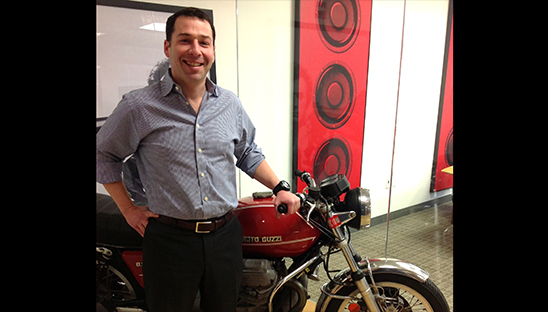
The same period found him building Stax Dev Corp, which he started in 2011 to incubate social ventures. He wanted a way to pursue social outcomes beyond the limits of his personal donations. A business model, if it worked, could bring its own resources to the task.
His family had supplied plenty of examples of giving. His paternal grandfather volunteered as chairman of PEF Israel Endowment Funds for more than two decades. His maternal grandparents supported education, the arts and Jewish causes. As a child, Musher spent summers in Israel; his mother ran the Israeli Consulate's speakers bureau for 25 years, and he and his brother helped stuff envelopes on days off. Public engagement came with actual envelopes attached.
When the answer requires a plane ticket
In 2011, Musher also co-founded the organization now known as itrek. Its premise was unusually literal: people who wanted to understand Israel could go there with peers and encounter it firsthand. Business contacts had expressed interest in visiting if they had someone suitable to go with. The organization gave that interest a structure.
It developed peer-led trips for emerging leaders, including graduate students in business, law and policy. The social mechanism mattered as much as the itinerary. Participants could explore a place and discuss its complexities with people they already knew, carrying those conversations back into their professional lives.
Those figures describe an organization built with colleagues, staff, donors and trip leaders. They also show how far the original invitation traveled. An idea prompted by conversations with interested acquaintances became a repeatable program.
In March 2025, itrek announced Jim Hirshorn as board co-chair alongside Musher, with a transition planned toward Hirshorn becoming chairman and Musher remaining on the board. The organization had expanded to three programs, including REALITY, absorbed from Schusterman Family Philanthropies in 2024. The founder was making room for another leader in an institution he had helped establish.
The inconvenient expense of doing good
Family lessons can produce loyalty. They can also produce an argument with the family arithmetic. In a 2019 essay about nonprofit overhead, Musher recalled his grandfather's aim of keeping PEF's overhead at 1.5%. He admired the example while questioning whether that number could reasonably guide other organizations.
A charity without a well-connected board may need to spend more to raise money. A program requires people who can administer it. Restricted gifts can leave the less photogenic parts of an institution struggling. Musher urged funders to understand real operating costs and support the resources behind the work.
There is a consulting habit here: examine the underlying economics before treating a tidy percentage as a verdict. An organization can look efficient on paper while lacking the staff or analysis to improve. He argued that volunteers could contribute analytical skills, and that foundations could help grantees understand their own costs.
It is an unfashionably practical form of generosity. The invitation extends beyond a checkbook to the sort of work that produces fewer ceremonial photographs: reviewing a budget, finding expertise, asking whether a different revenue model would make a useful program sustainable.
“Don't keep that gift in the closet. Use it.”
Rafi Musher, on the opportunity to help others, 2024
Learning to hand over the keys
By the 2021 recapitalization with Blue Point Capital Partners, Stax employed approximately 230 people across Boston, Chicago, New York and Colombo. The company sought an investment partner able to contribute operating capabilities as well as capital. For a business advising investors, selecting its own investor made the theory rather personal.
In October 2022, Musher became chairman as Jayson Traxler became president. Musher described Traxler as someone he had known for close to a decade and worked with intensely over the preceding year. He emphasized the importance of building a firm that served employees and clients together. Succession had a relationship behind it.
A further milestone arrived in September 2025, when Grant Thornton Advisors completed its acquisition of Stax. Around 300 Stax team members joined the wider platform. Musher publicly thanked colleagues, early friends-and-family investors, Blue Point and the acquiring team. His account spread the credit across the people who had built the firm over three decades.
The transaction belongs in his story as an institutional milestone. So does the earlier decision to step away from the CEO role. Founding creates a particular kind of attachment; developing successors asks a founder to put the institution's next chapter into other hands.
Still following the money
Musher's work now includes a venture partner role at RE Angels, where he is listed as its strategy expert. The fund concentrates on early real estate technology businesses. His public interests also extend to climate, energy, agriculture and the practical infrastructure that helps social organizations function.
In May 2026, he and Eylam Leshem published an argument about the funding of Israel's democratic institutions. Drawing on Leshem's mapping of the sector, they called attention to the smaller organizations working on civic education, policy and structural reform. Their concern was the allocation of resources behind an intensely discussed issue.
An October 21, 2026 Jewish Funders Network program listed Musher as moderator of a discussion on those structural questions, alongside Leshem and Israel Strategic Futures Institute co-founder Daniela Kandel. The description promised participants a closer look at organizations and data that could inform their giving.
That is a recognizable continuation of his working life. Begin with a question. Find people who know something. Examine how the resources move. Then decide where to be useful. The kitchen, the research team, the motorcycle and the nonprofit board belong to one career, with plenty of work still on the calendar.