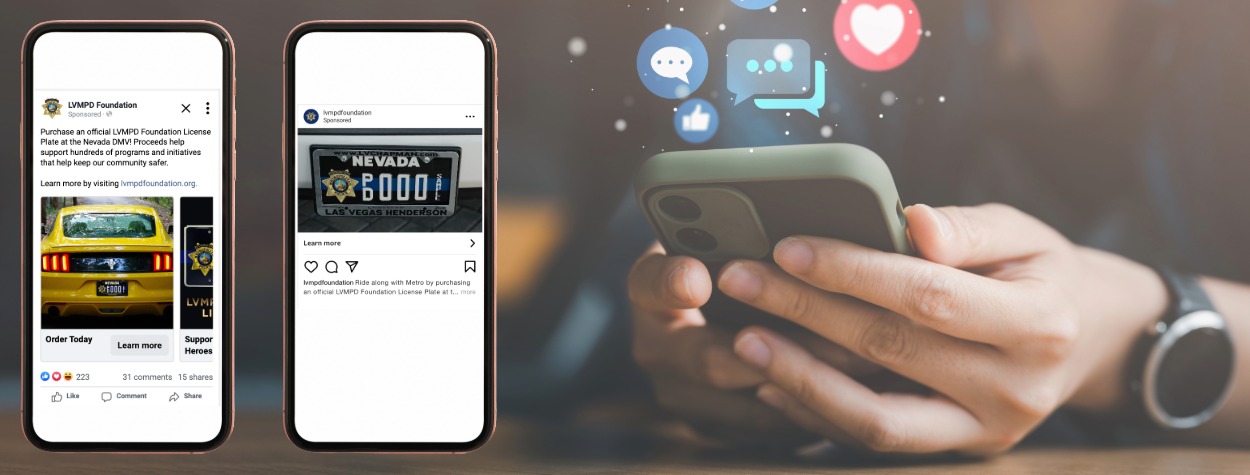
The cleverest fact in Quillin’s portfolio is not about a celebrity, a television spot or a stunt on the Las Vegas Strip. It is about a circle. The circle had a radius of one mile, and Quillin drew it around Southern Nevada DMV offices. Anyone inside could be shown an ad for an LVMPD Foundation specialty license plate. The audience was not merely interested in cars. It was standing near the counter where a plate becomes a decision.
This is a neat way to understand Quillin Advertising, Public Relations and Social Media. The Las Vegas agency can do the large, loud things its hometown teaches particularly well. It once fabricated a 10-foot Raising Cane’s cup for a Raiders partnership announcement. For a Taco Bell Cantina party, it arranged showgirls, ice sculptures, celebrity impersonators and models with video screens worn like lampshades. Yet its best evidence is more disciplined. It makes the setting do part of the selling.
The DMV campaign ran in phases for 11 months. Quillin mixed interest-based audiences, website retargeting and those one-mile geofences. According to the agency’s case study, the work delivered more than 23,600 landing-page clicks and 2.4 million impressions. The foundation’s original goal was 3,000 plates on the road. It passed 7,000.
Close enough to catch a customer when the advertised action is already on the afternoon’s agenda.
A full-service agency with a local operating system
Tim and Sharry Quillin opened Q ad | pr in 2003. This was a second act for Tim, who had built and sold an earlier full-service agency after a career that included television work in Century City and political communications in Nevada. In 2020, the couple renamed the evolving operation Quillin. The business now presents one front door for creative campaigns, public relations, social media, digital advertising, media planning and buying, websites, video, photography and events.
That breadth can sound like the standard agency buffet until you look at the assignments. A business bank needed search visibility and a poker-specific acquisition campaign. An opera company needed help using its Google Ad Grant. A law firm wanted its founder’s expertise to feel native to Instagram. Resorts and restaurants needed launches, television, events and social conversation. The customer is usually an organization with a real-world reputation and too many channels to coordinate alone.
“We rethink everything we thought we knew - on every project.”Quillin’s stated approach
Its business model is conventional and private: clients pay for strategy and execution, sometimes across several disciplines. Pricing is not published. Neither are campaign budgets in the agency’s case studies. That absence matters. Results such as clicks, impressions and registrations show what happened, but not whether another buyer could purchase the same efficiency. The copyable part is therefore the method, not a promised return.
When the budget vanished first
The most revealing failure in the portfolio was imposed from outside. When COVID-19 closed Mesquite Gaming’s resort properties, paid social campaigns were paused. The attractions that normally filled a content calendar - gambling, dining, concerts and events - disappeared at the same time. A resort account without a resort or a media budget is an unusually clean test of whether an agency understands the audience beyond the offer.
Quillin changed the subject. Instead of urging people to visit a closed property, it posted about nearby trails, city and national parks. It pulled out nostalgic memories of earlier trips and events. It tried puzzles, bingo, reviews and complete-the-sentence prompts. The point shifted from transaction to conversation, with loyal Mesquite customers supplying some of the energy.
Those results covered Facebook, Twitter and Instagram from March 17 through June 30, 2020. They do not prove every nostalgic puzzle will work. Mesquite had a loyal regional following before the shutdown. A new brand with no stored affection could copy the posts and hear nothing back. The useful move was recognizing what remained after the obvious content and paid distribution had gone away: place, memory and an audience that still wanted to talk.
The fortnight when poker players become a market
For Lexicon Bank’s Professional Poker Banking program, Quillin again narrowed the frame. The bank sponsored the World Series of Poker and had access to professional player Daniel Negreanu. Quillin ran Meta ads geofenced around the Horseshoe Las Vegas during the tournament’s first two weeks, when attendance was highest, and supported them with organic posts across Meta, X and LinkedIn. Google and YouTube ads joined the mix.
The paid ads generated more than 4,100 landing-page clicks, 136,365 impressions and 52,929 engagements. Organic social added more than 76,000 impressions. The campaign produced at least 55 website sign-ups, excluding people routed to a dedicated email address. The numbers are modest enough to feel like a real niche and precise enough to explain the bet: professional poker players have unusual banking needs, gather in one building and pay attention to one of their own.
What another marketer can steal
Start with the moment immediately before action. A person at the DMV is closer to choosing a license plate than a broad “car enthusiast.” A poker player at the WSOP is closer to needing poker-friendly banking than a generic high-income audience. A longtime resort guest stuck at home is closer to reminiscing than booking. Quillin’s repeatable idea is to treat context as a form of creative.
Then make the measurement resemble the objective. The law-firm social account was judged by impressions and engagement. The license-plate effort had clicks and registrations. Lexicon’s SEO work tracked technical performance and placement in search and map results. These are not interchangeable wins. A viral event can fail to sell, and a quiet search fix can be commercially useful without ever becoming famous.
Finally, remember where the method loses power. Tight geofencing works when location predicts intent and the audience is large enough to reach. It is weak for rare buyers scattered across a country, private decisions with no geographic signal or products that require months of committee approval. Organic nostalgia works when a community already has memories to retrieve. A full-service agency is valuable when channels need coordination; it can be unnecessary overhead when the problem is a single landing page or one specialist hire.
Quillin sits in the middle of the Las Vegas agency market: smaller and more locally concentrated than a national network, broader than a boutique devoted to one channel. Its competitive advantage is not secret software or venture financing. It is accumulated familiarity with how this city buys, gathers, celebrates and pays attention. In Las Vegas, everyone knows how to make something bigger. Quillin’s more transferable lesson is knowing exactly when to make the circle smaller.