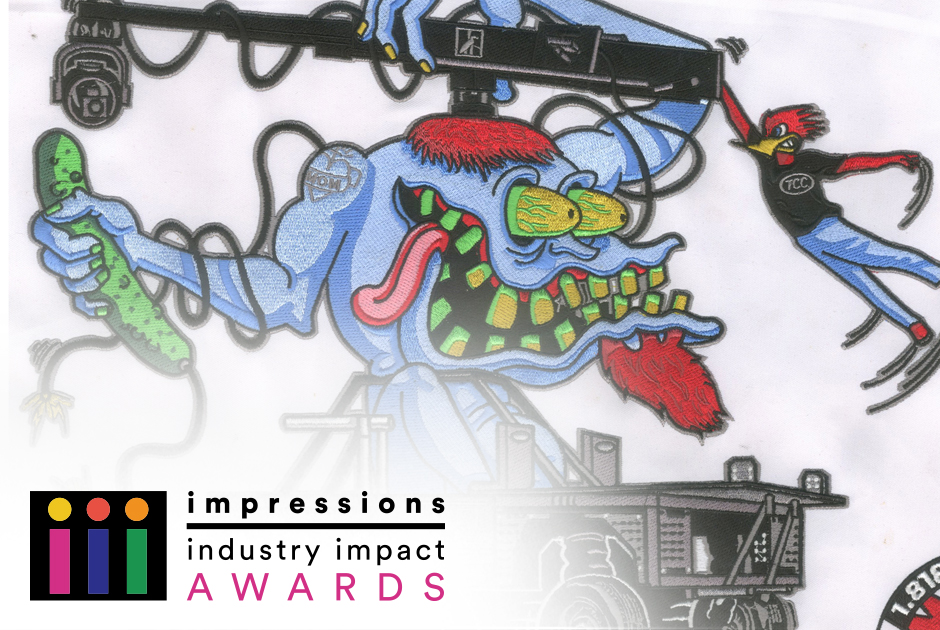
A monster with a spectacular dental problem makes an unlikely business card. For Quality Punch, it works. The company’s “Monster Truck” embroidery won the 2025 Impressions Industry Impact Award for Embroidery Design of the Year. Sixteen inches across, the customer-inspired design needed 12 colors, 300,000 stitches and six hours of sewing. That is a considerable amount of needle time for something destined to make people grin.
The hard part was keeping the sprawling picture aligned. Ria Habib, speaking to Impressions, described the danger of individual elements slipping out of registration. With a design this elaborate, an error could spoil the effect after hours of work. The joke depends on an unusually serious set of instructions.
Those instructions are Quality Punch’s principal product. The Torrance, California, business converts artwork into embroidery files and prepares vector graphics for printing. Behind an ordinary embroidered logo sits a series of decisions about how a machine should reproduce it. The company sells those decisions to people whose customers expect the finished garment to look right.
A file with a job to do
Quality Punch occupies the production end of graphic design. Its customers include embroidery businesses, screen printers and apparel decorators: companies handling the space between a client’s artwork and a physical order. Someone may arrive with a logo that looks perfectly respectable on a laptop. Putting that logo on fabric introduces a different set of demands.
The company says its embroidery designs are manually digitized, with designers who come from production backgrounds. It also converts low-resolution raster images into line art and supplies formats including EPS, AI, PSD and CDR. These are two related services with different destinations. One prepares the movements of an embroidery machine; the other prepares artwork for a print or design workflow.
That distinction is useful when buying. A business ordering embroidered caps needs to describe the cap and its intended design placement. A screen printer requesting separated colors has a different brief. Sending “the logo” leaves too much unsaid. Quality Punch’s value lies in handling that unfinished conversation between the original picture and the process that will reproduce it.
Its market position is a specialist service bureau. Customers can commission the work externally instead of assigning every file to an internal digitizer. Other options include independent specialists and established digitizing shops such as Florida-based Quality Punching, a separate business that describes operating since 1987. Manual expertise alone is therefore no monopoly. Quality Punch’s more persuasive evidence is its portfolio of completed work.
- 01 / INPUTThe pictureArtwork + intended use
- 02 / DECISIONSThe instructionsSize + material + stitch plan
- 03 / PROOFThe sew-outCheck the physical result
The photograph was too heavy
An older problem helps explain the company’s approach. In a July 2010 Stitches profile, head digitizer AJ Ahmed described the difficulty of reproducing photographs in embroidery. The resulting stitches became too dense to be friendly to production. Adding thread did not automatically make the picture more convincing.
“The stitches got very dense and weren’t too production-friendly.”
AJ Ahmed / Stitches, July 2010
The team developed what it called picture digitizing. Quality Punch describes using the fabric as the background and applying stitches in a drawing-like manner. It is an exercise in deciding where thread can be omitted while the image still reads. The company advertises lighter stitch files and a more lifelike result.
The technique has conditions. Its picture-digitizing page prefers a white base, asks customers to specify other background colors, recommends at least four inches for good results and requests clear, high-resolution artwork. It lists a three-day turnaround. A tiny portrait on a dark cap is a different proposition from a larger picture on pale cloth; the brief needs to acknowledge that before the order starts.
The useful lesson extends beyond embroidery: an input file is not a production plan. A photograph records what a camera saw. A digitizer must decide which of those details the material can carry, and which details will only add weight.
Four days before the needle moved
For a leather jacket described in Stitches in August 2014, that planning became a substantial project. Co-owner Karen Habe recalled an intricate customer design that had to retain its details while remaining suitable for a machine. The leather was expensive. This was an uncomfortable place to discover a bad assumption.
Digitizers AJ Ahmed and Habib Noor used Wilcom and Embird software and spent four days preparing the design. Sewing then took six hours, using 16 thread colors. The work involved balancing density, supporting stitches, color changes and trim stops for the leather substrate.
This example exposes a cost that a simple price list cannot convey: preparation time. The machine’s six-hour performance followed days of skilled labor. For a decorator, the sensible question is whether the setup suits the garment and the customer’s expectations. A cheap file that requires another round of production has not necessarily saved anything.
The business has competition results to accompany those anecdotes. Its “Soldier” entry took the overall Grand Champion award in the 2013 Impressions competition. In 2019, “Paws” won embroidered stock designs, “White Tiger” placed second in multimedia, and “Valentine” placed third in creative use of an embroidered logo or mascot. The variety matters: the portfolio covers more than one style of stitching.
The bear that made texture a business decision
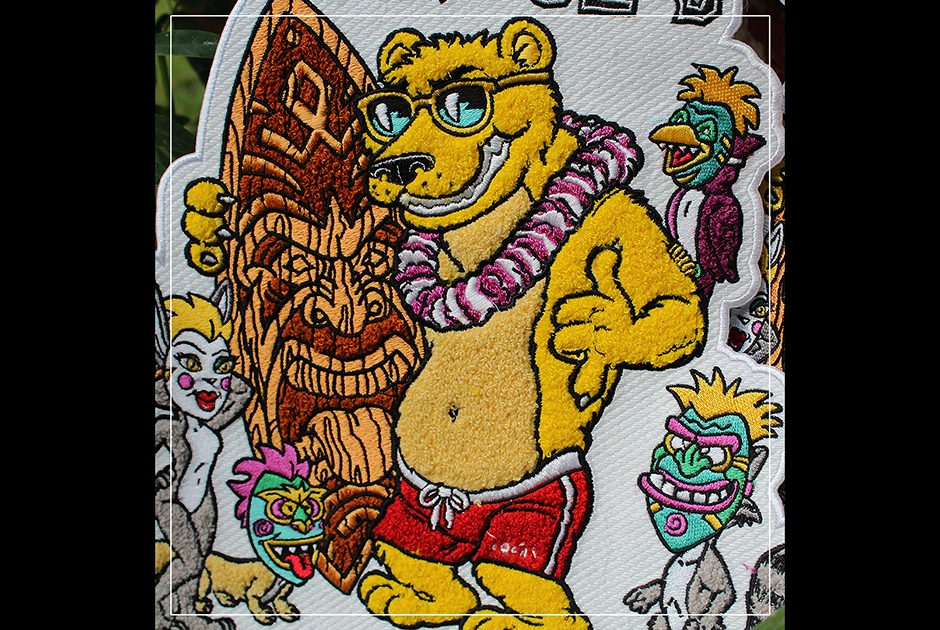
Then there is “Tiki Bear,” a patch with holiday plans. Featured by Impressions in June 2022, it combined six chenille colors with eight regular thread colors and contained 165,000 stitches. The important choice was which areas should be fluffy and which should be comparatively smooth.
Ria Habib, identified in that coverage as a co-owner, explained that large areas lent themselves to chenille; small ones presented difficulties. The bear, its garland and its surfboard combined the two treatments. The team had spent the preceding year researching chenille, work Habib said helped improve customer designs.
This was material research with consequences. Habib described the risks of thread jams, snagging, unraveling and inconsistent fluff. A visual effect that looks charming in a sample still has to behave when it is made. The resulting patch offers buyers an unusually clear demonstration of the choices behind the texture.
A different experiment, “Paws,” aimed to show customers that patches could belong on cushions as well as T-shirts. In 2021, Habe described testing roughly eight to 10 embroidered paws before choosing a combination. Each paw had about 22,000 stitches and five colors. Light densities helped create the animal imagery without losing the softer effect.
There is a practical sales idea here: demonstrate a new use on the actual object. A cushion makes the proposition tangible. Customers can see where embroidery might fit in their own product range without having to imagine the whole thing from a file preview.
What the first file costs
The core business model is paid work by design. Quality Punch’s digitizing page advertises $30 for left-chest and cap designs, $85 for midsize work measuring four to seven inches, and $150 for jacket backs. Complexity can change the quote. Its entry offer covers a first design worth up to $30 without requiring a credit card.
Vector work has its own ladder: simple artwork is listed at $15, complicated artwork at $30, and advanced work at $45 or more, subject to quotation. Custom templates, mock-ups and groups of sponsor logos are quoted separately. The page also lists color separations for its own vectors at $10-$30, and raster color separations at $10 per color.
These are advertised design-service prices, not the price of finished shirts or a production run. The distinction matters when comparing quotes. A decorator needs to budget for the garment, decoration and other production costs separately.
Buyers should get the job price confirmed. A legacy terms page still describes stitch-count billing, while the picture-digitizing page carries two different sets of prices. The service pages are useful for estimating the order of magnitude; a written quote is the better basis for committing a customer’s job.
The trial offer makes commercial sense for a service whose result needs inspection. It lets a prospective buyer submit a real brief and evaluate the output before settling into repeat orders. The sensible test is a representative design on the intended material, with the same level of scrutiny the buyer would apply to a paying customer’s work.
Design preparation only. Complexity can change the quote.
The sew-out earns the repeat order
Quality Punch says orders are machine-tested and accompanied by an image of the actual sew-out on the required fabric. It advertises next-day standard digitizing, customer support around the clock on five days of the week, and specific digitizers assigned to regular accounts. Those are operational promises worth discussing when setting up a recurring relationship.
The buyer’s part is to supply a usable brief: final size, fabric and background color, placement, deadline and required file format. For an unusual technique, establish the production requirements before approving artwork. A sample photograph can help assess appearance, but the customer’s own equipment and material remain part of the finished result.
The wider commercial offering includes Quality Patches, which is linked from the digitizing site and identifies Quality Punch Inc. in its privacy notice. Its catalog includes embroidered, chenille, woven and other patches, alongside products such as pins and socks. That gives the business a route into physical merchandise as well as digital preparation.
For the customer, the choice is straightforward: commission production artwork or ask about a finished product. Keep the deliverable explicit. A patch order and an embroidery file solve different parts of the same commercial problem.
The monster gets the attention. The repeat business has to come from less theatrical achievements: an appropriate file, a clear quote and a design that makes sense on the material. Quality Punch’s most useful pitch is visible in that gap between the original picture and the stitched result. The needle is where the promise gets tested.
Follow the thread
Explore the work, compare services and keep up with the company.