Being good at everything sounds like an excellent qualification for running a business. Qasim Habib has a practical objection: eventually, everything has to wait for you. The reward for competence can become a queue outside your own door.
In a July 2026 conversation about entrepreneurship, the Quality Punch founder considered the cost of doing every job yourself. He began by acknowledging what founders bring: drive, motivation and an unusually personal attachment to the work. Those qualities make it tempting to keep taking tasks back. They can also leave a company unable to grow beyond the person who started it.
It is a useful place to begin with Habib, whose business turns pictures into instructions for embroidery machines and supplies customized products. The finished object may be a logo on a cap. Getting it there requires people who understand things a customer rarely needs to think about: fabric, stitch density, registration and production files.
There is a small comedy in this arrangement. The customer wants something that looks effortless. An entire operation must concern itself with the effort. Habib’s story sits between those two expectations, where a founder has to make skilled work repeatable without personally performing every part of it.
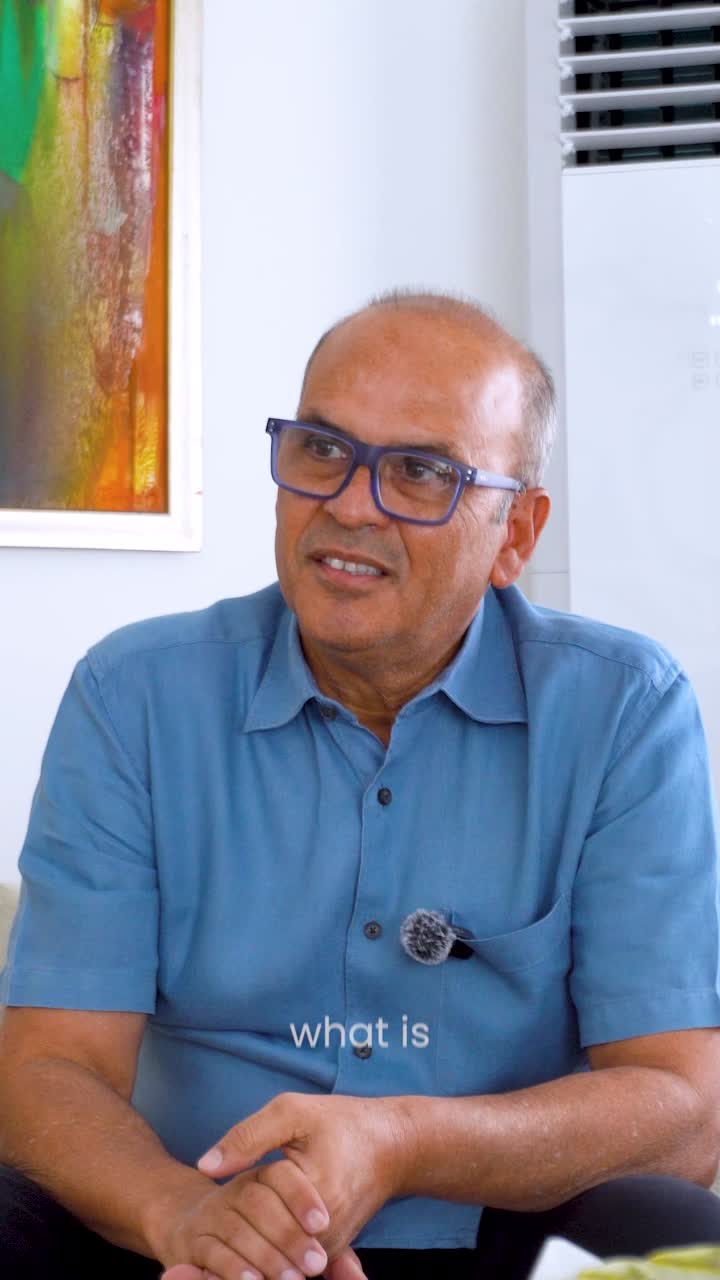 WATCH THE CONVERSATION ↗
An earlier lesson in keeping quiet
Years before that discussion of delegation, Habib described another occasion when other people’s experience mattered. In December 2011, he wrote that Quality Punch had suffered a data theft, which he attributed to former employees. The company addressed the security gaps and pursued legal action. Facing an unfamiliar process, he brought the problem to his Entrepreneurs’ Organization Forum.
The group followed Gestalt Language Protocol: members recounted their own experiences rather than prescribing his next move. Habib valued the format because it made room for quieter participants and kept the discussion from becoming a contest between competing recommendations. He wrote that the exchange helped him move toward a successful resolution.
That account offers a revealing distinction between obtaining help and surrendering a decision. Habib wanted the benefit of what others had learned while retaining responsibility for his response. A room full of entrepreneurs could contribute without each needing to become the temporary chief executive.
His gratitude was directed toward a setting where he could explain a difficult situation openly. Read alongside his later comments about delegation, the episode suggests a consistent practical interest: arranging work and conversation so that other people’s knowledge can actually reach the person who needs it.
- 01Bring the problem
- 02Hear lived experience
- 03Make your decision
Before the embroidery file
Habib’s working life also includes a trading business. Before Quality Punch, he served as chief executive of Sun West Trading, Inc., developing operations in the United States. His textile work involved bringing knitted fabrics and garments into sportswear and promotional apparel markets. The connection to his later business is tangible: both deal with the commercial life of clothing.
He earned an MBA at the Institute of Business Administration, University of Karachi, specializing in finance and marketing. That combination makes a fitting background for a business in which creative work must arrive as a usable commercial service. A beautiful sample and a functioning operation have to coexist.
He has served as Quality Punch’s CEO since 2007 and also sits on the Karam Ceramics board as an independent director. His supplier and production network in Pakistan includes more than 800 professionals working exclusively on company projects. That figure describes the network; it should be read on those terms, rather than as a count of employees at one office.
The business serves customers in the United States and Europe. Seen together, those details place Habib in a familiar but demanding kind of entrepreneurship: coordinating expertise across countries while keeping the result straightforward for the buyer. Distance can disappear from the customer’s experience only when somebody has done the organizing.
A cap has opinions
The business itself explains why specialists matter. An embroidery machine needs instructions suited to the object it will stitch. A cap brings a curved surface and a center seam. Small lettering brings a different problem: keeping characters legible when the medium is thread. Neither concern is solved by admiring the original artwork harder.
Quality Punch describes machine-testing designs and supplying customers with an image of the sew-out on the required fabric. For regular customers, it assigns particular digitizers to an account, acknowledging that individuals have different strengths. Consistency is treated as something to organize, rather than something to demand and hope for.
The company also describes running two or three sew-outs for small text. That modest detail says a good deal about the work. A digital preview may appear finished while the production problem remains unsettled. The useful judgment comes from seeing what the material actually does.
For a founder, this creates an interesting management problem. Customers buy a dependable outcome; the route to that outcome depends on individual expertise. Assigning the right person and allowing room for testing becomes part of the product. The file may be delivered electronically, but the reasoning behind it is thoroughly physical.
The monster and the people behind it
One conspicuous result arrived in 2025. Quality Punch’s “Monster Truck” won Embroidery Design of the Year in the Impressions Industry Impact Awards. The customer-inspired design measured 16 inches across, used 12 colors and required 300,000 stitches. Sewing took six hours.
Ria Habib described keeping the large design in registration as a particular challenge. At that scale, the separate elements had to line up across an elaborate stitched picture. The cheerful result concealed a fairly unforgiving production exercise. A monster can be ridiculous; its stitch plan has to behave.
The award belongs to the company’s work, and the technical explanation comes from Ria. Keeping that distinction visible makes Qasim’s role more interesting. A founder building an organization of specialists succeeds partly by creating the conditions in which someone else’s expertise can be seen.
The design is also a useful corrective to an abstract discussion of scale. Here is a physical outcome: colors, thread and hours of machine time. A larger organization still has to produce something that holds together at the smallest level. Growing the operation does not make the needle any more forgiving.
One design. Many opportunities to get a detail right.
The quieter machinery
There is another system behind the stitching. Quality Punch’s order-taking operation includes a dozen web applications accepting orders worldwide. The project prepared Amazon Web Services infrastructure for application migrations, using two Availability Zones and a separate account for administration and intrusion detection.
The configuration was deployed through code, providing an auditable record and reducing opportunities for manual setup mistakes. Those details belong to the technical team. Habib’s own description of the relationship is a brief testimonial: “I call Qalius my Canada Pros”. He praises their ability to anticipate questions he has yet to ask.
The nickname gives the technical partnership a human touch. Behind the architecture diagram is a client who values being understood before he has assembled the perfect brief. That is a recognizable desire for someone running a business with many moving parts.
It also echoes the earlier Forum episode without making the two events the same story. In one, fellow entrepreneurs supplied experience. In the other, a technology partner supplied expertise. Both illustrate the usefulness of building relationships in which the founder can ask for help and still remain accountable for the result.
“I call Qalius my Canada Pros”
Qasim Habib · Qalius customer testimonial
A company with room for other people
The July 2026 interview brings those strands together. Habib argues that founders need the right people in place if the business is to move to its next stage. His observation starts with respect for the founder’s ability. The problem emerges when that ability becomes the reason to keep doing every task personally.
That makes delegation a surprisingly difficult compliment to pay someone else. It requires believing that the work matters enough to entrust it to a specialist, then resisting the urge to reclaim it at every opportunity. The founder’s standards still matter. So does the capacity of others to exercise judgment.
This is an interpretation of the pattern in Habib’s public comments, rather than a claim to know how every day at Quality Punch unfolds. The details he has chosen to discuss point toward a practical question: how much can an organization learn, decide and deliver when its founder is occupied elsewhere?
For Habib, the question has particular weight in a business whose finished work depends on so many small decisions. The cap has its seam. The letters have their limits. The customer has a deadline. Someone has to understand each of them, and a company needs enough room for those people to do their jobs.
There is a discipline in choosing which problems deserve the founder’s attention. A difficult customer brief, a production question and a decision about the next stage of the company can all demand an answer. Treating them as equally dependent on the same person makes each harder to resolve. Habib’s argument leaves a founder with a demanding form of work: choosing people well enough to let their judgment count. A business organized that way gives its customers access to more knowledge than any single person could hold. That is a useful ambition for a company selling carefully considered instructions.
The pleasure of the finished embroidery is that none of this needs to be explained to the person wearing it. The logo simply belongs on the garment. Behind that ordinary success sits a less visible achievement for any founder: building a business in which good work can travel farther than one person’s attention.