Lucy is a useful person to remember in a story about Teo Vanyo. Long before he was selling businesses on virtual assistants, he was building blogs for customers and doing the work himself. In his telling, the week had room for roughly five to ten blogs. Then, in 2010, he hired Lucy. Deliveries became quicker. More orders followed. Within two months, he had hired her sister, then her brother. A business that had depended on one person’s available hours was acquiring a rather different shape.
Vanyo now runs Stealth Agents, a company built around finding and managing remote support for other businesses. His early experience gives the proposition a human scale. The first hire has a name. So do the people who followed her. Before staffing becomes a discussion of screening, supervision, or capacity, somebody has to hand over a piece of work they have grown accustomed to doing alone.
There is a small indignity in discovering that your business can function while somebody else does something you once considered your department. There is also the prospect of getting through lunch. Vanyo’s career has spent considerable time in that gap.
Two versions of the future
His account of wanting a business begins with a family comparison. An uncle who owned a company retired at 50. There was a house on a lake and winters spent somewhere tropical. His parents had another experience. Both lost their jobs in their 50s, after long periods with their employers. The contrast gave ownership a practical appeal: a chance to have more say over what happened next.
He has described those layoffs as arriving after 17 and 20 years of service. They were the sort of tenures that make a job feel like a permanent feature of the landscape. Having to begin again gave his ambition a sharper purpose than the usual wish to be his own boss.
Later, he said his parents had become shareholders in his company. He hoped it would help them retire comfortably. It is an unusually concrete answer to the question of why someone wants to build a business. The beneficiaries have already been chosen. The future he wanted to influence included theirs.
That family story gives his later enthusiasm for delegation an interesting tension. Business ownership offered him control over his future. Running a business would require him to trust other people with parts of it.
Selling the work behind the storefront
Vanyo’s working background is in online business. He has taught Shopify and Facebook advertising, and his public instructor profile still introduces him through those subjects. It places him in the practical world of products, traffic, and the mechanics of getting an online store to sell something. An ecommerce operation can look beautifully simple from the customer’s side. The machinery behind the purchase button tends to have more moving parts.
Teaching that machinery was part of his public career. A coach has to take something that works in one person’s hands and make it understandable to somebody else. That problem would follow him into staffing. Knowledge kept entirely inside the founder’s head has limited usefulness to a new colleague, however enthusiastic the welcome email.
His later career account describes a period of building Shopify stores at volume, followed by customers asking for access to virtual assistants. The work his own operation had learned to organize became something other businesses wanted help organizing too. The move into staffing had a customer question behind it.
By February 2021, he was appearing in an entrepreneur interview as CEO of Stealth Agents. The business gave him a new version of an old problem. Each client brought a different operation, different expectations, and different habits. A process that worked inside his own company had to become useful in someone else’s.
- 2010Vanyo recalls hiring Lucy to help build customer blogs.
- 2021Appears in an entrepreneur interview as Stealth Agents CEO.
- 2026A new public listing names him as Scoutly’s founder.
A manager needs somewhere to stand
Vanyo’s view of management leaves room for the manager. He has argued that employees need confidence in the person directly leading them, and that founders should allow those leaders to make decisions. It is a modest proposition with awkward consequences for anyone accustomed to being the answer to every question.
“You need to give managers space to make decisions and support their team.”Teo Vanyo
A manager whose decisions are constantly rerouted has a difficult job. Colleagues quickly learn which approval actually counts. Soon the founder is busy, the manager is bypassed, and everyone has an additional conversation to fit into the day. Vanyo’s advice puts responsibility on the person at the top to make the reporting relationship mean something.
He has made the same argument in his public writing about delegation: a team waiting for permission cannot contribute as much as a team allowed to act. In that view, keeping every decision close comes with an operating cost. The founder’s attention becomes a queue that the rest of the business has to join.
For someone selling remote support, this is a demanding message to give customers. Bringing in another person creates a relationship that needs instructions, feedback, and authority. The client has work to do as well. An assistant can help clear a calendar; explaining which commitments deserve a place on it requires the owner’s participation.
The surprisingly small first step
His advice for beginning is deliberately manageable. Document the work. Hand over one recurring task. Give the arrangement a little time before deciding whether it works. In a public post about routine administrative work, he recommends a two-week starting period. It is a much smaller assignment than asking a new hire to make the entire business more efficient by Friday.
The examples he names are familiar: sorting an inbox, entering data, maintaining spreadsheets, scheduling calls. None requires a stirring launch speech. Each requires some agreement about what a completed job looks like. The quiet achievement is reaching a point where it can be done again without another round of explanation.
His more recent training advice goes further. A finished task gives only part of the picture. Ask the person how they made their choices. What did they notice? Which instruction mattered? At what point did they stop and ask for help? Repeated mistakes may mean the rule needs to be clearer. Better choices may mean the person is ready for more responsibility.
“Ask what they saw. Ask which rule they used.”Teo Vanyo
That is a useful shift in emphasis for a founder who wants fewer interruptions. Someone who understands the reasoning behind a task can begin handling variations. Someone who has only memorized the steps may need the founder whenever the day departs from the script. And days have a well-established fondness for departing from scripts.
Books, ambition, and an owl
Vanyo’s interests extend beyond the next hiring decision. In a long conversation with James Xander in 2023, he discussed entrepreneurship, setbacks, mentorship, and the influence of business books. The reading list included Napoleon Hill’s Think and Grow Rich, Gary Keller’s The One Thing, and Eliyahu Goldratt’s The Goal. Ambition, concentration, and systems sit close together on that shelf.
The conversation also made room for balancing work and play, choosing the people around him, and meeting Arnold Schwarzenegger. These are interests and encounters, rather than entries on an organizational chart. They give a less office-bound view of someone whose business involves so much discussion of offices, even when the people in them are scattered across countries.
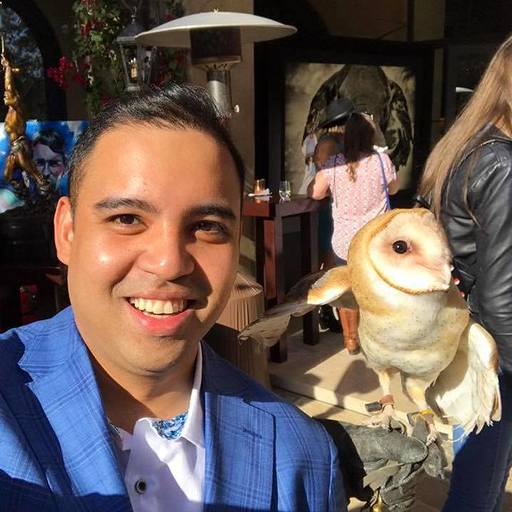
There is a pleasingly uncorporate photograph of him beside an owl. He is smiling broadly; the bird appears to be taking the occasion more seriously. The picture belongs comfortably beside a career that has moved between teaching, selling, hiring, and building. A founder’s public image need not spend every working hour leaning over a laptop.
His marketing advice can be similarly specific. He has recommended using short social videos to answer audience questions, letting those questions inform the next piece of content. In advice about website popups, he suggested allowing a delay and making the window easy to close. The details matter to him: a useful tactic still has to accommodate the person on the receiving end.
Back to the beginning, with software
In October 2026, another business appeared beside his name. Scoutly, described as a buying-intent lead tool, looks for public conversations in which people express a need that a seller could meet. Its proposition is to make an approach more relevant by beginning with what a potential customer has actually said.
The public listing named Vanyo as founder and showed two active subscriptions and $38 in monthly recurring revenue, in a snapshot updated October 21. Those are small beginnings. They also provide a useful counterweight to the language of expansion that accompanies so many founder careers. A new product has to find its own customers.
The problem is recognizably adjacent to his earlier work: how to spend less time searching blindly and more time on a useful conversation. Across customer blogs, online stores, remote assistants, and a lead tool, the recurring interest is the work that allows another piece of business to happen.
Lucy’s place in the story endures because her arrival made a practical difference to his week. Someone else could help produce what customers wanted. The next challenge was learning how to organize that help. Vanyo has made a career out of returning to that question, with more people involved each time.