In 2012, an unnamed global retailer had a problem with its tilt-tray sorters. The equipment moved merchandise through a distribution center, but aging PC controls offered poor diagnostics and unreliable tracking. Timing errors could stop a sorter. Inventory disappeared into the uncertainty. Owning the machinery had not settled the question of whether it would behave.
- Pyramid connects warehouse software, equipment controls and light-directed fulfillment.
- Its products include NEXUS, Director, Compass CORS and Lightning Pick.
- It works on new installations and retrofits of existing equipment.
- Duravant acquired the business in December 2025; the Pyramid name followed in April 2026.
The machine was fine. The instructions were failing.
Pyramid Controls replaced the retailer’s legacy controls with Allen-Bradley ControlLogix controllers, connected to its Director warehouse control software. The installation took place over weekends. Avoiding disruption helped win the contract. Better tracking reduced lost inventory, and diagnostics gave operators a clearer view of faults.
“That meant we had to work after hours and on weekends to meet the deadline.”
Mukesh Ram, then president of Pyramid Controls
The revealing detail is the weekend work. Warehouse automation is often pictured as an immaculate new facility. Pyramid’s example involved a distribution center that still had deliveries to make. The project’s value included making a change while the customer carried on working.
That is a useful entrance to this company. Founded in 1994 by software and control engineers from the material handling industry, Pyramid built its early identity around managing distribution systems. Its original proposition was to make equipment work more intelligently. Today, the business formerly called Matthews Automation Solutions combines that controls heritage with warehouse execution software and Lightning Pick’s physical picking technologies.
Three layers, one carton
Follow a carton and the jargon becomes less forbidding. A warehouse management system holds the inventory and order information. A warehouse execution system helps coordinate the work needed to move those orders through the operation. Warehouse control software and machine controls direct equipment. Their boundaries vary by installation, but the distinction helps explain why a warehouse might need several systems to send one perfectly ordinary parcel.
Pyramid occupies the space where that plan becomes movement. A customer can use its controls engineering to upgrade a conveyor or sorter, its software to coordinate automated processes, and its picking systems to guide operators. This is an engineering and implementation business as well as a software business. Interfaces, commissioning and ongoing support are part of the proposition.
NEXUS, introduced in March 2021, emerged after the Pyramid and Compass teams joined at an expanded Cincinnati campus in 2019. It brought their warehouse software experience into a platform with a web interface for desktop and mobile use. The premise is straightforward: the day’s workload changes, so the allocation of work should change with it.
The NEXUS product literature describes algorithms that shift work in response to conditions throughout the day. Think about the practical implication: releasing orders into a busy area can create a queue even when another part of the operation has spare capacity. Seeing those conditions and adjusting the work is the software’s advertised job. A faster machine alone cannot make that decision for the whole facility.
Director and Compass CORS remain established names in the portfolio. They matter because warehouse buyers inherit systems. A new platform enters a building with an existing operational history, equipment and information systems. Pyramid’s experience with those earlier products gives its NEXUS story a lineage more substantial than a fresh interface.
The light does the explaining
Lightning Pick makes the company’s work visible at human scale. In pick-to-light, illuminated modules indicate where to pick and how many units to take. The worker confirms the action. A put wall applies the idea to sorting: scan an item, place it into the indicated order compartment, and let completion signals tell the packing side when the order is ready.
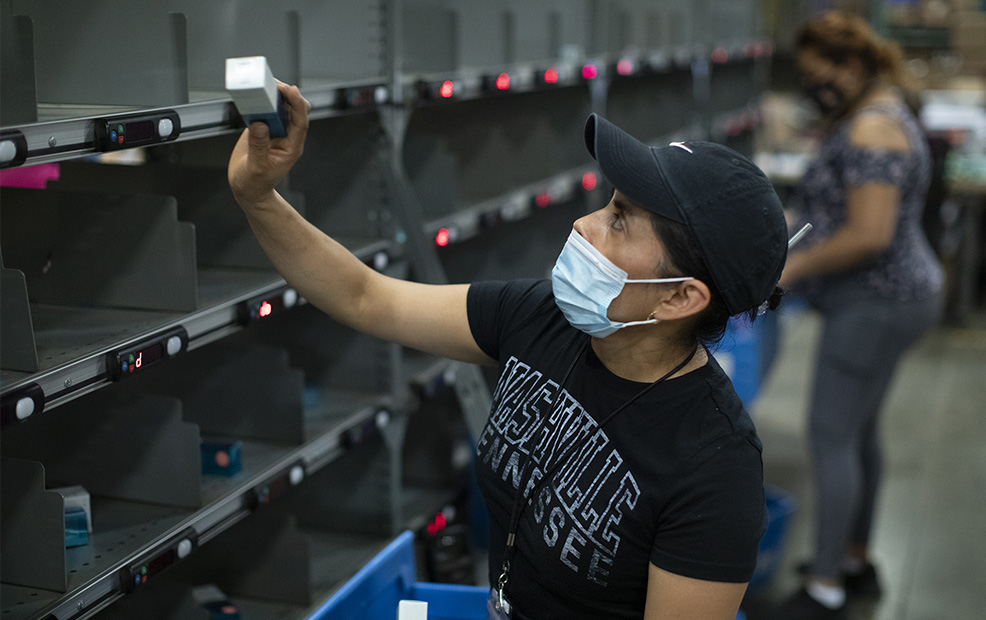
The appeal lies in reducing the interpretation required between an instruction and a movement. Paper lists ask someone to read, locate and remember. Lights place information near the action. Workers still do the picking; the system makes the instruction easier to follow and records confirmation.
Raynor Garage Doors supplies a wonderfully concrete example. It wanted to consolidate twelve parts-picking lines into one. After considering alternatives including carousels, it chose Lightning Pick. More than 250 light modules helped organize the new line. The project manager reported that the layout occupied half the previous space.
The same implementation guided custom-parts consolidation and the selection of product manuals. That last detail is worth lingering over. A garage door order needs the correct literature as well as the correct parts. The lights covered both. Useful automation attends to the unphotogenic item that can otherwise send a customer hunting for instructions.
Picking lines consolidated.
Project manager reported half the former layout space.
The Hillman Group’s historical implementation adds another lesson. Its fast-moving hardware products used pick-to-light, while slower-moving products used other picking methods. The company worried about communication between technologies and selected Lightning Pick partly for its experience interfacing with Manhattan Associates. A warehouse full of similar-looking fastener boxes needed accurate replenishment as well as accurate picking. A light cannot rescue a wrong product stocked behind it.
A cart has the virtue of moving
At third-party fulfillment provider Capacity, paper-based processing involved a picker, packer and quality checker inspecting orders. The company wanted higher throughput and fewer touches. Changing client requirements made a permanent conveyor less appealing. Lightning Pick supplied batch-picking carts and put walls, installed in October 2016.
Capacity reported moving from roughly 2,500 orders in a normal workday to 12,000 or more in a normal shift. Those are vendor-published customer results, with different period descriptions, rather than a controlled comparison. They illustrate the project’s reported outcome; they are no forecast for another building.
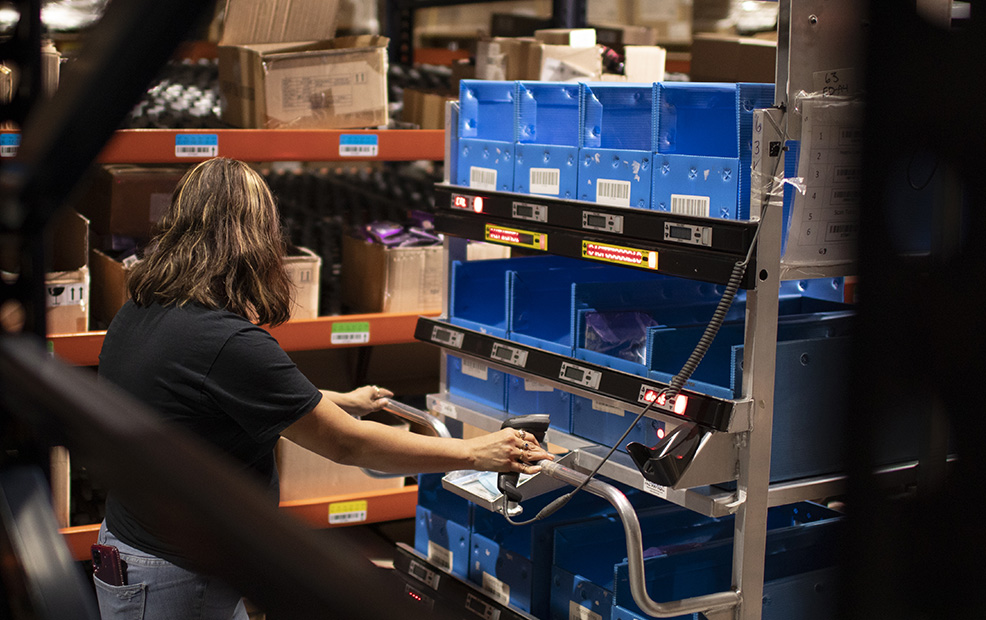
The movable design is the transferable idea. When clients and storage assignments change, carts can follow the work. Conversely, a fixed light-directed picking area deserves scrutiny when product locations change continually or the order volume cannot justify dedicated infrastructure. Those are evaluation questions drawn from the case, not universal verdicts on a technology.
A software company walks into a machinery group
Duravant completed its purchase of Matthews Automation Solutions on December 31, 2025. The seller’s closing filing records approximately $232 million in consideration, including $225.4 million in cash and assumed liabilities. The agreed enterprise value was $230 million. These figures describe the business transaction; they do not describe what a warehouse customer pays for a system.
The strategic fit is visible in Duravant’s own announcement: software and controls extend its material handling capabilities. Its machinery portfolio gains a business experienced in the layer that coordinates equipment and order fulfillment. In April 2026, the acquired operation adopted Pyramid as its company name, bringing NEXUS, Director, Compass CORS and Lightning Pick under that identity.
Pyramid still competes in a market with other orchestration options. Honeywell Intelligrated offers Momentum WES to coordinate disparate automation, and Softeon offers WES alongside its warehouse management system. Connecting equipment is therefore a shared market promise. Pyramid’s distinctive proposition is the combination of controls engineering, established warehouse software and light-directed fulfillment in one business, now within a machinery group.
Buy the handoff
A prospective customer should start with the place where work waits. Is the problem an unreliable sorter, an overloaded picking zone, repeated checking or an interface between systems? Those problems can look alike in a disappointing shipping total. They demand different interventions.
The business sells software, physical picking technologies and integration services to organizations with those operational problems. Its examples span manufacturing, retail replenishment and ecommerce fulfillment. Choosing it means evaluating the proposed project: what gets replaced, what stays, who owns the interface and how the team will demonstrate that the result works.
The useful comparison is a costed sequence of changes. Include software, hardware, integration, training, commissioning and support. Ask how the installation will proceed during operating hours, and which measurements will establish success. Raynor’s space saving, Capacity’s movable design and the retailer’s weekend retrofit each answered a different constraint. Copy the method of finding that constraint before copying the equipment.
That is what makes Pyramid interesting beyond a shopping list of industrial acronyms. Its subject is the moment one task hands responsibility to another. An order reaches a sorter. A picked item reaches a cubby. A finished order reaches a packer. Make those exchanges dependable, and a warehouse becomes a better team.