Cancer cells are terrible houseguests and accomplished travelers. A normal epithelial cell that loses its attachment to the surrounding matrix receives a blunt biological instruction: die. The process is called anoikis. A metastatic cell learns to ignore it, float away, survive the circulation and, on a good day for the cancer and a very bad one for the patient, colonize somewhere new. PRUNUS Therapeutics has built its company around that instant of disobedience.
The Chicago startup, founded in 2016 by molecular biologist Nobu Ueki, is developing a preclinical anti-metastatic candidate with the cheerful name :D, pronounced “Smiley.” The company says Smiley kills cancer cells growing without attachment as three-dimensional spheroids while doing little to the same cells arranged as a conventional two-dimensional monolayer. Same cells, different physical state, radically different response. It is the sort of result that makes a scientist squint, repeat the experiment and, eventually, start a company.
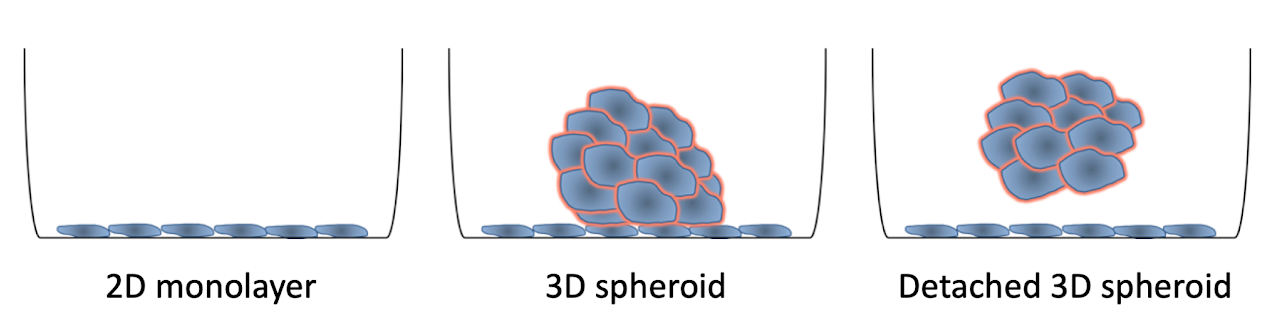
One moment, not one mutation
Targeted oncology usually begins with a molecular address: a mutated kinase, an overexpressed receptor, a protein that a tumor depends on. PRUNUS starts with context. Its public explanation argues that attachment-free growth exposes a vulnerability across a broad range of cancer cells. If the hypothesis holds, the treatment might not need every tumor to wear the same molecular name tag. It would recognize what the cell is doing.
That is meaningfully different from saying “we treat metastatic cancer.” Metastasis is a chain of events, not a single target. Cells must separate, invade, travel, evade hostile conditions and establish a new home. PRUNUS is aiming at one section of that chain. The focus is narrow enough to test and potentially broad enough to matter. It also creates an obvious limitation: a drug that depends on an attachment-free state may be uninteresting when the relevant cells are firmly attached.
“We won't miss the chance when cancer cells expose their weakness.”PRUNUS Therapeutics
What they actually did
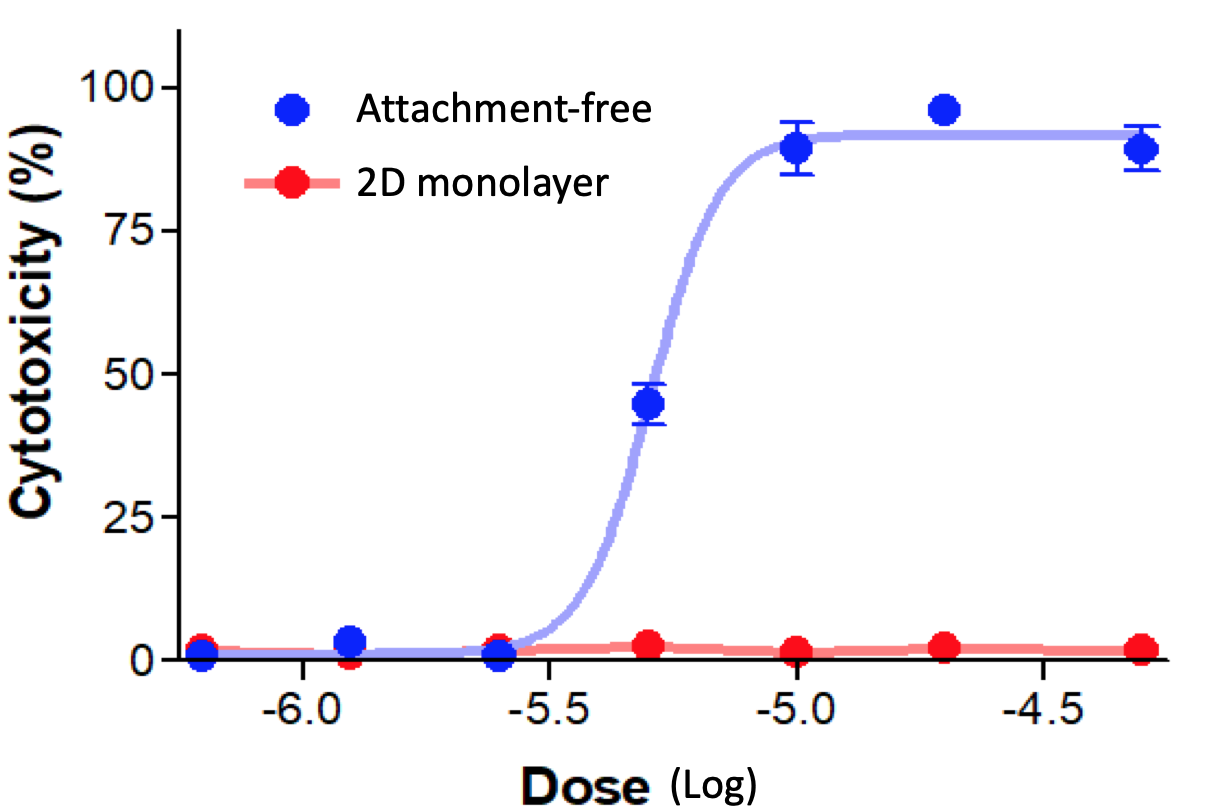
The company's public experiment is refreshingly visual. Cancer cells were grown in two conditions. In the first, they spread across a flat surface as a 2D monolayer. In the second, they grew without attachment as 3D spheroids. PRUNUS applied its candidate across increasing doses and measured cytotoxicity. The blue attachment-free curve rises steeply toward roughly 90 percent cytotoxicity in the displayed assay. The red 2D curve sits close to zero.
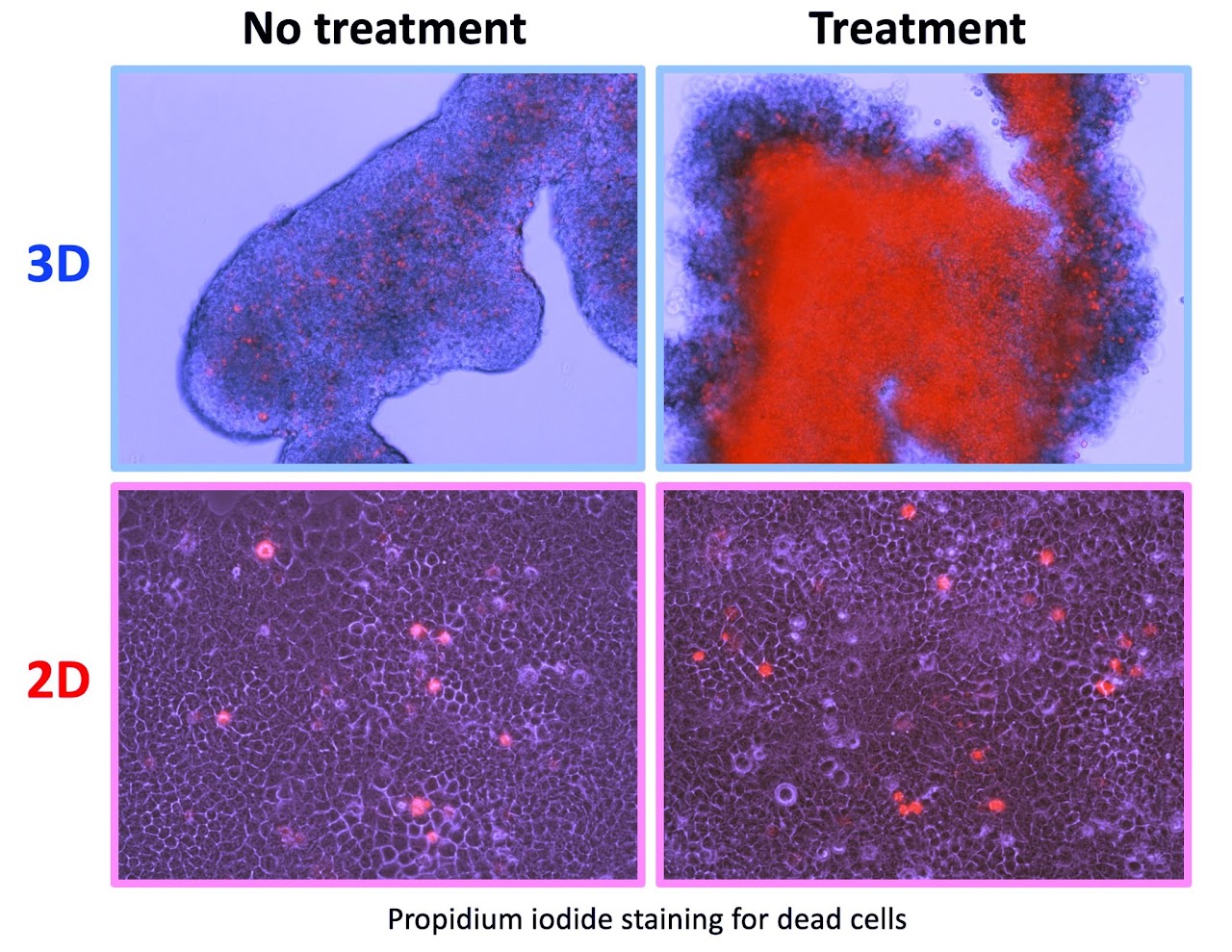
Microscopy makes the distinction concrete. Red staining marks dead cells. After treatment, the detached 3D culture glows and breaks apart, while the treated 2D culture looks much like its untreated neighbor. PRUNUS describes the candidate as “chemo-free,” by which it means the effect does not rely on familiar DNA-damaging agents or microtubule inhibitors. The company also claims no off-target toxicity from a bystander effect in this experimental framing. Those are product claims at the preclinical stage, where every promising adjective still owes the world a stack of validation.
What failed first - the flat-dish assumption
PRUNUS frames its origin with a scientist's shrug: “It might happen from unusual observations.” The observation was that the candidate's effect appeared under attachment-free 3D conditions and disappeared in 2D. In other words, the first thing that failed was the assumption that a flat dish tells the whole story.
That seems to have changed the frame. A conventional screen might discard a compound that looks inactive in a monolayer. PRUNUS treated the conditional activity as the feature. The company moved from asking whether a molecule kills cancer cells in general to asking whether it kills them at a particularly dangerous point in their life cycle. For anyone building products, that is the reusable part: when performance changes with context, investigate the context before “fixing” the result.
Product, customer and market
There is one publicly featured product program, not a department-store pipeline. Smiley is described as patent-pending and in preclinical development. PRUNUS also calls its wider work a synthetic-biology platform for sustainable therapeutics and diagnostics in human and animal health, but the anti-metastatic candidate is the center of gravity.
There are no patients using it and no physicians prescribing it. The immediate audience is the small circle that can move a drug from a compelling chart into serious development: translational researchers, toxicologists, investors, grant makers and potential pharmaceutical partners. The eventual customer would not buy a vial from a website. If the program survives mechanism studies, animal pharmacology, safety work, manufacturing, regulatory review and clinical trials, it would enter the oncology market through the same guarded doors as other experimental medicines.
So what does it cost? To a patient today, nothing, because there is no treatment for sale and no commercial price applies. Its current economics are research economics. The company asks supporters for contributions devoted to product development and clearly says the gifts are not tax-deductible because PRUNUS is for-profit. It also warns that technical limits, production problems or regulatory direction could change the product or stop development. That paragraph is the least glamorous and most credible thing on the site.
The expensive gap
A clean in-vitro separation is the beginning of a drug story. The bill grows when a team must identify the mechanism, reproduce the effect across models, measure exposure, establish dosing, manufacture consistently and show that selectivity survives in living systems.
Mechanism studies, animal work, toxicology and manufacturing turn a clean chart into a capital-intensive development program. PRUNUS makes that financing need explicit.
The founder has been chasing selectivity for years
Ueki's earlier academic work gives the current bet useful context, though it should not be confused with Smiley. At Stony Brook University, he and collaborators developed an enzyme-activated prodrug strategy. A masked cytotoxic compound required two cancer-associated enzymatic steps before releasing puromycin. The work appeared in Nature Communications in 2013, followed by an improved preclinical version in Theranostics in 2016. A related US patent issued in 2018 to the Research Foundation for the State University of New York, naming Ueki and Michael Hayman as inventors.
That AcK-Lock research and PRUNUS's current attachment-free candidate are not publicly established as the same technology. The connecting thread is more general and more believable: selective killing. Ueki has spent years asking how to make a toxic payload matter more to cancer cells than healthy ones. PRUNUS shifts the selection rule from a pair of enzymes to a physical growth condition.
What a reader can copy
Steal the experimental logic, not the molecule
- Look for state changes. A customer, cell or system may behave differently while moving between stable conditions.
- Run the paired test. Hold the subject constant and change the context. PRUNUS's 2D-versus-3D comparison makes the claim legible.
- Build around the exception. If an effect appears only under one condition, that narrow window may be the product.
- Name the failure conditions. Conditional products earn trust when the boundary is part of the pitch.
This playbook applies well outside biotechnology. Fraud systems can focus on the moment money changes hands. Security tools can watch privilege escalation instead of every routine action. Marketplace products can intervene when a buyer moves from browsing to negotiating. The pattern is the same: a transition can reveal information that a static snapshot hides.
Where the smile could fade
The approach would not work if attachment-free selectivity is an artifact of the particular assay, cell lines or dosing conditions. It may falter if relevant cancer cells spend too little time in the vulnerable state, if the compound cannot reach them at a safe concentration, or if normal cells in the body encounter a similar vulnerability. A drug that spares a plastic-dish monolayer has not yet proved it will spare marrow, gut, liver or nerves.
There is also a category problem. “Metastatic cancer” covers many diseases and many routes of spread. Spheroids are useful models because they better reproduce gradients and cell interactions than a flat culture, but they remain models. The winning conditions are therefore demanding: repeatable activity across relevant tumor types, a mechanism that explains the state selectivity, exposure at the right site and time, a wide safety margin, and evidence that suppressing detached cells improves outcomes rather than merely changing a laboratory picture.
PRUNUS's differentiation is real at the level of its stated hypothesis. Competitors typically target a molecular driver, activate a drug inside tumors, restore anoikis pathways or attack other parts of metastasis. PRUNUS instead presents attachment-free growth itself as the selection gate. Its market position is that of a very early, very concentrated oncology bet. No sprawling commercial apparatus. No approved therapy. One curious result trying to become a medicine.
The name is Smiley. The useful posture is a raised eyebrow.A preclinical thesis deserves interest and interrogation in equal measure.
That tension makes the company worth watching. The public evidence is not enough to declare victory, but it is enough to state the wager cleanly. Most startups spend pages explaining why they are different. PRUNUS can do it with two cultures and two colored curves. Blue rises. Red stays flat. Now comes the harder experiment: seeing whether biology outside the dish agrees.