If your job is simply to coax 700 passable words from a blinking cursor, Writesonic is now more machine than you need. The product that arrived in 2020 as an AI copywriter has spent the years since accumulating dashboards, agents, audits, integrations and a new obsession: whether ChatGPT, Gemini or another answer engine remembers your company when a buyer asks for help. This is a sensible reinvention. Generic text became cheap. Knowing where a brand disappears, what source replaced it and what a marketing team should do on Monday morning did not.
That makes the buying question pleasantly specific. Writesonic is for the marketer who owns both discovery and production: the SEO lead asked to explain a traffic wobble, the agency juggling six client brands, the content team that must turn a visibility gap into a brief and then a published page. A novelist, student or occasional newsletter writer should look elsewhere. A general AI assistant will cost less and feel lighter. Writesonic earns its keep when the dashboard and the workshop need to share a wall.
A copywriter walks into a control room
Founder Samanyou Garg's origin story is almost comically pure: an engineer who did not know marketing wanted software to study the clean landing pages of Stripe and Apple and write one for him. GPT-3 had just opened the door. The early product found paying customers quickly, joined Y Combinator's Summer 2021 batch and raised $2.6 million. In a 2024 Reddit AMA, Garg said the company had crossed 10 million users, reached multi-million-dollar annual recurring revenue and remained profitable.
Then the market swallowed the category. ChatGPT made an empty chat box everybody's copywriter. Writesonic responded by moving up the work chain. The current company describes itself as an AI Search Growth Engine. Its core question is no longer merely “Can a model write this?” It is “When a prospective customer asks an AI for options, do we appear, which pages get cited, and what can we fix?”
The distinction matters because a visibility chart on its own is a weather report. Writesonic pairs measurement with an Action Center for on-page, off-page and technical recommendations; a site audit; content strategy; Article Writer 6; and agentic workflows. The promise is a route from symptom to work order. Higher plans unlock more of the execution, so buyers should inspect the plan matrix rather than assume every colorful button is included.
What you can actually do
Start with a project, define the prompts and competitors that matter, and choose the answer engines you want to watch. Writesonic records brand mentions, citation share, sentiment and changes over time. The Starter, Basic and Growth plans cover ChatGPT, Gemini and Google AI Overviews; the enterprise tier advertises ten platforms, adding names such as Claude, Perplexity, Grok, DeepSeek, Copilot and Meta AI.
| Desk | What it handles | Best use |
|---|---|---|
| Visibility | Mentions, citations, sentiment, competitors and answer tracking | Finding where a brand is absent or misrepresented |
| Action Center | On-page, off-page and technical priorities | Turning charts into a ranked work queue |
| Article Writer 6 | Research, outlines, 500-5,000 words, links, sources, voice, FAQs and images | Producing a structured first draft with editorial controls |
| Site Audit | SEO and AI-crawlability checks with automatic fixes | Finding technical barriers before adding more content |
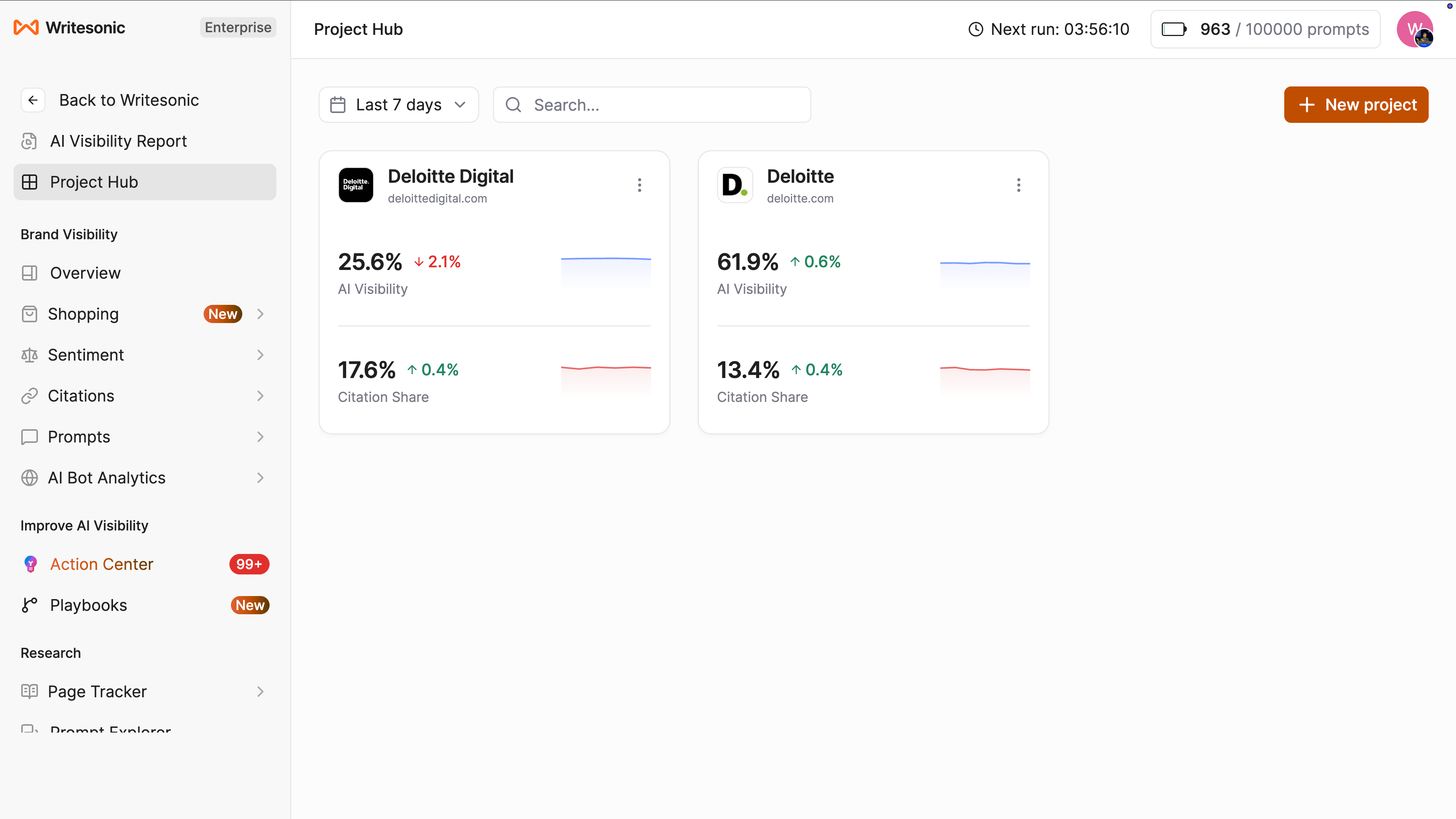
| Project Hub | Portfolio view of brands, trends and citation share | Agency and multi-brand triage |
| MCP | Live Writesonic data inside AI clients, plus confirmed project actions | Briefs, comparisons and reports without dashboard hopping |
Article Writer 6 remains the bridge to old Writesonic. Its ten-step mode lets an editor choose article type, references, keywords, length, outline, brand voice, call to action, images and FAQs. Four-step and instant modes trade control for speed. The machinery can save research and assembly time, but “publish-ready” should be read as a workflow ambition, not permission to skip an editor. Sources still need checking. Examples still need a pulse. Brand voice presets cannot invent firsthand experience.
The bill arrives wearing a dashboard
The public annual-billing prices at the time of review are $79 per month for Starter, $199 for Basic and $399 for Growth, with Enterprise priced by quote. Starter includes one user and one project, 50 tracked prompts, 50 answers tracked daily, 15 AI articles and ten site audits a month. Basic raises those allowances and adds a second user. Growth allows three users, two projects, 200 prompts, 600 daily answers, sentiment analysis and small monthly trials of Action Center tasks.
There is a free trial, but the current pricing page does not advertise a permanent free plan. That shifts the product away from hobbyists. The cheapest sensible test is to choose one domain, a compact set of buyer questions and two or three competitors, then decide in advance what a useful signal would look like. If the trial only produces fascinating charts, cancel. If it produces a repeatable list of pages to refresh, sources to pursue and technical fixes to ship, the economics become easier to defend.
Credits, tracked prompts, daily answers, audits, users and projects are separate limits. Map your real monthly workload to each one. “Includes AI articles” does not mean unlimited publishing, and lower tiers do not include the full Action Center.
Choose your rival carefully
Writesonic now competes on several fields at once. Profound, Peec AI, Scrunch AI, Otterly.AI and AthenaHQ address AI visibility. Semrush owns a broad SEO toolkit. Jasper and Copy.ai compete for structured marketing production. ChatGPT and Claude undercut the whole bundle for anyone happy to build a process manually.
The useful dividing line is execution. A dedicated visibility tracker may offer a cleaner or cheaper answer to “Where do we show up?” Writesonic makes more sense when the next questions are “Why?” and “Who can draft the fix today?” Its native article system, audits and integrations reduce handoffs. The penalty is breadth: more menus, more quotas, and a price that only works if the team uses multiple desks.
The review section has two weather systems
The aggregate scores are strong. G2 displayed 4.7 out of 5 from more than 2,100 reviews during our research, while Trustpilot showed 4.6 from more than 5,700. G2's review summary repeatedly points to speed, ease of use and relief from the first-draft problem. It also flags generic or repetitive passages and the need for editing. Capterra reviewers tell a similar time-saving story.
Users describe fast drafts, an approachable interface and a useful way around writer's block. One recent reviewer called it a “reliable writing assistant.”
Critical posts mention rising prices, credits, cancellation or refund disputes and slow support. One 2026 reviewer found results “lacked only in consistency.”
Those complaints deserve more than a footnote because annual plans magnify friction. Read renewal and refund terms before paying for a year, export work you need to keep, and test support during the trial. Also separate reviews of the older writing product from the present AI-visibility suite. Writesonic itself has written about the web remembering the company it used to be. Some reviewers are judging that earlier company too.
A sensible first month
Do not begin by generating fifty articles. Begin with ten to twenty buyer questions tied to an actual product line. Add the competitors that sales hears in calls, not the ones that look impressive in a report. Let the system gather a baseline, inspect the cited pages by hand, and mark which gaps are commercial, reputational or merely amusing.
Next, pick one gap that can be changed: a stale comparison page, a missing answer section, a crawler problem, or a third-party source that consistently frames the category. Use the audit and Action Center to make a short queue. Use Article Writer for the research and scaffold, then put a named expert through the draft. Track the relevant prompt and page after publishing. This small loop tells you more about product fit than a grand dashboard tour.
Agencies should test Project Hub early. Its cards show visibility and citation-share deltas across accounts, which is useful for deciding where a strategist spends the morning. The June 2026 MCP release offers another pragmatic route: ask for a weekly change summary from Claude, ChatGPT, Cursor or another supported client, request a competitor comparison, then move the result to Slack or Notion. Writesonic says writes require confirmation, a welcome brake on enthusiastic automation.
The verdict
Writesonic's old reputation as a budget AI writer now obscures the interesting product. In 2026, it is a marketing operations platform organized around a new anxiety: an answer engine may be recommending everyone except you. The company has built useful connective tissue between measuring that problem and doing something about it.
Buy it if the same team owns SEO, AI-search reporting and content execution, or if an agency needs a repeatable view across brands. Trial it cautiously if your main interest is visibility data, since narrower trackers may be enough. Skip it if all you want is occasional copy. The product is broad, the pricing assumes real work, and the best output still depends on somebody in the room having evidence, taste and a red pen.