The fastest way to understand Wiza is to imagine a sales rep at 4:47 p.m., staring at a promising LinkedIn profile and one blank cell marked “email.” Wiza exists to fill that cell, then check its own handwriting. It searches for work and personal addresses, direct dials and mobile numbers, verifies what it can in real time, and sends the result to a list, CSV, CRM, sales sequence, API client, or now an AI assistant. The attraction is less data janitoring. The catch is that no contact database is omniscient, and every reveal, export cap, and missed record eventually becomes arithmetic.
That makes Wiza a clean fit for SDRs, account executives, recruiters, agency operators, and founders who already know whom they want to reach. It is especially sensible when the prospect list begins with professional profiles and the expensive problem is not discovery alone, but whether the person still holds the job and whether the address will bounce. Teams that mainly need an outbound sequencer, intent data, or elaborate org charts should keep shopping. Wiza is a data and prospecting layer first.
The useful magic trick is patience
Founder Stephen Hakami built Wiza out of his own outbound-sales agency. His team was hopping between LinkedIn, a tool that guessed an address, and another tool that checked it. In an early interview, he remembered the frustration plainly: even after finding an email, “you don’t know if it’s valid or not.” Wiza launched in May 2019 with a small, sharp promise - turn a target into contact data and charge for the valid result.
The product’s organizing idea remains live verification. A conventional database can answer quickly because the answer is already sitting on a shelf. Wiza says it checks requested data against live sources, including current company, title, and email status. Hakami has joked that the company prides itself on being the slowest email finder. That is a good line because it describes the bargain honestly: wait a little now, clean up less later.
“We somewhat pride ourselves on being the slowest email finder out there because we do these live verifications.”Stephen Hakami, founder and CEO, in a 2025 interview
Wiza advertises 99%+ deliverability on verified email. Treat that as a claim to test, not a tattoo to get. Accuracy shifts with geography, seniority, company size, and the kind of address requested. Independent review signals are encouraging but untidy. G2 showed 4.5 out of 5 from 1,192 reviews, with praise clustering around ease, contact information, LinkedIn integration, and accuracy. The same summary surfaced “expensive” and “limited credits” among common complaints. Trustpilot was a much smaller and harsher pool at 1.9 from 13 reviews, with billing, support, privacy, and export complaints. Different audiences and collection methods can produce wildly different portraits. The honest conclusion is a trial, not an average.
Wiza grew out of the LinkedIn tab
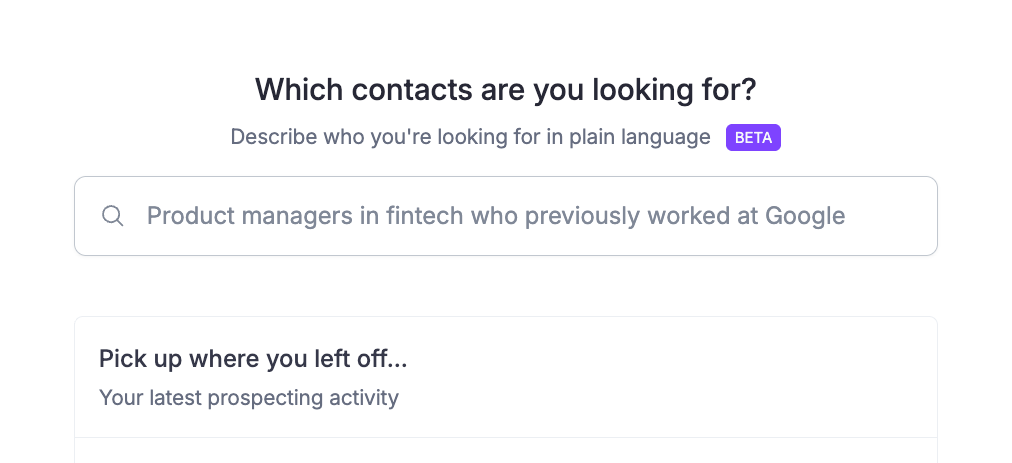
The 2019 version was essentially a lever attached to LinkedIn Sales Navigator. The current Wiza is broader. Wiza Prospect is a searchable people-and-company database with filters for job, location, skills, education, company attributes, and more. Smart Search accepts a plain-language request and translates it into filters. The API can enrich a person from a LinkedIn URL or name and company. Its MCP server lets compatible clients such as ChatGPT and Claude search people and companies, enrich a contact, and pull firmographics inside a conversation.
The browser extension still matters, but its job changed in August 2026. LinkedIn tightened what third-party extensions can do, so Wiza removed bulk export and list creation from LinkedIn, Sales Navigator, and Recruiter search and list pages. On full profile pages the side panel can reveal one contact, save that person, and use CRM actions. Company pages show details and syncing options. Bulk building now happens through Wiza Prospect, which means a paid Sales Navigator seat is no longer required for the core database workflow.
The practical translation: old tutorials showing an “Export with Wiza” button across a Sales Navigator results page are stale. If your entire purchase case depends on that motion, run the current extension before committing.
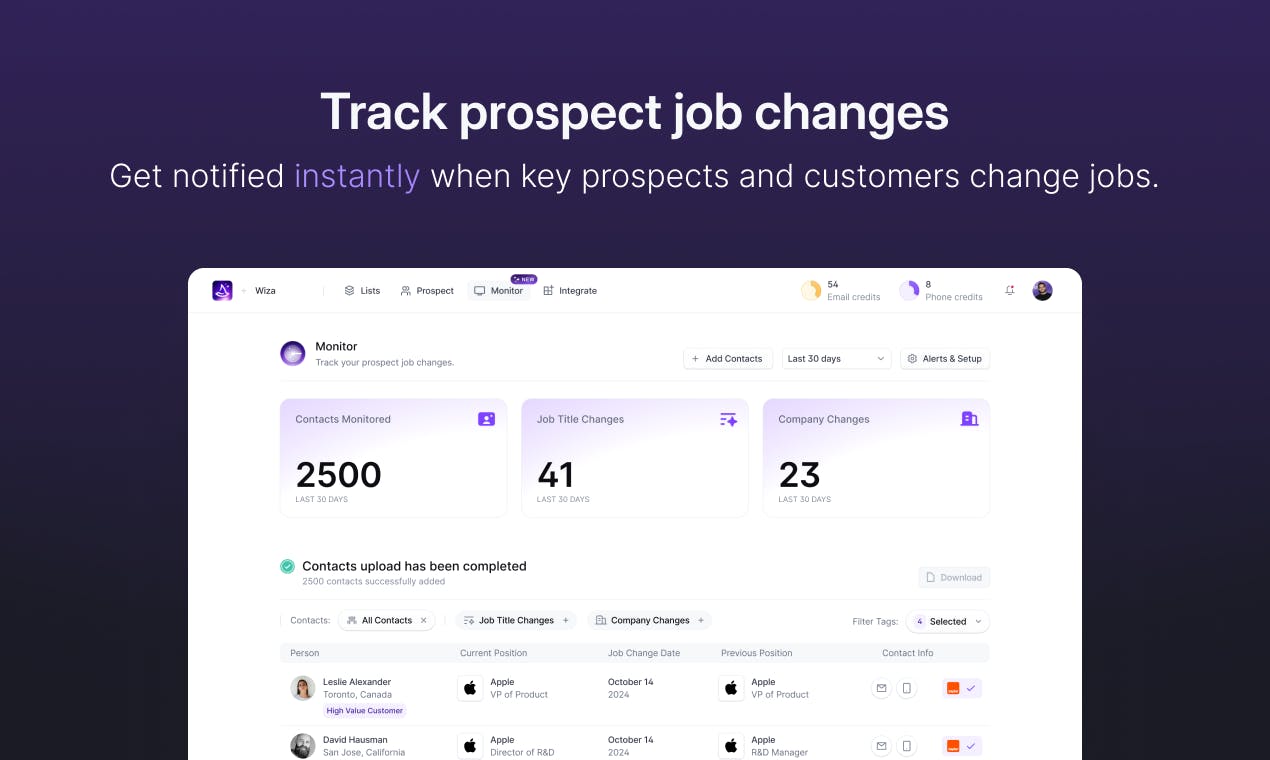
The rest of the suite follows the life of a record. CSV imports and CRM enrichment fill gaps. List refreshes re-check details and show old versus new values. Scheduled refreshes can catch a job move, alert Slack or email, write the new record back to a CRM, and add an eligible contact to a sequence. In August, Wiza added a direct Gong Engage integration; in May, Attio arrived with custom mapping and duplicate prevention. Salesforce, HubSpot, Pipedrive, Zoho, Outreach, Salesloft, Creatio, and Zapier are among the other named routes.
Price the workflow, not the wand
The free plan offers 20 valid emails and five phone numbers. That is enough to test the interface, not enough to settle data quality. Monthly Starter is $49 per user for 100 emails and 100 phone numbers. Monthly Email is $99 for 500 valid emails; Email + Phone is $199 for 500 of each. Email overages are listed at 15 cents and phone overages at 35 cents. Annual plans shift the pitch to unlimited reveals: $990 per user per year for email, or $1,990 for email plus phone, both with a stated 2,500 monthly export limit. Teams of three or more get custom annual pricing.
The word “unlimited” needs a neighboring sentence. A reveal is not always an export, and list exports have caps. Usage also differs by action: the July automation notes say scheduled refreshes consume included export credits, while follow-up actions do not. Ask sales to price your real sequence from search to CRM, including failed matches, phones, exports, refreshes, API usage, and seats. The cheapest-looking row rarely describes the final workflow.
| Choose | When your day looks like | Mind the gap |
|---|---|---|
| Wiza | Find a defined B2B audience, verify contacts, and push clean records into existing tools. | Credits and export rules; it is not a full engagement suite. |
| Apollo.io | You want database, sequencing, and outreach in one product. | Test data quality in your segment and count phone-credit costs. |
| Lusha | Your reps work profile by profile and phone numbers matter most. | Less workflow depth than broad sales platforms. |
| ZoomInfo | A large team needs intent, org charts, governance, and enterprise coverage. | Budget, contract scope, and implementation weight. |
| Clay | Operators want multi-provider waterfalls and custom enrichment logic. | More assembly and governance; data vendors still sit underneath. |
The comparison is about operating style. Apollo can suit a smaller team that wants data plus sequencing under one roof. Lusha is often shortlisted for a profile-first, phone-heavy motion. ZoomInfo plays deeper in enterprise intelligence and intent. Clay is an orchestration workbench for teams willing to combine sources. Wiza makes the most sense when verification and tidy handoff matter more than owning every stage of engagement.
A trial designed to catch bad surprises
Pick 100 people from the market you actually sell into: a mix of regions, company sizes, seniority, and roles. Do not cherry-pick friendly SaaS executives. Keep a control sheet with the known current employer and title. Reveal work emails and phones, record how many are found, and send only a compliant, relevant sample through your normal infrastructure. Measure hard bounce rate and phone connect rate. Re-check a few known job movers. Time how long it takes to get the list into your CRM without duplicate records.
- Found rate: how often did Wiza return the field you needed?
- Validity: how many emails bounced, and how many phones reached the right person?
- Freshness: were company and title correct today?
- Economics: what did a usable record cost after misses, exports, and seats?
- Handoff: did mappings, ownership, deduplication, and sequence entry behave?
Privacy and outreach rules belong in that test, too. Wiza maintains a trust center covering GDPR, CCPA, US privacy, and SOC 2 materials, including a SOC 2 Type 2 document available by request. The Chrome listing says the extension handles authentication information and website content. Those statements help procurement begin; they do not replace your own lawful-basis review, opt-out handling, suppression lists, and regional calling or email rules.
Our read: Wiza is easy to recommend to a team that already owns the rest of its sales stack and can explain exactly why verified contact data is the missing piece. Its best idea has survived seven years: a lead is only useful if the person is still there and the route reaches them. The free tier makes that proposition cheap to challenge. Challenge it properly.
There is a sturdy company story underneath the product. Hakami started Wiza at 21, funded it with agency profits, and reported reaching $160,000 in monthly recurring revenue within 16 months. A December 2025 interview put the business at $13 million ARR, 24 employees, profitable, and entirely bootstrapped. Those are founder-reported numbers, but the trajectory explains the product’s temperament: engineering first, narrow promise, then a gradual spread into integrations, monitoring, database search, and AI interfaces. Even the early calamity has garage-movie charm. The company lost its sole developer and discovered the working code had not been backed up to GitHub; a local copy helped save the rebuild.
The wizard hat can make Wiza look playful. The actual product is about something wonderfully dull: keeping rows accurate long enough for a person to start a conversation. For a sales team, dull can pay the bills.