StackAI is for the person who owns a business process nobody enjoys but everybody fears breaking. Picture a compliance analyst opening a government alert, searching an internal database, finding the right policy in SharePoint, drafting a memo, asking a manager for approval, and finally updating another system. The glamorous AI demo writes the memo. The useful product handles the whole relay race, preserves the evidence, and stops before the irreversible bit.
That is the pitch behind StackAI, a no-code agent builder aimed at IT teams, enterprise architects, and operations leaders. On its visual canvas, users connect documents, databases, language models, fixed rules, code, and actions. The finished workflow can appear as a chat, form, API endpoint, browser extension, Slack bot, Teams bot, or embedded app. The company calls the package an “AI Agent Factory.” Strip away the factory language and the proposition is straightforward: make messy knowledge work visible enough to design, controlled enough to approve, and connected enough to do something after the model answers.
Who should put this on the shortlist?
Start with regulated and document-heavy teams: banking, insurance, healthcare, legal, government, defense, industrial operations, and large internal support groups. StackAI makes the most sense when a job crosses several systems, contains unstructured material, and still needs a human checkpoint. Contract intake, claims review, policy Q&A, anti-money-laundering screening, service-desk triage, grant analysis, and RFP drafting all fit that shape.
A solo builder can use the free plan to learn the canvas, and a small team can prove a workflow. But the commercial center of gravity is unmistakably enterprise. One seat, two projects, and 500 monthly runs make the free tier a workshop bench, not a department-wide operating layer. The next published option is a custom enterprise quote. There is no public bridge price for the team that has outgrown a prototype but is not ready for procurement theater.
What the canvas gets right
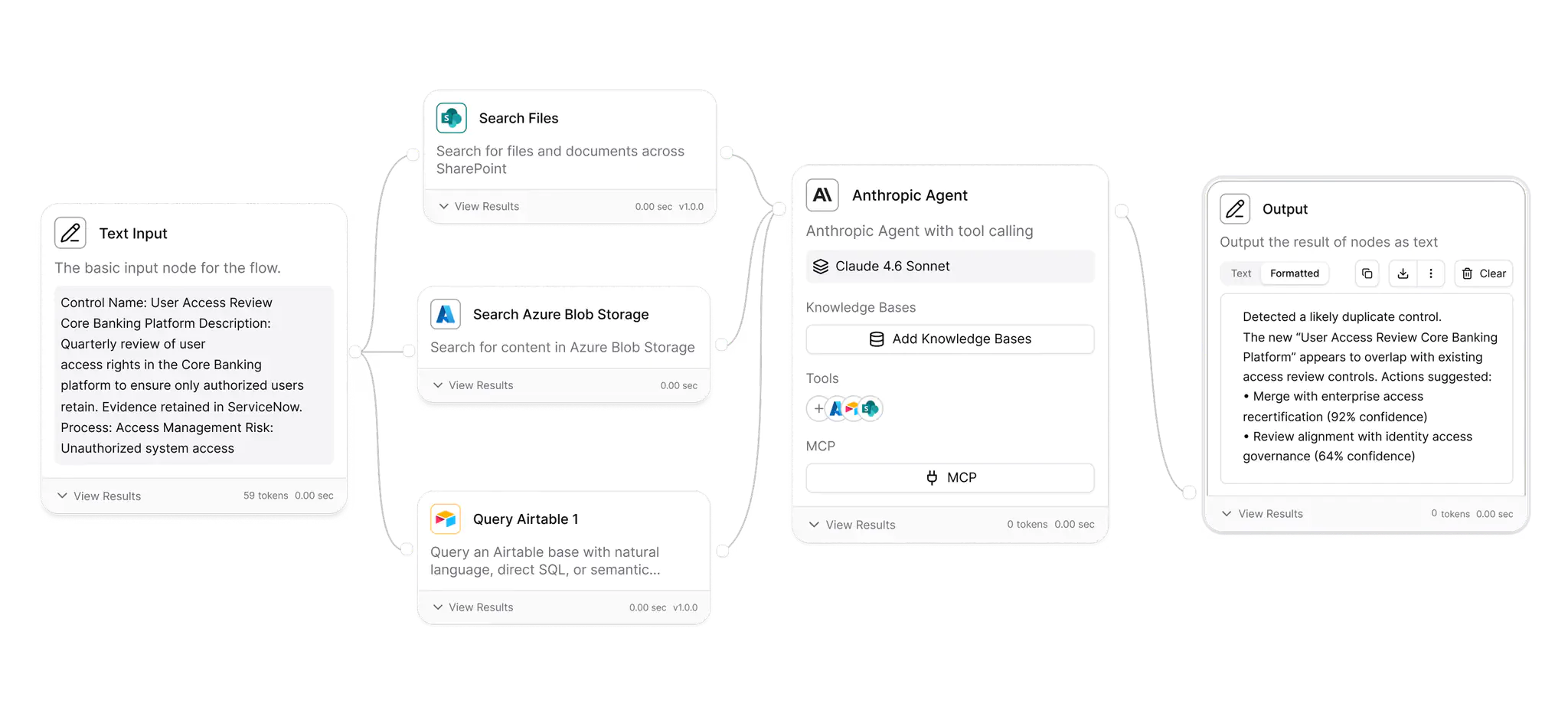
The visual builder is the product’s clearest advantage. A workflow is a map, not a mystery box. A finance team can see a document enter, watch a model extract figures, route low-confidence cases to review, and send a summary. Nodes can be reused and workflows can be nested, which keeps a serious build from becoming one enormous tangle. For retrieval work, StackAI bundles document ingestion, hybrid search, reranking, and source citations. That removes a fair amount of plumbing from the first useful version.
Model choice is equally practical. StackAI supports providers including OpenAI, Anthropic, Google, Meta, Mistral, and models served through AWS Bedrock. In September 2026, the company said OpenAI's GPT-6 Astra was coming to the platform, though it did not publish an availability date. A team can assign a different model to a different job and replace it later without redrawing the entire process. “Model agnostic” is often brochure wallpaper; here it matters because the expensive, careful model may belong on contract reasoning while a faster one handles classification.
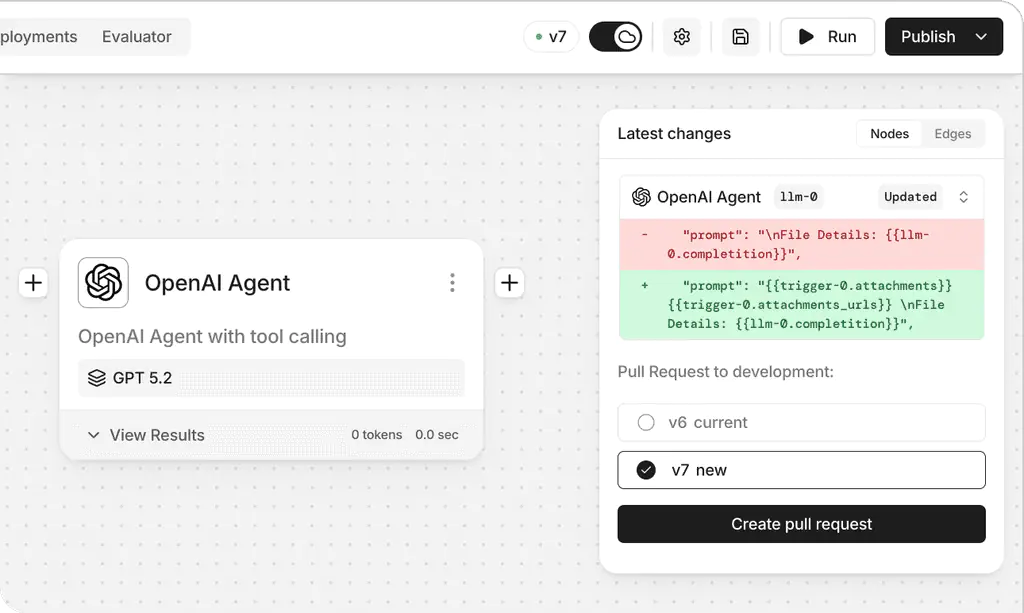
Then come the grown-up controls: roles, SSO, audit logs, run logs, analytics, version history, prompt diffs, feature controls, and deployment in a shared cloud, VPC, dedicated setup, or on-premise environment. StackAI advertises SOC 2 Type II and ISO 27001 certification, plus HIPAA and GDPR support. Security still depends on configuration, contracts, model providers, and the data a customer connects. A badge cannot choose least-privilege permissions for you.
The workflow worth automating
“The most persuasive StackAI feature is a pause button with paperwork behind it.”YesPress review
The human button is the headline
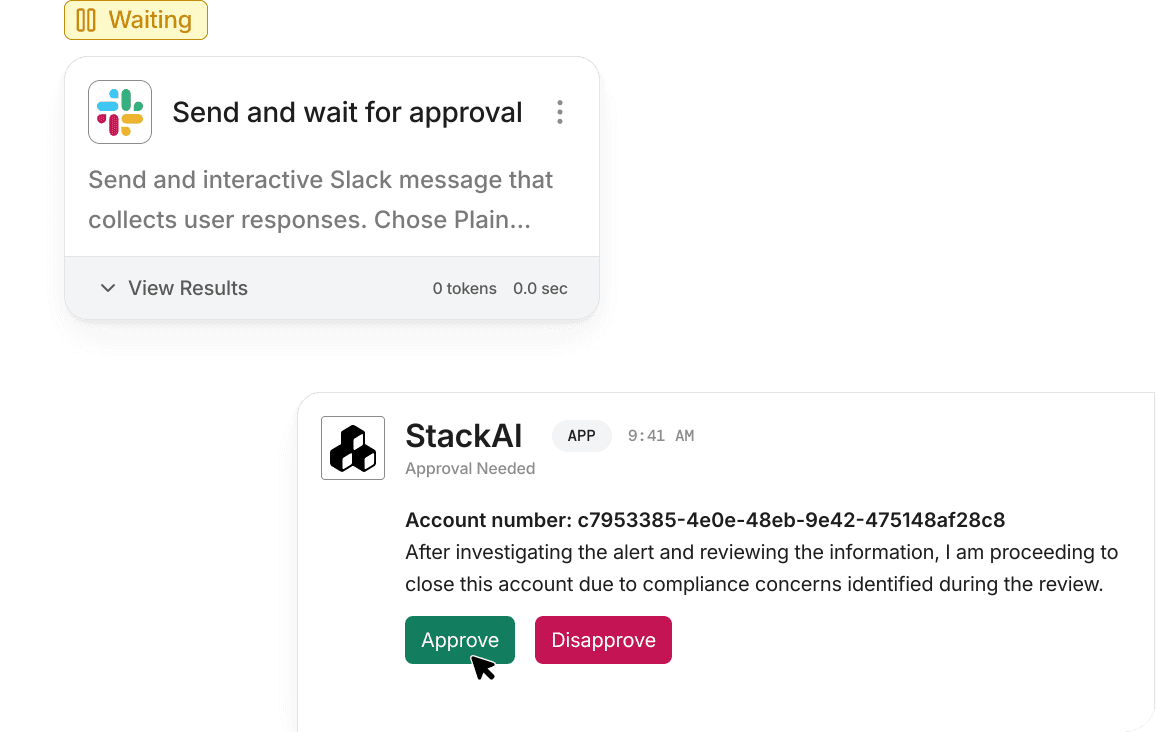
Human-in-the-loop approval sounds modest beside autonomous-agent claims. It is also the feature a risk owner is likely to ask about first. StackAI can stop a workflow in Slack or Teams for approval. In August 2026 it extended that behavior to API-triggered runs: a job can save a checkpoint, wait minutes or days, then continue without repeating earlier steps. That is a small, consequential piece of workflow engineering. It reduces duplicate actions, wasted model calls, and the possibility that a resumed process quietly does the first half twice.
The same August releases added scoped API keys, WhatsApp Business messaging, more than 50 integrations, and custom actions written in Python or TypeScript. Custom actions run in a sandbox, can reuse saved connections, and remain pinned to the version a workflow was built against. That version pinning is the sort of unflashy safeguard that keeps a clever automation from changing personality on Tuesday morning.
Where the no-code promise bends
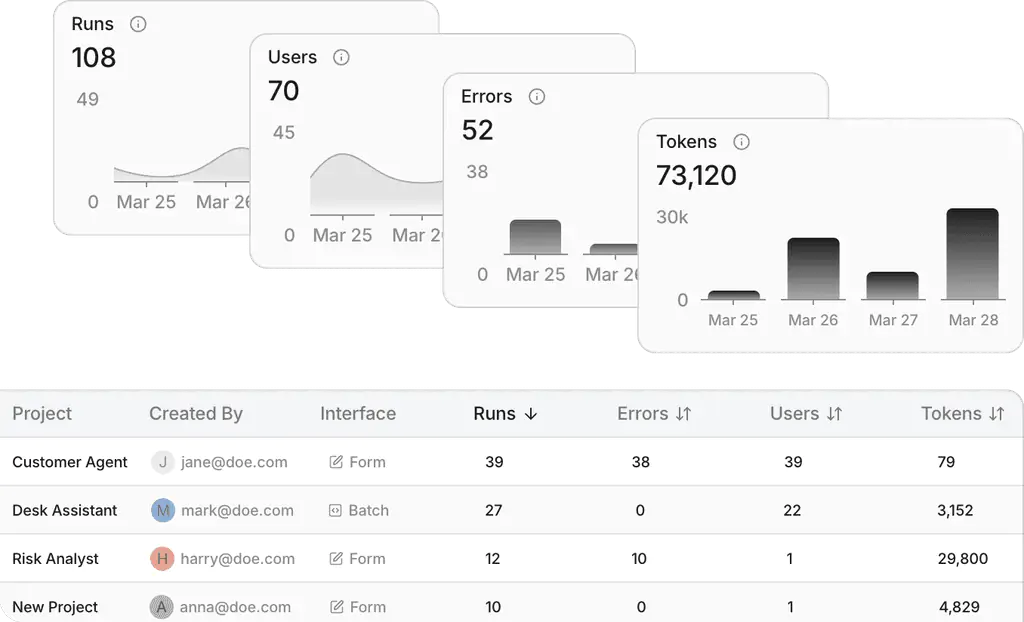
No-code removes syntax, not systems thinking. Someone still has to decide what happens when a document is malformed, a model returns an empty answer, a connector loses permission, or two records disagree. The broader the workflow, the more debugging matters. StackAI exposes runs, errors, usage, and versions, but visual density can become its own form of complexity.
That tension appears in user feedback. When checked, G2 showed 4.5 out of 5 across 38 reviews. Reviewers repeatedly praised quick setup, the drag-and-drop interface, document processing, and integrations. The recurring complaints were also concrete: a learning curve for advanced work, opaque debugging, busy interfaces, unclear documentation, usage limits, and connector gaps. One reviewer summarized the trade as fast workflow building with debugging and pricing still needing improvement. Another liked stacking smaller workflows into a master flow, but found memory settings tricky.
The review pool is not enormous, and several entries were marked as seller-invited or incentivized. Treat it as directional, then test your own ugliest inputs. Reddit discussion has historically been thinner and often compares StackAI with cheaper, more technical tools such as n8n, Flowise, Langflow, Dify, and Relevance AI. The useful division is ownership: StackAI sells a managed enterprise product and deployment help; open or self-hosted alternatives can cost less, but they ask your team to own more infrastructure and sharp edges.
StackAI versus the nearby shelves
| Option | Best fit | What you trade |
|---|---|---|
| StackAI | Governed, cross-system AI workflows with business users and IT sharing ownership | Public pricing jumps from free to custom; complex flows still need technical discipline |
| n8n / Flowise / Langflow | Technical teams that want control, self-hosting, and a lower software bill | More assembly, operations, and maintenance land on your team |
| Copilot Studio | Organizations already deep in Microsoft 365, Dataverse, and Power Platform governance | Microsoft gravity shapes connectors, administration, and economics |
| Vertex AI | Data science and engineering groups building inside Google Cloud | More infrastructure knowledge and configuration are expected |
| Relevance AI / Gumloop | Teams wanting a friendlier managed builder for lighter or faster-moving automation | Verify governance, deployment, and support against your exact enterprise needs |
A very short history of moving quickly
Toni Rosinol and Bernard Aceituno met at MIT, where Rosinol worked in robotics and Aceituno studied mathematical optimization and planning. They finished their doctorates in late 2022 and entered Y Combinator’s Winter 2023 batch with an idea around semantic annotation for autonomous-vehicle imagery. The timing was wrong. They pivoted through prompt engineering and model orchestration, found demand for connecting company data to new language models, and launched StackAI.
Aceituno has said the first public launch brought 10 customers in a week. By late 2023, he reported more than 35,000 users. The company later narrowed from prosumers toward enterprise deployments, raised a $3 million seed round, and announced a $16 million Series A in May 2025. In May 2026, Asana acquired the legal entity behind StackAI, Eigen Inc., for $74.6 million in cash. The founders joined Asana; both sides said StackAI would keep its product, brand, workflows, and customer support.
The strategic logic is tidy. StackAI brings execution across Salesforce, SharePoint, Oracle, document systems, and custom tools. Asana brings a work graph, organizational context, governance, and an enterprise sales channel. The unanswered question is how quickly those worlds merge without blurring StackAI’s model-neutral, cross-system appeal. For current customers, the stated message is continuity.
How to buy it without buying a science project
Bring one workflow, not a company-wide AI manifesto. Choose a process with repetitive retrieval, clear rules, expensive handoffs, and measurable cycle time. Collect real exceptions. Name the human who approves risky outcomes. Confirm every required connector and action, because “integrates with Salesforce” does not tell you whether the exact object and permission you need are supported.
Run the free tier as a design exercise, then ask the enterprise team for a proof using your data shape, security model, expected run volume, and failure cases. Price the model calls, implementation help, hosting, and ongoing workflow ownership together. Ask how logs are retained, how secrets are scoped, how versions are promoted, and what happens when a provider retires a model.
StackAI is a strong shortlist candidate for an organization that wants business-readable automation without giving up IT controls. It is excessive for a simple three-step notification flow and awkward for buyers who need transparent self-service pricing. Its real advantage appears when the work is messy enough to need AI, serious enough to need governance, and repetitive enough that fixing it will show up on a spreadsheet.