You should buy Semrush when one good answer creates work for several people. A strategist finds the keyword gap. A writer turns it into a page. An SEO spots the technical drag. An account lead sends the client a clean report. The platform makes those handoffs unusually tidy because the research, audit and monitoring live close together.
You should pause when your entire plan is “check my ranking once a month.” Semrush can do that, but asking this much software to perform one small chore is like renting a newsstand to hold a single magazine. The entry price is serious, the limits matter, and the navigation rewards people who already know the question they came to ask.
Who is this control room for?
The sweet spot is an agency, an in-house growth team or a hands-on content operation with multiple sites, markets or competitors to watch. These users can move from Domain Overview to Keyword Gap, build a project, crawl the site, track positions and return next month to see what changed. Paid-search researchers, local marketers and social teams can bolt on their own toolkits, though each addition changes the economics.
Freelancers can benefit too, especially when research is billable across several clients. Solo founders and local businesses should begin with the free tools and a trial. Google Search Console tells you what happens on your own property for no subscription fee. Semrush becomes valuable when you need to inspect the houses across the street, estimate the traffic through their doors and keep notes on which rooms they renovate.
What the account actually buys
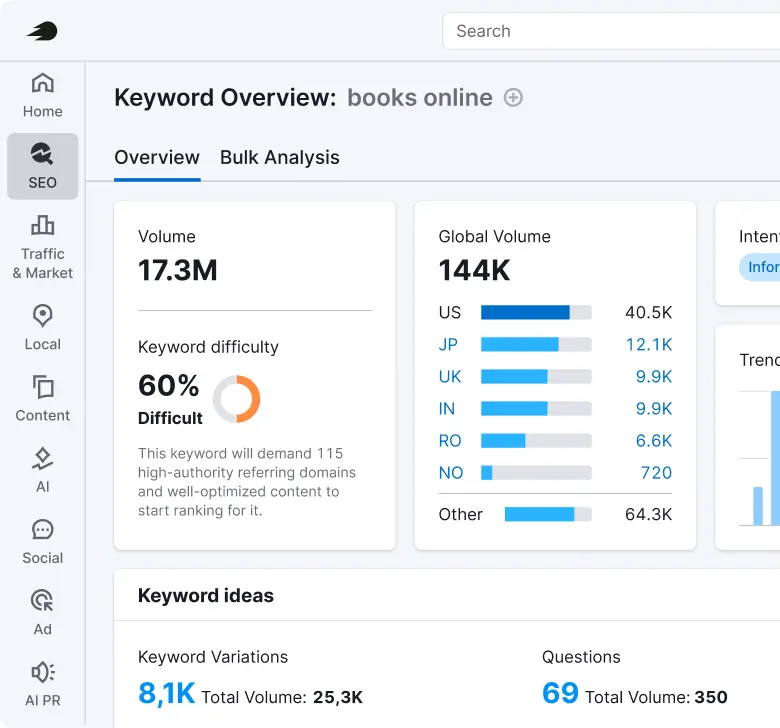
At the center is a large comparative database. Enter a domain you do not own and Semrush estimates the terms it ranks for, the pages attracting search traffic, the paid ads it appears to run and the sites linking to it. These are modeled observations, not a rival’s private analytics. Treat the figures as directional intelligence. Trends, gaps and relative movement are generally more useful than pretending an estimated visit count is an audited fact.
Find the opening
Keyword Magic, Keyword Gap and Organic Research turn a vague topic into specific queries, intent and competing pages.
Inspect the plumbing
Site Audit crawls your pages, groups technical problems and gives a health score that can be tracked after fixes.
Watch the scoreboard
Position Tracking follows a chosen set of terms by device and location instead of making you repeat manual searches.
Read the new room
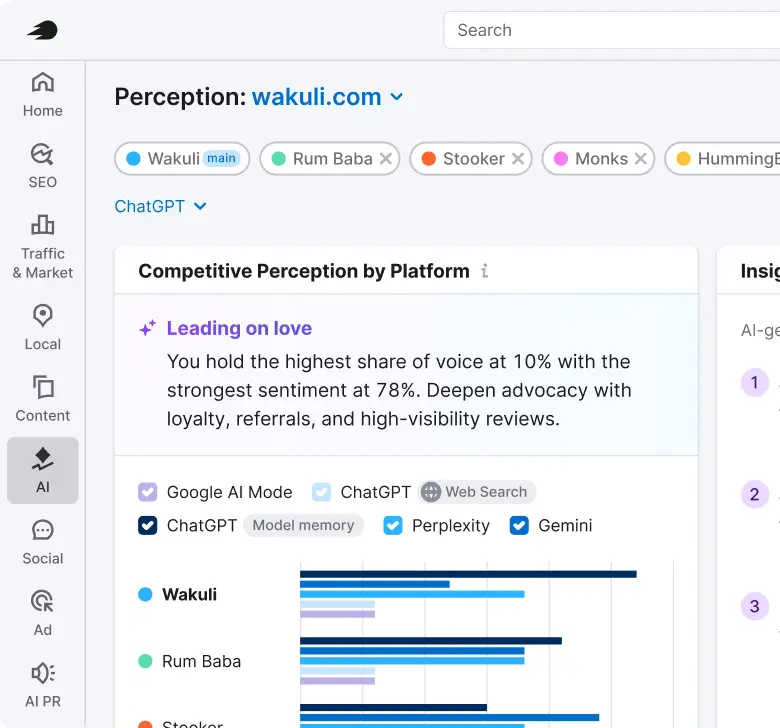
AI Visibility examines mentions, citations, sentiment and competitor share across supported answer engines.
Backlink Analytics adds another view of the neighborhood: who cites whom, which competitors have links you lack, and whether a new referring domain looks promising. The content products can carry research into briefs and drafts. Reports and Looker Studio integration move findings out to people who will never volunteer to explore a 40-item sidebar.
Begin with a decision, not a dashboard tour. “Which product category can we credibly win?” produces a better first week than clicking every report.
AI answers joined the spreadsheet
Semrush’s most consequential recent move is the jump from search-engine optimization to brand visibility. Semrush One bundles the classic SEO toolkit with AI Visibility. The newer reports track whether a brand is mentioned in answers, which pages are cited, how the description sounds and which competitors own more of the conversation across services such as ChatGPT, Gemini, Perplexity and Google’s AI experiences.
That connection is the interesting part. A stand-alone AI tracker may tell you that a competitor appears more often. Semrush can lead from that gap into the competitor’s ranking content, backlinks and related keywords. The result is closer to a work queue. It still does not implement the strategy for you, and an AI-generated recommendation deserves human judgment before it becomes a publishing brief.
These are Semrush’s published dataset figures in August 2026. Database size signals coverage, not automatic accuracy for every niche, country or phrase.
The invoice is part of the product
The buying page deserves the same attention as the dashboards. SEO Classic starts at $139.95 a month. AI Visibility starts at $99 a month per domain. Semrush One bundles both from $199.95 a month. Separate starting prices include $20 for Social, $30 for Local, $60 for Content, $99 for Advertising, $149 for AI PR and $289 for Traffic & Market. Enterprise plans are quoted.
| Route | Starts at | Best fit | Watch closely |
|---|---|---|---|
| Free tools | $0 | Sampling reports and learning the vocabulary | Tight limits and no serious ongoing workflow |
| SEO Classic | $139.95/mo | Traditional SEO research, audits and tracking | Projects, tracked keywords, users and API access |
| AI Visibility | $99/mo | One brand focused on answer-engine monitoring | Price is per domain and prompt capacity varies |
| Semrush One | $199.95/mo | Teams joining SEO and AI-search work | Higher tiers and add-ons raise the real total |
Do not compare only headline prices. List the domains, daily keywords, seats, crawl volume, reports and API units your team needs. Then model a normal month and a busy month. A cheap plan that repeatedly hits its limits is not cheap; a broad plan with six untouched toolkits is not value.
What working users keep saying
The review pattern is remarkably stable. G2’s public summary highlights comprehensive SEO insight, keyword research and competitor analysis, while its recurring complaint labels include expensive, high pricing and learning curve. Capterra’s summary similarly points to the database, accuracy and ease of use, with complaints about fragmented pricing and weaker coverage in some niches. TrustRadius reviews describe a comprehensive set of tools, alongside a familiar observation that specialists may prefer more focused alternatives.
Reddit supplies the less polished version. One long-time SEO wrote that “between Semrush and Search Console, 98% of my SEO needs are covered.” Another beginner called the experience “a nightmare,” while replies argued that any simpler, cheaper suite would also give up capability. These comments are anecdotes, not a vote. Together they describe the product honestly: powerful after you form a workflow, intimidating before you do.
Can three people name the report they will open every week?
If yes, the connected suite can repay its cost in shared research and fewer hand-built exports. If no, buy the narrower tool and keep the leftover budget for the person who will act on the data.
Semrush versus the field
Ahrefs is the closest default comparison. Its identity remains more concentrated around search, links and content discovery, while Semrush stretches further into paid media, local, social, market intelligence and now AI visibility. Moz Pro offers an approachable SEO suite with familiar authority metrics. Similarweb leans toward market and traffic intelligence. Screaming Frog is a desktop crawler rather than a full competitive platform, but it is a sharp alternative when the job is primarily technical auditing.
| Product | Natural center of gravity | Choose it when |
|---|---|---|
| Semrush | Connected search and marketing intelligence | Several disciplines need one shared research layer |
| Ahrefs | SEO, content and backlink exploration | The team wants a more search-centered daily workspace |
| Similarweb | Traffic, audience and market intelligence | Category and channel benchmarking lead the brief |
| Screaming Frog | Technical crawling | You need deep site inspection without a broad suite |
No vendor sees a competitor’s private Search Console or analytics. Run the same five domains and ten business-critical keywords through your finalists during a trial. Look for useful discrepancies, country coverage and exports your team can understand. The prettiest total is less important than whether the tool finds the same opportunities your customers actually search for.
Adobe enters the search box
Adobe completed its roughly $1.9 billion acquisition of Semrush in April 2026. By June, the companies had announced Adobe Brand Visibility, joining Semrush’s search corpus and AI visibility intelligence with Adobe’s enterprise content and customer-experience products. Semrush remains available to customers ranging from small businesses to enterprises, and the company has kept shipping under its own name.
Recent releases show the direction. The AI database expanded internationally. Enterprise products gained analysis of search and AI crawler logs. MCP connections brought Semrush data into Perplexity and, in August, a native Claude connector. Crazy Egg arrived in the App Center the same month. The platform is becoming both a destination and a data source that can meet marketers inside other tools.
Your seven-day buying plan
Use the trial like a short consulting engagement. Gather your five most valuable pages, three honest competitors, two locations and the questions customers ask before they buy. Connect only the properties you are comfortable sharing. Set up one project, not every possible project, and record the baseline before changing the site.
- On day one, compare the three rivals and save five plausible gaps.
- On day two, crawl the site and separate revenue blockers from cosmetic warnings.
- On day three, track a small keyword set with the correct location and device.
- On day four, inspect backlinks and AI citations without treating either score as gospel.
- Before the trial ends, export one report and assign every useful finding to an owner.
Then count. How many decisions changed? How many hours did the platform save? How many findings have an owner and a due date? If the answer is mostly “we found interesting charts,” cancel. Semrush is an observatory, not an implementation crew. Its value appears only when someone leaves the telescope and changes the site.
Relevant links
Go straight to the product, documentation and live company channels. Pricing and limits change, so confirm the current checkout terms before committing.