The first question in any Rows review is no longer whether it can replace your Monday-morning CSV ritual. It is whether you can use it at all. Rows announced in February 2026 that Superhuman had agreed to acquire the company and that the standalone product would fully wind down on May 31. For a buyer, the verdict is brutally short: do not start a new workflow there. For a former user, or anyone designing the next generation of office software, the longer answer is worth reading.
Rows is a discontinued standalone product. Its public pages remain useful as documentation, but your buying decision should begin with migration, not a free trial.
That is because Rows had a coherent idea hiding beneath the cheerful gradients. A spreadsheet should not spend its life waiting for somebody to drag a CSV into it. It should fetch data from the tools where work happens, understand the untidy bits, help with the analysis and publish the result without turning every chart into a screenshot. Rows built that loop for people in marketing, sales, finance and operations who knew enough spreadsheet logic to be dangerous, but did not want to become data engineers.
If your week involved pulling Google Analytics, Stripe, HubSpot or bank transactions into a report, Rows was aimed squarely at you. If your livelihood depended on a 70-tab financial model, an offline workbook or Excel macros older than some colleagues, it was not. The product sat in the lively gap between a conventional spreadsheet, a connector service and a lightweight business-intelligence tool.
01 / The origin cellA spreadsheet built by people tired of spreadsheet chores
Humberto Ayres Pereira and Torben Schulz began the company in 2016, first calling it dashdash. The useful creation myth is pleasingly ordinary: at an earlier online food business, the pair used spreadsheets for clients, revenue, margins and marketing. They liked the freedom of the grid and disliked the shuttling of data around it. In 2020, dashdash became Rows. A public beta followed in 2021 after a long waitlist era.
The financing matched the size of the ambition. Accel led an $8 million Series A. Lakestar led a $16 million Series B, with Accel, Cherry Ventures and Christian Reber participating. Rows was trying to improve a category whose incumbents had decades of shortcuts, edge cases and corporate muscle. Catching up on basics while inventing a new data layer was slow work. The company later described its million-user moment as an overnight success that took eight years.
“People want to create their own tools. They want to understand and test and iterate.”Humberto Ayres Pereira, speaking to TechCrunch in 2021
The quote explains the product better than the usual “Excel with superpowers” pitch. Rows did not ask users to abandon cells, formulas and tables. It let a cell call an API, send data or repeat a job. Its Matrix data type even treated JSON and cell ranges as cousins, which meant familiar functions could operate on the nested output returned by web services. That is the sort of plumbing nobody puts on a billboard and everybody misses when it breaks.
02 / What clickedLive data went in; a presentable answer came out
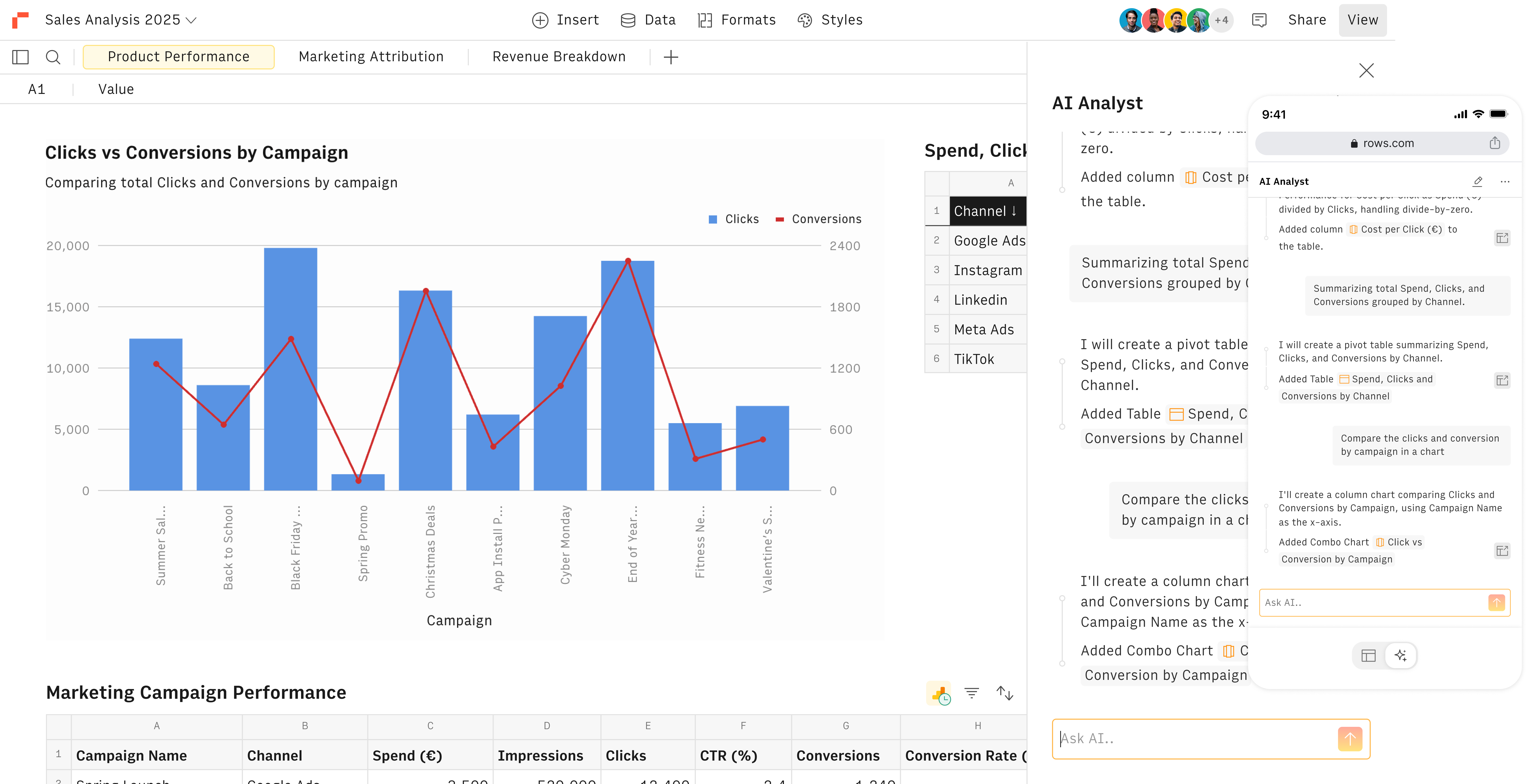
By its final version, Rows connected more than 50 sources. The list ranged from Google Search Console, GA4 and ad platforms to Notion, Stripe, Salesforce, HubSpot, BigQuery, Snowflake, MySQL and PostgreSQL. HTTP functions handled custom endpoints, while the Rows API let outside systems read and update spreadsheet ranges. Data Tables could refresh on a schedule, every day on Plus or as often as every minute on Pro.
CRM · ads · bank · API
AI · formulas · Python
report · embed · form
The clever bit was continuity. Updating the source did not require rebuilding the report from a fresh export.
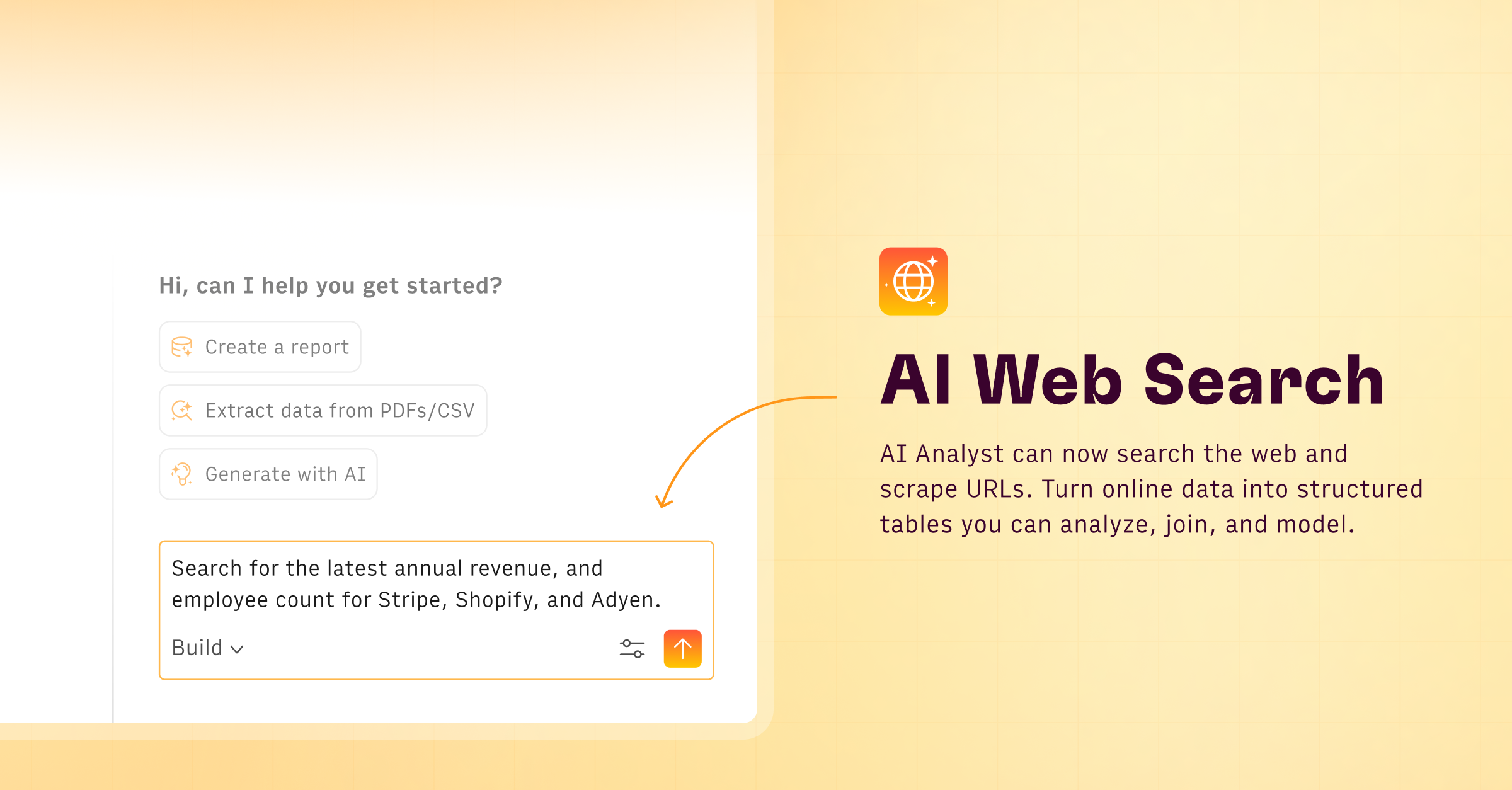
AI Analyst 6.4 sat on top of this connected grid. It could write formulas, clean columns, join tables, build models, format cells, create charts and, late in the product’s life, search the web or scrape a supplied URL. Checkpoints made a sequence of AI edits reversible. AI Replays saved a successful conversation as a repeatable workspace routine, a prompt-era cousin of the macro.
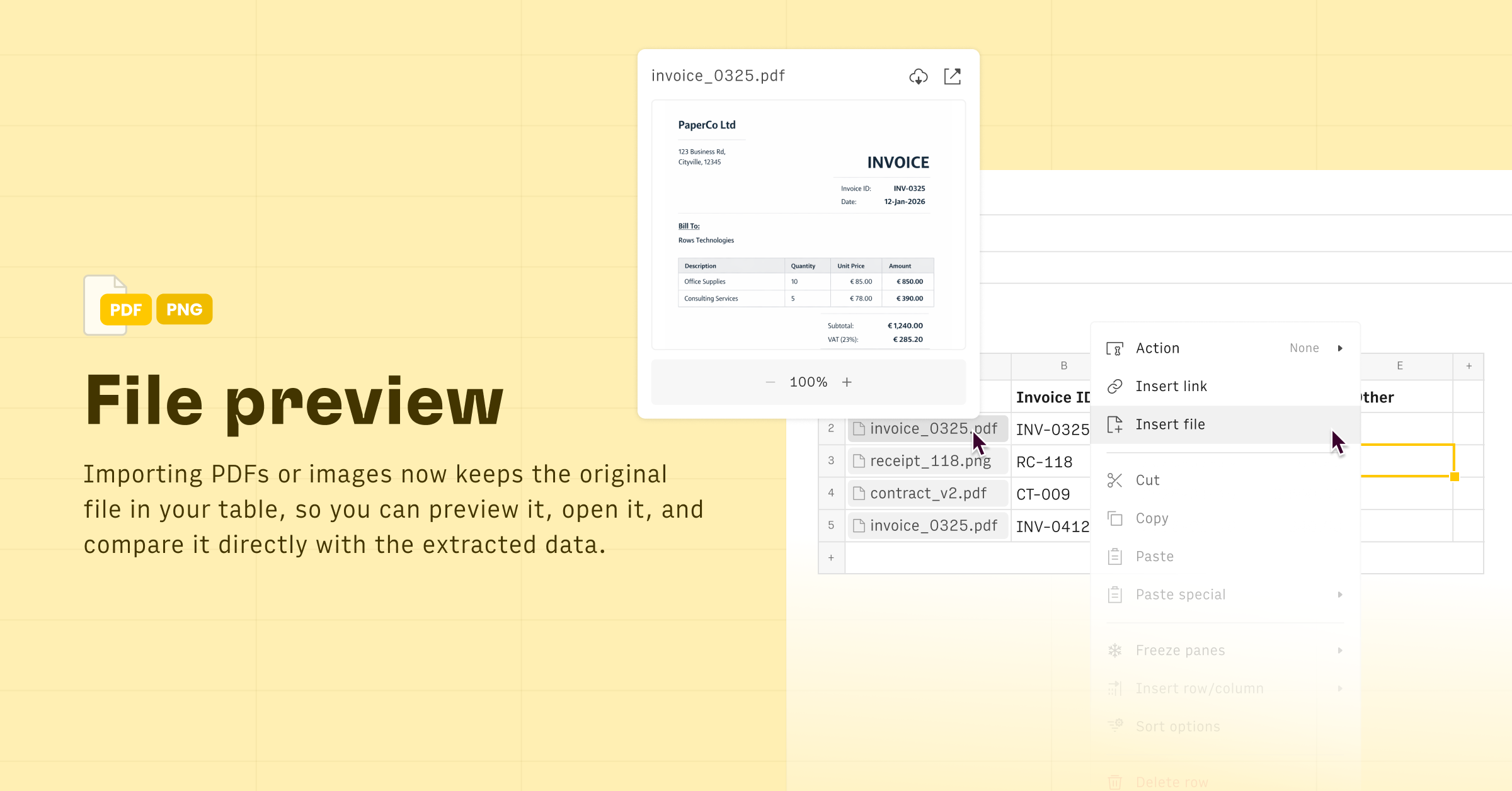
Rows Vision addressed another familiar nuisance: the invoice, receipt or report that arrives as a PDF or image. Users could specify the fields they wanted, extract a batch into editable rows, and preview the original beside the result. Python 3.12 covered jobs the formula bar could not. Its sandbox included pandas, NumPy, SciPy, matplotlib, seaborn, scikit-learn and statsmodels, although network requests from Python were disabled.
The final step revealed Rows’ taste. A spreadsheet could become a clean view-mode report, an interactive form, a calculator or an embedded chart. You could decide which cells a viewer was allowed to touch. Reddit users noticed the visual difference. One called Rows better for “simple calculators and dashboards, nice web view” while still judging Excel the stronger spreadsheet overall. That tension was accurate, not damning.
03 / The honest fitWho loved it, and who kept Excel open
Rows worked particularly well when the spreadsheet was a way station rather than a warehouse. A growth team could import campaign results, classify them, chart them and share a live weekly report. An operations lead could turn API responses into an internal tool. A finance team could collect transactions or extract invoice fields. A founder could build a calculator that behaved well on a phone. Those are specific, repeatable jobs with a clear source and audience.
Clear fit
Small and midsize teams repeatedly moving cloud data into reports, dashboards, lead lists or operating tools.
Good fit
Spreadsheet users who wanted AI to perform scoped edits while leaving a formula, table or chart they could inspect.
Awkward fit
People uncomfortable with spreadsheet logic. Rows simplified formulas, but the grid still expected structured thinking.
Poor fit
Huge offline models, macro-heavy Excel estates, or any workflow that now requires a supported standalone vendor.
Reviews praised the same combination. One G2 operations reviewer described Rows as the child of Excel and Zapier, then pointed to missing traditional spreadsheet features. Another valued first-class JSON support for joining APIs. The G2 page ultimately showed a 4.9 rating from 24 reviews, a small and plainly enthusiastic sample. On Reddit, comments were more mixed: people liked the aesthetics, embeds and improved AI, while others found the editor confusing or asked what it did that Excel could not.
That criticism matters. AI did not remove the need to ask a precise question. Rows’ own guide marked “clean rows” and “make a chart of the numbers” as bad prompts. It wanted a column, range, condition and intended result. The interface reduced syntax, but it could not supply intent. Nor could Rows match Excel’s depth or Google Sheets’ default place inside millions of organizations. A modern spreadsheet is still a spreadsheet, complete with blank-canvas anxiety.
04 / The money, thenHistorical pricing that no longer buys a future
Rows’ last published plans were reasonable for a specialist team tool. Free offered unlimited spreadsheets, five monthly AI tasks, manual Data Table imports and 500 API calls. Plus cost $8 per user each month, or $6 on annual billing, with 200 AI tasks and daily refreshes. Pro added a $79 monthly base plus $8 per user, or $59 plus $6 per user annually, with 1,000 AI tasks, minute-level updates and one million API calls. Enterprise was negotiated. Taxes were extra.
Those numbers are historical, not an invitation to buy. They do reveal Rows’ commercial bet: ordinary spreadsheet editing was cheap; connected, automated data movement was the meter. That is useful when comparing replacements, because connector limits, refresh frequency and guest access can matter more than the sticker price.
05 / Your exit rowChoose the replacement by the job, not the resemblance
There is no perfect Rows clone, and searching for one can prolong the migration. Inventory each workbook first. Record its source connections, refresh schedule, formulas, scripts, permissions, embeds and downstream consumers. Export the underlying data and a formula-preserving format where possible. Capture screenshots of important layouts. Then rebuild one limited live workflow and reconcile totals before moving the rest.
| Destination | Choose it when | Watch for |
|---|---|---|
| Microsoft Excel | Model depth, large files, Power Query, mature formulas or offline work lead the brief. | Publishing and browser collaboration can feel heavier; recreate live SaaS connections carefully. |
| Google Sheets | Familiar browser collaboration, easy sharing and broad organizational adoption lead the decision. | Complex or very large workbooks may slow down; connectors often come from add-ons. |
| Coda | The spreadsheet sat inside a larger team workflow with docs, buttons, automations and structured tables. | It is a different mental model, not a cell-for-cell replacement. The Rows team is contributing here. |
| Airtable | Your “spreadsheet” is really an operational database with records, views, forms and automations. | Formula modeling and free-form grid work are less central than in a classic sheet. |
| Sheets + connector | Rows mainly moved marketing or sales data. Pair Sheets with Supermetrics or a similar service. | Price the connector, destinations and refresh limits together, not as separate purchases. |
Do not migrate dead dashboards. A sunset is permission to ask who still reads each report and what decision it changes. Archive the ornamental ones. For the survivors, assign an owner, a refresh promise and a test value. If a weekly revenue table moves, compare row counts, currencies, date boundaries and a known total in both systems. An attractive chart can conceal a broken filter with remarkable confidence.
Security deserves its own pass. Revoke old integration tokens, rotate API keys, remove scheduled jobs and confirm that public embeds no longer expose data. Ask Rows support about account-specific export or deletion details rather than inferring them from an old help article. The public contact is support@rows.com.
06 / What survivesThe workbook closed; the argument won
Rows said more than 2.2 million people used the product, running over 17 billion spreadsheet functions, 8.3 billion business-tool imports and 800,000 AI Analyst prompts. In 2025 alone, it reported 30,000 weekly active teams. Those figures came from the company, but they make the acquisition legible: Rows accumulated hard-won knowledge about connectors, calculation, AI edits and the peculiar way business users think in grids.
Superhuman said the Rows team would join from Porto and strengthen Coda’s connection between collaborative work and data analysis. That is a sensible destination. Coda already mixes documents, structured tables and automations, while Superhuman’s broader suite includes Grammarly, Mail and Go. The standalone brand may be over, but the product ideas have somewhere to travel.
The key Rows lesson is modest. Business users rarely need a magical answer floating beside their data. They need a result placed into the table, tied to a source, open to inspection and easy to rerun next Tuesday. Rows understood that unusually well. Its AI made things; its integrations kept them current; its sharing layer gave them an audience. The company did not unseat Excel. It did leave the old grid looking less inevitable.