The office AI problem is no longer access. Anyone can open a chat box and ask for a tidy paragraph. The problem is that the useful facts are marooned across Slack, Notion, Drive, GitHub, Salesforce and the private memory of the person who knows why the spreadsheet has three tabs named FINAL. Dust is built for the moment after curiosity, when a company wants AI to know its work, use its tools and behave like a colleague who can be corrected.
That makes Dust most interesting for teams with a recurring mess and a willing owner. Think support leaders who keep rebuilding the same incident brief, sales operations teams reconciling calls with CRM records, or analysts fielding the same metric question every Monday. Dust lets those people build specialized agents, share them with colleagues and connect them to approved company systems. A solo user seeking clever conversation can buy a direct model subscription and call it a day. Dust earns its keep when context and collaboration matter.
Why the flock beats the lone chatbot
Founders Gabriel Hubert and Stanislas Polu started Dust in early 2023 after working at Alan, Stripe and OpenAI. Their original wager was that no single model would rule every task, and that private company data would matter more than another polished prompt box. That bet has aged well. Dust now offers more than 20 frontier and open-source models from OpenAI, Anthropic, Google, Mistral, DeepSeek and others. The model can change while the workflow, permissions and connected knowledge remain.
The product has also changed its noun. Early Dust coverage talked about custom assistants. The current version talks about agents, skills, triggers, Frames and Pods. The vocabulary can feel like a small petting zoo, yet the underlying idea is sensible: different jobs deserve different instructions and tools. A support agent needs ticket history and an escalation policy. A proposal agent needs past wins and current CRM data. Giving both of them access to everything would be lazy design and a security headache.
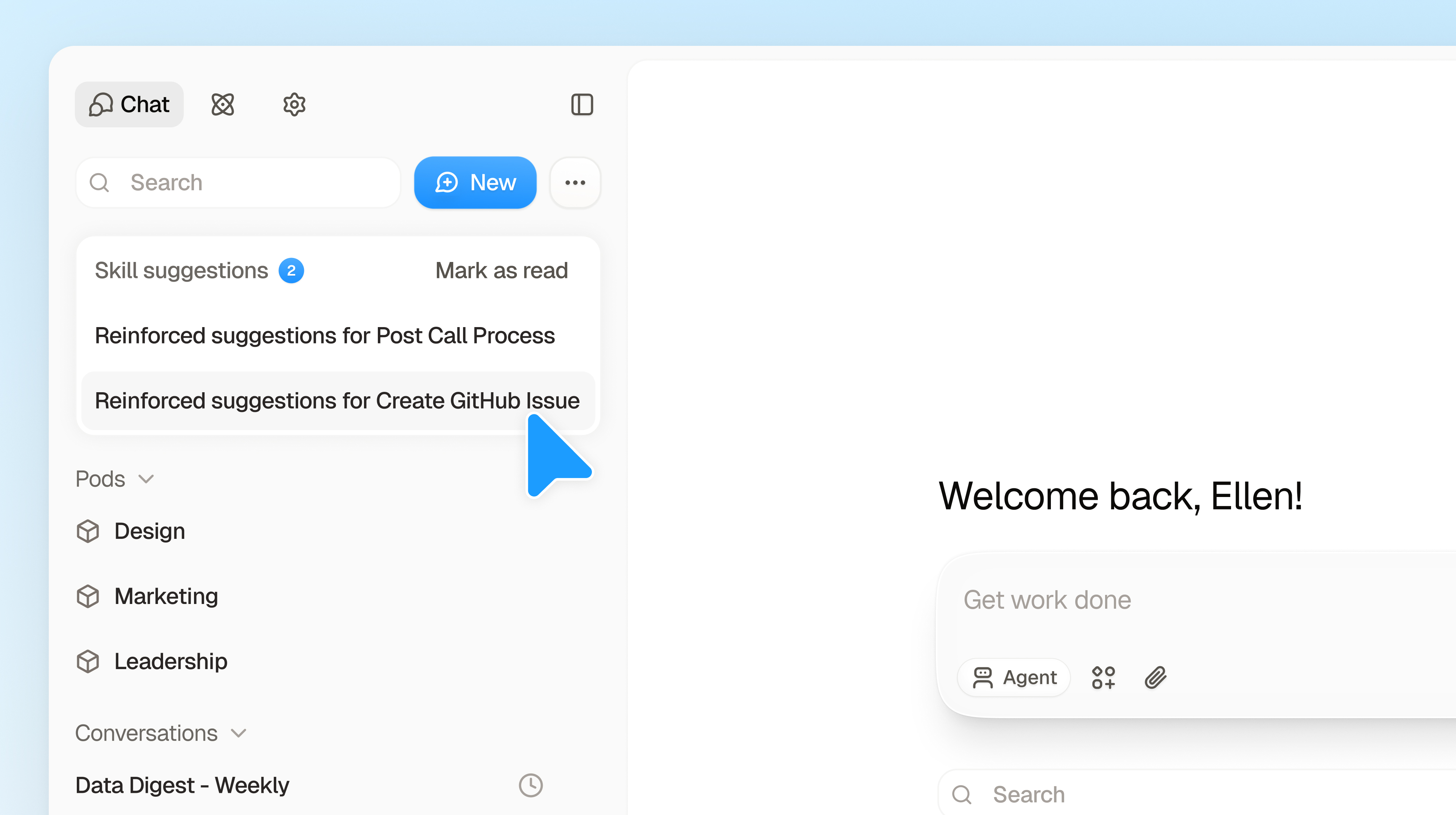
What happens after you connect the pipes
Connections keep third-party knowledge synchronized. Pods are newer shared spaces where a team and its agents gather conversations, files and tasks around a project. Agents can write files, pick up tasks and hand work to other agents; people can inspect the same history and steer the work. Dust's documentation is explicit that everyone inside a Pod sees everything in it, so sensitive work belongs in a separate restricted Pod. This is a useful constraint, not a footnote.
CRM
Docs
+ Pods
+ Skills
+ Review
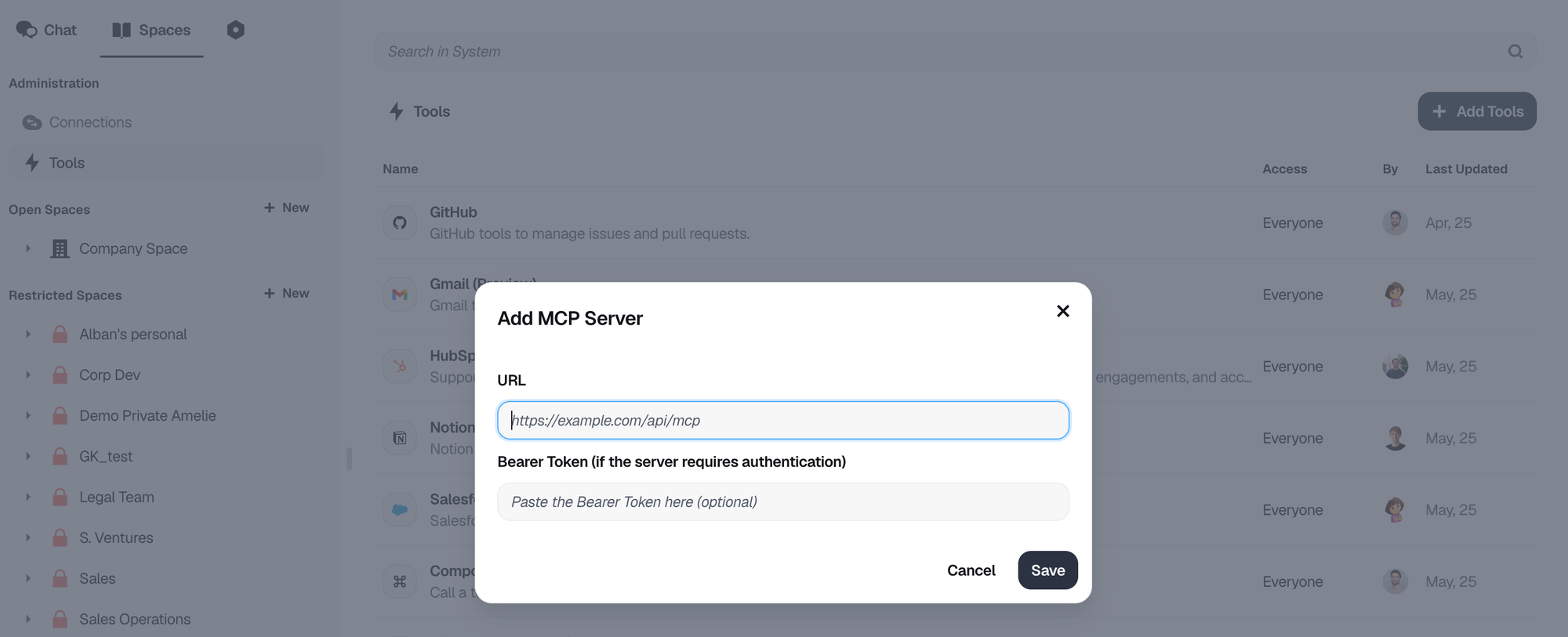
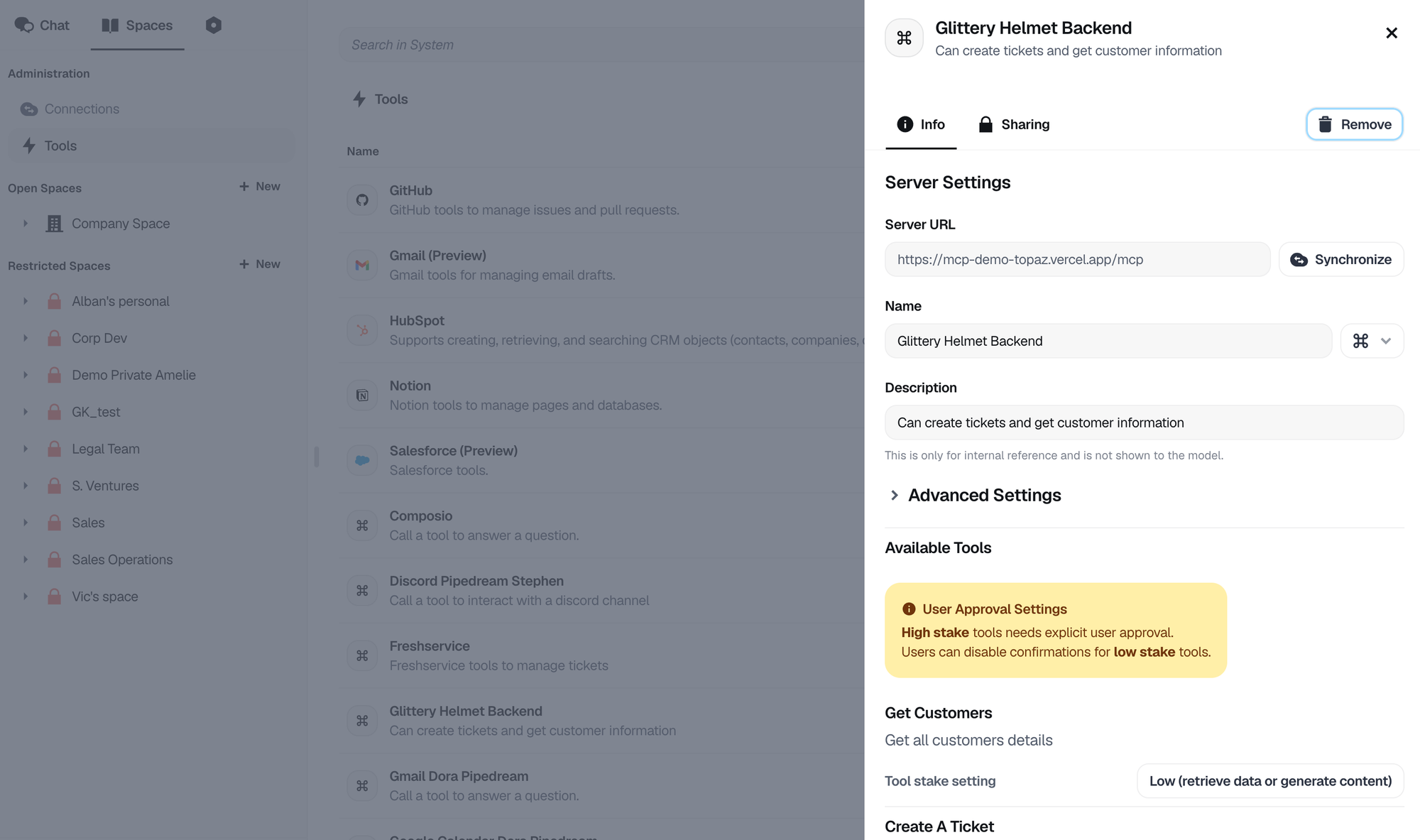
MCP servers widen the action surface. Dust can use native connectors and remote Model Context Protocol tools, while custom MCP servers provide a doorway into internal systems. In Dust's own demo, a fictional support agent retrieved customer details, searched for related issues and created a structured ticket. The attractive part is not the demo ticket. It is that an administrator can define the doorway and its approval level instead of giving a model a master key.
Triggers and schedules move agents beyond on-demand chat. The browser extension can read the current page, capture screenshots, work across tabs and click or fill forms after requesting permission. Slack gives teams another surface. In April 2026, Steering added the ability to send fresh instructions while an agent is working, with live views of searches and tool calls. Anyone who has watched an agent confidently tour the wrong neighborhood will understand the appeal.
“We used to do the work. Now we build the agents that do it.”Shashank Khanna, Vanta, quoted by Dust
The real product is operating discipline
Dust calls its hands-on builders “AI Operators.” The label is a little grand for someone automating QBR preparation, but it points to the correct buyer. A successful agent needs a person close enough to the workflow to spot a bad assumption, update a skill and decide when review is mandatory. Forbes reported that Dust had passed 3,000 organizations and 300,000 deployed agents by May 2026. Vanta's published case study says its GTM workflows save roughly 400 hours a week on quarterly business review preparation. Those are company-supplied numbers, but the shape of the result is credible: many small retrieval and drafting steps, repeated at scale.
The quieter examples may be more persuasive. Dust says Wayflyer cut the time spent maintaining support runbooks by more than 90%. Blueground reported 20% faster support resolution after connecting agents to Zendesk. In 2024, TechCrunch reported that 75% of Qonto's 1,600-person team used Dust monthly, while 80% of Alan used it weekly. Adoption is the graveyard of enterprise AI pilots, so repeated use matters more than a dazzling demo.
Pricing: count credits before sheep
Dust's Business plan now mixes seat pricing with credits. A Free seat includes 500 lifetime credits. Pro is $30 a month, or $24 per month billed yearly, with 8,000 monthly credits. Max is $150 monthly, or $120 on an annual term, with 40,000 credits. Enterprise pricing is negotiated and adds pooled credits, volume pricing, unlimited connectors and MCP servers, advanced governance and support. Unused monthly credits do not roll over.
Credit use varies with the model, task complexity, retrieval, code execution and connected actions. That makes a spreadsheet comparison incomplete. A short chat and a deep research workflow do not cost the same, even when the seat label does. Programmatic Conversation API use on Business is listed at $0.01 per credit, and Dust has added API-key and daily spending caps. The buyer's move is obvious: run a four-week pilot on actual work, separate light users from power users, and record credits per completed outcome.
| Option | Center of gravity | Good fit | Watch closely |
|---|---|---|---|
| Dust | Multi-model agents, shared context and connected actions | Cross-tool workflows owned by business teams | Credit burn, permissions and agent maintenance |
| ChatGPT Enterprise | General AI workspace with enterprise controls | Broad individual and team AI use | How deeply each workflow needs custom orchestration |
| Microsoft Copilot Studio | Agents in the Microsoft business stack | Organizations centered on Microsoft 365 and Power Platform | Platform complexity and ecosystem dependence |
| Glean | Enterprise search, knowledge and assistants | Companies prioritizing discovery across many repositories | Whether action-heavy workflows or search come first |
What users like, and where it gets fiddly
Public discussion outside customer stories is still thin for a product sold largely to companies. The official Chrome extension has a 4.5 rating from 25 ratings and lists 20,000 users. A technical Reddit thread called the agent orchestration “pretty solid,” then questioned how far custom models and advanced RAG pipelines could be pushed without workarounds. That is a fair dividing line. Dust reduces the effort required to assemble company-aware agents; it does not remove architecture from ambitious deployments.
The browser extension deserves a deliberate permission review. Its usefulness comes from seeing page content and, when allowed, interacting with tabs. Dust says access is requested explicitly and that it only processes content users choose to share. Administrators should still test those controls against company policy. The same principle applies to MCP tools: start read-only, add narrow write actions, require approval for costly or irreversible steps, and examine audit logs before widening access.
Choose Dust when
You have repeatable work crossing several systems, need model choice, and can name the person who will own each agent after launch.
Keep shopping when
Your need is mostly personal chat, your knowledge already lives inside one vendor suite, or nobody has time to govern workflows and credits.
A sensible first month
Do not begin with “AI transformation.” Begin with a task people already resent. Pick one workflow with a visible input, a checkable output and enough repetition to learn quickly. A weekly account brief is better than “make sales smarter.” Support classification is better than “automate customer experience.” Then keep the first agent narrow.
- Name an owner. The builder should understand the process and have authority to improve it.
- Limit the context. Connect only the spaces and systems needed for this job.
- Set a baseline. Measure current time, error rate and handoffs before the agent arrives.
- Require review. Drafts and read actions are good opening moves; external writes can wait.
- Track cost per outcome. Credits per finished brief are more useful than credits per chat.
- Publish the lesson. Save the working instructions as a skill and document the failures too.
Dust's durable advantage may be its refusal to marry one model. Models improve, prices move and yesterday's default becomes tomorrow's dropdown option. The company keeps the valuable layer elsewhere: permissions, connected context, shared memory and the habits a team develops around its agents. That layer is harder to demo in thirty seconds, but it is where enterprise software either becomes work or becomes shelfware.
The verdict is practical. Dust is worth a serious pilot for teams prepared to operate agents together. Its product makes the organizational work visible rather than pretending a prompt can replace it. Bring one ugly process, one skeptical reviewer and a calculator for credits. If the agent survives all three, invite it to the group chat.