The most revealing thing about Primo Brands is how easy it is to miss. Its corporate name is barely two years old. Its products are not. Open a refrigerator in Maine and find Poland Spring. Walk through a Florida supermarket and see Zephyrhills. A hotel might set out Pure Life; a restaurant might pour Saratoga; an office might park a blue five-gallon Primo jug on a dispenser. What looks like a noisy collection of unrelated water choices is, increasingly, one operating system.
Primo Brands was formed in November 2024 by the all-stock combination of Primo Water and BlueTriton Brands, the former North American water business of Nestlé. BlueTriton brought famous retail labels and regional spring-water strength. Primo Water brought a less glamorous but unusually sticky apparatus: home and office delivery, refill kiosks, bottle exchange and the machines that dispense the water. The deal put 30 brands, a coast-to-coast network and two distinct corporate histories under one roof.
That roof has two addresses, in Tampa and Stamford, and shelters more than 12,000 employees. In 2025, the first full year at combined scale, the company recorded $6.7 billion in net sales. Poland Spring and Pure Life each contribute more than $1 billion annually. Yet the company’s most useful story is not its size. It is how thoroughly Primo has surrounded the everyday act of getting a drink.
One company, several drinking habits
Most beverage companies win a moment: the cold can at lunch, the bottle after a workout, the case placed in a pantry. Primo wants all of them. It sells still spring water, purified water, premium glass bottles, sparkling water and fruit-flavored drinks. It appears in supermarkets, drugstores, mass merchants and convenience stores, but also in schools, restaurants, hospitals and hotels. Then it bypasses the store with scheduled deliveries to homes and businesses.
The customer base is correspondingly broad. A grocery buyer can treat Primo as a category partner with national and regional labels at multiple price points. A household can buy a dispenser and exchange an empty multi-use bottle for a full one at a nearby retailer. Another customer can refill a bottle at a self-service station. An office manager can subscribe to delivery or filtration. Each option solves a slightly different problem: portability, taste, distrust of aging pipes, convenience, bulk supply or the simple wish to stop carrying cases from the car.
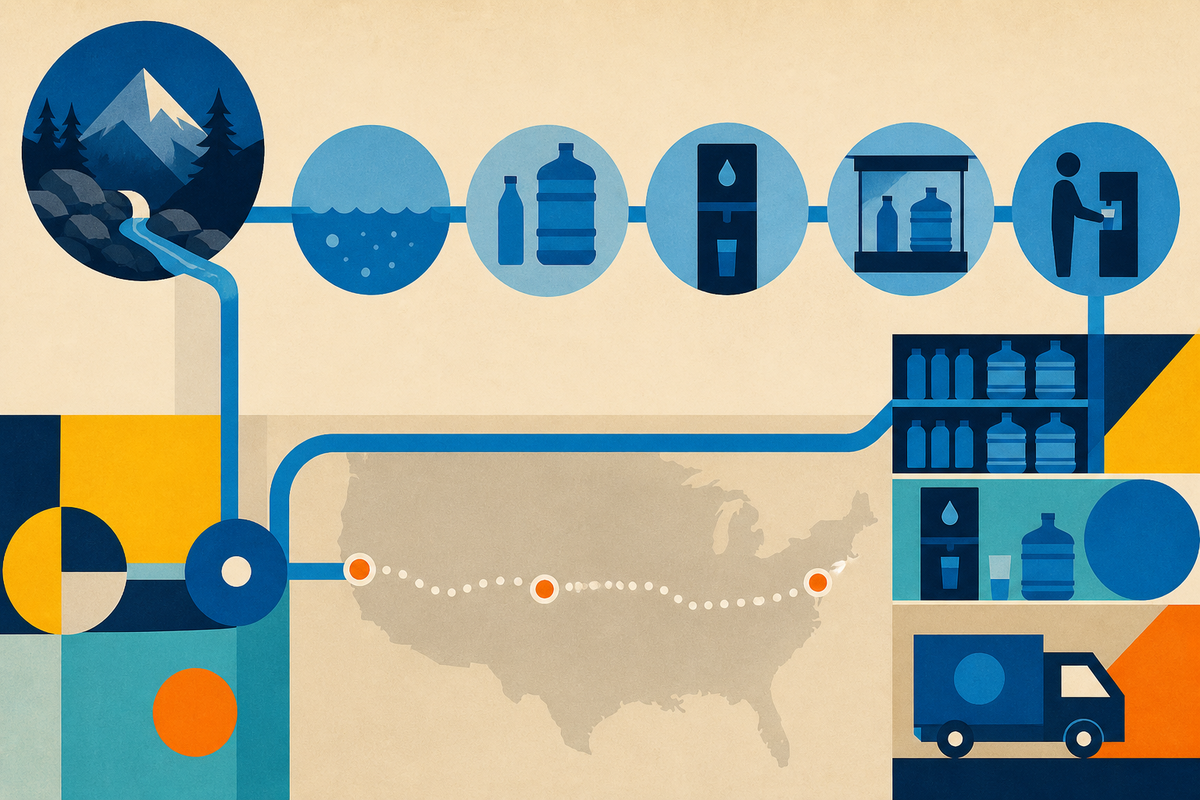
source
plant
delivery
refill
The loop matters: a dispenser creates a place for the product, while delivery, exchange and refill create reasons to return.
The dispenser is a quiet subscription
A branded bottle competes again every time a shopper reaches for the shelf. A dispenser changes the geometry. Once the appliance occupies a corner of a kitchen or break room, the next decision is narrower: where does the next jug come from? Primo’s exchange program lets customers buy a full multi-use bottle at roughly 26,500 locations, then return the empty for a discount. Its refill network offers more than 23,500 places to fill one. Direct Delivery makes the trip disappear.
This is the flywheel hiding inside a commodity. The hardware creates what the company calls consumer connectivity. The heavy, awkward container encourages a routine. The routine produces recurring revenue. It also gives Primo information and relationships that an anonymous bottle sold through a retailer cannot. Water itself is difficult to differentiate indefinitely; a convenient system is harder to replace on impulse.
“The network is the product that nobody drinks.”A useful way to read Primo Brands
The portfolio supplies a second advantage. Regional spring labels preserve origin stories and local recognition: Arrowhead in the West, Ozarka in Texas, Zephyrhills in Florida, Deer Park in the East and Ice Mountain in the Midwest. Premium brands Saratoga and Mountain Valley can occupy restaurant tables and glass-bottle occasions. Pure Life travels nationally. Primo Water and Sparkletts fit large-format and delivery routines. The labels stay distinct while manufacturing, procurement, distribution and customer relationships can be coordinated behind them.
Water is local, heavy and repetitive
Those three facts explain Primo’s place in the market. Shipping water over great distances is expensive because the product is, almost comically, mostly weight. Spring sourcing is tied to geography. Demand repeats daily. A company that can source regionally, operate nearby plants, fill trucks efficiently and keep shelves stocked has an advantage that advertising alone cannot create.
Primo says its network reaches more than 200,000 retail outlets across every U.S. state and Canada. It manages more than 80 springs and says it helps conserve over 28,000 acres. Its expertise is therefore wider than beverage marketing: hydrogeology, source protection, food safety, packaging engineering, route planning, fleet operations, equipment maintenance and retail execution all sit inside the same business. In 2025, the company says products, sources, packaging and refill equipment were tested more than 160,000 times.
The competition is bigger than Dasani versus Deer Park. Coca-Cola, PepsiCo, Danone and regional bottlers fight for shelf space. Retailers push their own cheaper private labels. Filters from a refrigerator, pitcher or whole-house system can eliminate the bottle. Municipal tap water costs almost nothing by comparison. Coffee, tea, soda, energy drinks and every other nonalcoholic beverage compete for the same occasion. Primo’s answer is breadth: many labels, many formats and unusually many paths to the customer.
The merger slide meets the delivery route
On paper, the combination was tidy. One side was strong in branded retail water; the other was strong in reusable large-format water and direct service. Management initially identified $200 million in annual run-rate cost synergies, later raising the target to $300 million by the end of 2026. Procurement, plants, technology, call centers and corporate functions all offered savings. The combined company also had more leverage with retailers and more ways to extend a successful brand.
But water routes are not spreadsheet cells. During 2025, the integration brought service disruptions and higher costs. The annual results included nonrecurring integration expenses, and management changed at the top, with Eric Foss becoming chief executive. By the first quarter of 2026, sales had returned to modest growth: $1.626 billion, up 0.8 percent year over year, with premium water particularly strong. Adjusted EBITDA, however, fell 10.4 percent and transportation and integration costs weighed on margins.
The operating question
Primo does not need to prove that people buy water. It needs to prove that a vast portfolio and delivery network can feel reliable at the level customers notice: the right bottle, on the right shelf or doorstep, at the promised time.
That distinction matters. A missed marketing campaign can be repaired next quarter. A missed home delivery leaves an empty dispenser in the room. The company’s differentiation depends on executing thousands of small, physical promises. The merger’s strategic logic will be judged less by the elegance of the portfolio chart than by route density, on-time service, product availability and whether savings survive contact with the customer.
A sustainability business with plastic in the room
Packaged water companies cannot discuss stewardship as an accessory. Water sources are the raw material, and containers are the visible residue. Primo frames its program around water stewardship, circular packaging, people and communities, and greenhouse-gas reduction. Its packaging mix includes recycled plastic, aluminum and glass, while the exchange and refill businesses keep large bottles in repeated use.
The company reported that watershed projects replenished more than 400 million gallons in 2025. It has a four-year partnership with The Ocean Cleanup supporting work in Los Angeles County waterways, and it backs River Partners’ restoration along California’s Sacramento and Feather rivers. In 2026, a 13-megawatt solar project began operating at a Poland Spring facility in Hollis, Maine. These are concrete programs, but they do not dissolve the central tension. The company’s growth still means packaging, trucks and extraction must be managed credibly at enormous scale.
Primo’s reusable formats offer the most intuitive response. A five-gallon bottle that cycles through exchange or delivery can replace many single-serve containers. Refill removes the need to transport finished water for part of the journey. Filtration competes with packaged water while remaining inside Primo’s own portfolio. Instead of betting that one format wins the environmental argument, the company owns several.
Where Primo fits
Primo Brands sits at an unusual intersection: consumer packaged goods company, logistics operator, appliance seller, subscription-like service and water-resource manager. That combination is more defensible than any one bottle, and more difficult to operate than a conventional beverage portfolio. It can meet a shopper at a convenience-store cooler, a family at a refill kiosk, a patient in a hospital or an office worker waiting for Tuesday’s delivery.
The company’s opportunity is to make those channels reinforce one another. A regional label can open the retail door. A dispenser can create repeat demand. Delivery can turn brand preference into a household habit. Premium water can raise the value of a restaurant occasion. The risk is that complexity travels through the same system: a technology failure can interrupt routes, a packaging increase can squeeze margins and a service problem can make customers notice the corporate name for the wrong reason.
For now, Primo Brands remains a paradox suited to the water business: ubiquitous but mostly invisible, familiar but newly assembled. Its labels have been on American tables for generations. Its corporate experiment is just beginning. The next chapter will not be decided by whether consumers feel thirsty. It will be decided by whether one company can reliably own the many ways they answer.