The first version of Apache Superset had three days to live, or at least three days to become interesting. In 2015, Maxime Beauchemin began it during an Airbnb hackathon. The brief was practical: give people a quick visual way to explore data held in Apache Druid. It worked. Then it spread beyond Druid, beyond the hackathon, and eventually beyond Airbnb. A decade later, Beauchemin’s company Preset earns money by solving the less romantic problem that follows a successful free tool: who runs it on Monday morning?
- Preset manages business intelligence built on Apache Superset, with dashboards, SQL exploration and embedded analytics.
- Its Starter tier is free for five users; Professional lists at $20 per user per month when billed annually.
- Preset reported more than 400 customers in March 2026 and raised a $7.27 million Series C.
- The practical bargain is open source flexibility in exchange for a paid operator, security layer and support.
Superset is software for turning database queries into charts, dashboards and questions a colleague can actually answer. Preset wraps it as a service. An analyst can connect a warehouse, build a dataset in SQL, let a business user explore it without code, and publish the result to a team or embed it in a product. The company also sells the unglamorous necessities: authentication, permissions, upgrades, logging and support.
An accidental product, an intentional company
Beauchemin had seen the gap first hand. Airbnb invested in Druid, Presto and Hive, while conventional BI tools did not fit neatly around those systems. His experiment became a way to see data across them. Superset later became an Apache project. In 2019, he announced Preset with a simple early ambition: hosted Superset on demand. He also wanted a business that could put money and staff back into the open source project.
That origin matters because Preset cannot pretend it invented a secret visualization engine. The engine is public. Anyone sufficiently determined can install Superset. Preset’s wager is that determination costs more than many teams expect once an experiment becomes a system with hundreds of users, sensitive fields and dashboards that must load before the weekly meeting. The first thing that tends to fail is rarely the chart. It is the surrounding operating routine: access rules, upgrades, performance, and the answer to a support ticket.
“While an early goal for Preset is to offer hosted, hassle-free Superset on demand, Preset's wider mission is to deliver modern, collaborative productivity tools.”Maxime Beauchemin, announcing Preset in 2019
Its business has followed that sentence. Preset Cloud became generally available in 2021, alongside a $35.9 million Series B. The current product extends from a free shared cloud workspace to managed private cloud deployments and an on-premises option. That range is unusual for a dashboard company because infrastructure choice is part of the sale. Some buyers are content with a shared service. Others require their analytics to live inside their own cloud account. Preset now offers managed private cloud on AWS, Google Cloud and Azure.
The dashboard is only the visible part
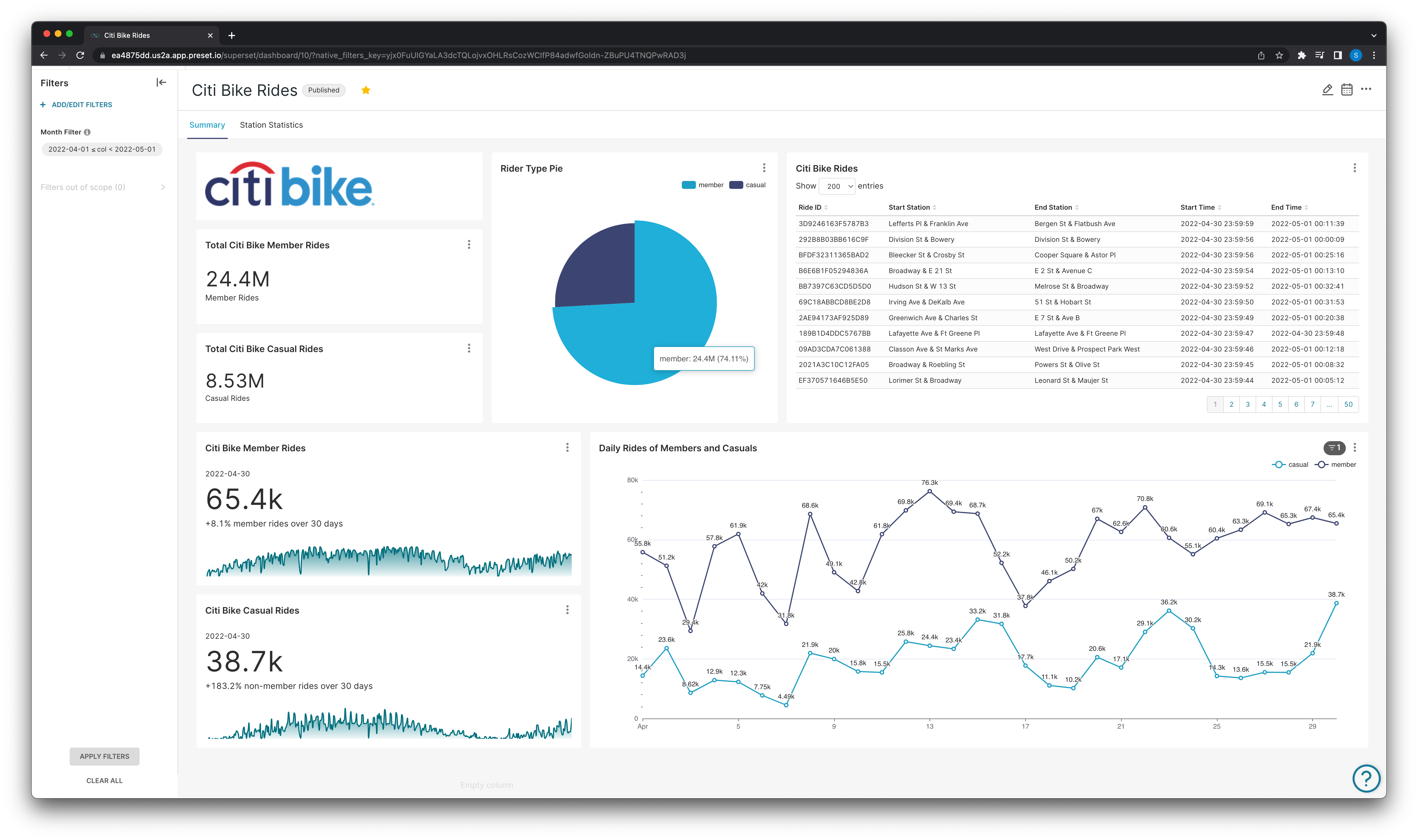
The product begins where most modern data stacks end: databases and warehouses such as Snowflake, BigQuery, Redshift and Databricks. Preset queries those systems and presents results through charts, tables, maps and dashboards. Its SQL editor serves analysts; its visual builder serves colleagues who would rather choose a metric than write a query. Shared datasets provide a common vocabulary, so a change in a metric definition need not be reargued in every chart.
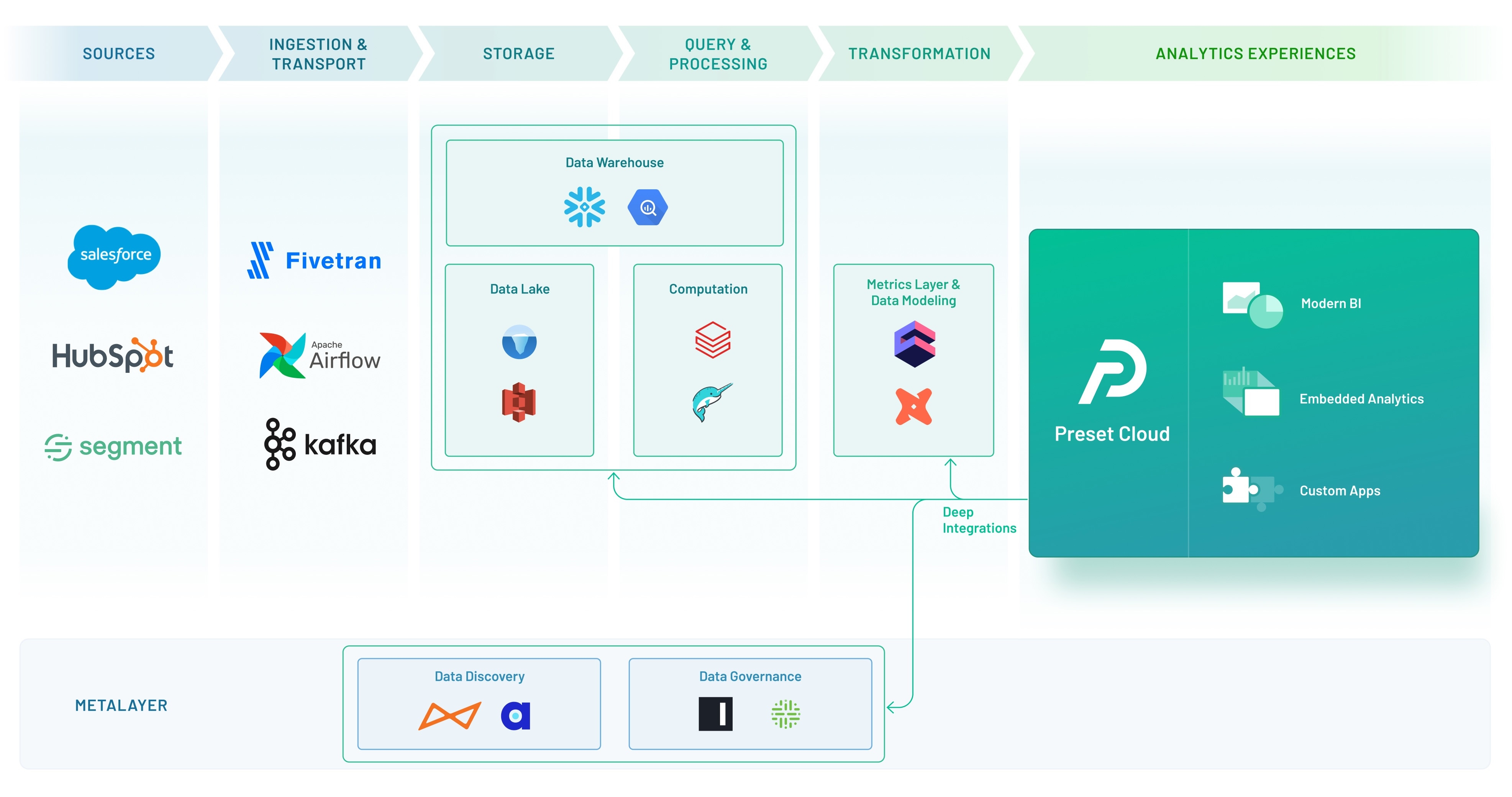
For software companies, Preset Embedded Dashboards put those visuals inside a customer-facing app. The embedding tools include domain restrictions and row-level security, which matters when one merchant must never see another merchant’s sales. For enterprise teams, API access, audit logs, single sign-on and managed private cloud address the work that turns a demo into a maintained service. The market alternatives include self-hosting Superset, or buying a more closed BI platform such as Tableau, Looker, Power BI or Metabase. Preset’s distinctive offer is that its core remains the open source project, giving customers an exit path in principle, even if a real migration still takes work.
What the buyer actually pays
The published price list gives the proposition a sharp edge. Starter costs $0 for up to five users and one workspace, with unlimited charts and dashboards. Professional lists at $20 per user per month when billed annually, or $25 month to month, adding unlimited users, more workspaces, role controls, scheduled reports and support. Enterprise uses custom pricing for private cloud, SSO, audit logs and other large-organization needs. Embedded viewer licenses begin at $500 per month for 50 viewers. These are list prices, not a promise that every deployment has the same bill.
The copyable test
Before choosing a BI platform, price the whole operating job. Count the people building charts, people only viewing them, infrastructure, access management, upgrades, training and the cost of a broken dashboard. Then test one governed dataset with real users. The cheapest license can be an expensive Tuesday.
There are conditions under which this bargain is less persuasive. A team with strong platform engineers and modest governance needs may prefer self-hosted Superset. A company already deeply invested in another vendor’s semantic model or reporting workflows may face enough migration work to stay put. A business that needs a very particular visual interaction should prototype it before signing; having 40-plus chart types is not the same thing as having the one chart that matters. Preset’s paid convenience is most valuable when its saved operating time and flexibility outweigh its subscription and implementation costs.
A revealing customer: OpenTable
OpenTable’s published story shows what adoption looks like when the challenge is human, not merely technical. Its global strategy, operations and analytics team wanted one reporting solution for people ranging from analysts to customer-facing staff. The team liked Superset’s flexibility and Preset’s hosted version was ready to use. The migration required a training curriculum, cleaned-up data models, consolidated sources and support for Google Sheets, which staff already used for ad hoc work.
“Preset is the primary BI tool for business users at OpenTable because of its self-service analytics capabilities.”Belinda Eg, VP of Global Strategy, Operations, and Analytics at OpenTable
The case study says roughly 400 colleagues gained self-serve access. The interesting part is what made that number possible: familiar inputs, shared definitions and planned change management. A dashboard platform can lower the effort of asking a question, but it cannot decide what a company means by “customer,” “active” or “revenue.” That work still belongs to people. Preset becomes more useful once they have done it.
A sensible sequence. The difficult work is agreeing on step two.
Now the questioner may be a machine
In 2026, Preset added a Chatbot and MCP tools so people and AI clients can ask questions or create analytics through the platform. The company says the chatbot uses the same governed datasets, workspace permissions and row-level rules as ordinary dashboards. That design is more important than the novelty of typing a question. An answer is only useful if the number means the right thing and the requester is allowed to see it. Preset’s Series C announcement, led by Andreessen Horowitz, framed open APIs and Superset’s public code as assets in an era when software agents can inspect and build against them.
It is a plausible extension of the original hackathon. Superset began as an interface between a complicated data system and a human who wanted to see something. Preset now sells interfaces for analysts, business users, customers and agents. Its strongest claim is also its most modest one: the interesting part of analytics is the question, while the operation of the tool should be somebody’s deliberate job.