Twelve years after interviewing at QBurst, Ranjith Vijayan found himself back in conversation with Prathapan Sethu. This time they met at the company’s office in Chantilly, Virginia. There were stories, pleasantries and lunch. In Vijayan’s account, the reunion carried no grand agenda. Its significance came from the years between the two encounters.
Vijayan had worked at QBurst for two and a half years. Looking back, he remembered a leader whose connections with employees and clients became easier to appreciate with distance. He used the phrase “silent intensity.” It is an arresting description for a business career usually presented through titles and investment announcements. Intensity, apparently, can arrive without raising its voice.
By the time of that reunion, QBurst had reached a substantial financial milestone. But the former employee’s memory gives us a different entrance into Sethu’s story: an interview that remained meaningful, a working relationship that outlasted employment, an invitation years later. The company had grown. The conversation could still take place across a lunch table.
Before the title, the work
Sethu’s professional background includes a master’s degree from the Indian Institute of Technology Madras and a project-manager role at Ushus Technologies. That is a useful sequence. The technical education and the coordination of other people’s work both preceded the CEO title. Software businesses need those two capacities to coexist, sometimes rather uncomfortably, in the same meeting.
A project manager lives among dependencies. A customer needs an answer. A developer needs a decision. A deadline approaches with its customary lack of sympathy. The role offers repeated encounters with the distance between an agreed plan and a working result. Sethu’s earlier job gives his later leadership a practical context without requiring a romantic founding myth.
He and his future co-founders, Binu Dasappan and Ansar Shihabudeen, were graduates of the College of Engineering, Trivandrum. Their paths reunited at Ushus. In 2004, they established QBurst. The founding partnership brought together people who knew engineering work before they were responsible for building an engineering business.
QBurst’s own account places the beginning in a small rented space with a handful of people. Its present values include modest promises, transparent communication, merit-based hiring and relationships built on trust. Those are company commitments rather than a transcript of Sethu’s private thinking. Still, they describe the operating environment the founders helped create.
“I dedicate this award to the entire team at QBurst.”
Prathapan Sethu, October 2012
When growth acquired a decimal point
In October 2012, QBurst announced recognition in the Deloitte Technology Fast 50 India program. It reported revenue growth of 199.39 percent over the preceding three years. Business storytelling usually rounds its numbers. This one arrived with two decimal places, as if the spreadsheet had insisted on attending the ceremony.
Sethu’s response was to dedicate the award to the team. He also connected the company’s growth with customer satisfaction and quality. The remark is brief, but the allocation of credit matters. An award handed to a business becomes a judgment on work distributed among people whose names rarely appear in the announcement.
Reported revenue growth over three years when QBurst announced its Deloitte Fast 50 India recognition.
A January 2013 company announcement offered another glimpse of his approach. Sethu discussed serving customers of different sizes, from startups to large corporations, and adapting to their requirements. The emphasis was on the range of work the company could take on. A small customer and a large customer could each present a serious engineering problem.
External recognition continued. Dun & Bradstreet’s 2019 profile recorded QBurst’s inclusion in the 2018 Financial Times list of high-growth Asia-Pacific companies and Deloitte’s Asia-Pacific rankings from 2012 through 2016. It also described relationships with several technology-platform providers. By then, the founding business had accumulated a track record beyond its first customers.
These recognitions help locate Sethu’s tenure in time. They show that the business had visible momentum well before its later ownership change. They also resist a familiar distortion of founder profiles: treating the largest transaction as the moment when all the preceding work suddenly became real. The earlier numbers had already been counting.
A room full of people who build things
On July 6, 2019, QBurst’s architects gathered at the Taj Gateway Hotel in Calicut. More than 100 attendees came from different company locations. Sethu and chief technology officer Ansar Shihabudeen joined the discussions about the technology direction for the following year.
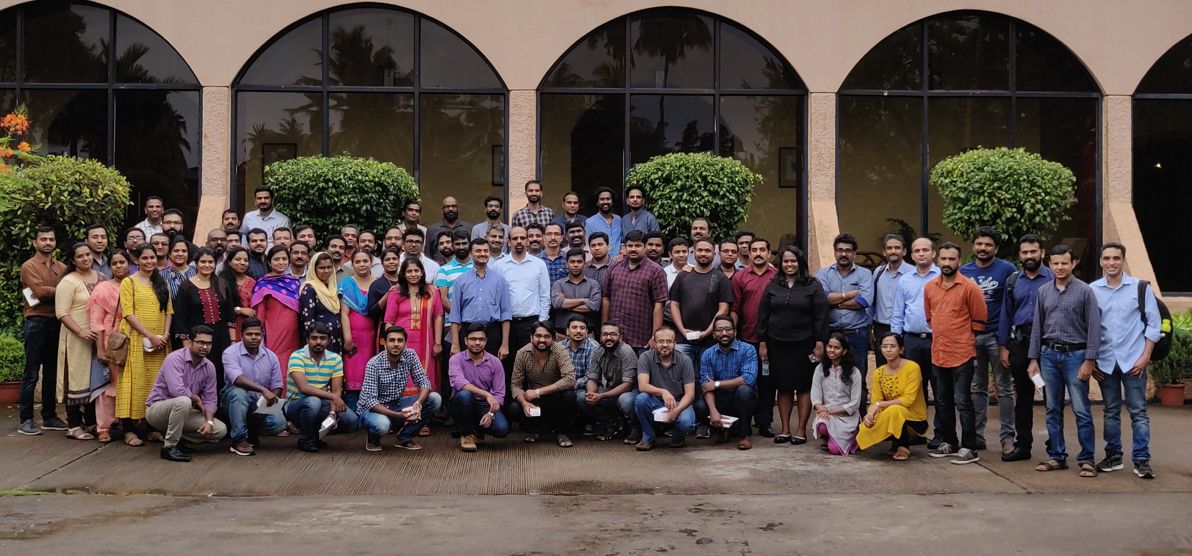
The agenda included AI-driven development, augmented analytics and quantum computing, alongside blockchain and connected environments. Digital ethics, security and privacy also entered the conversation. Project demonstrations covered optical character recognition, streaming and image analytics. This was a gathering where emerging ideas could meet examples of work already under way.
The date matters. AI was part of this company conversation years before the 2025 investment. It would be too easy to read the later strategy backward and make every earlier discussion seem prophetic. The narrower, more useful observation is that Sethu participated in a technical forum where people examined future tools alongside current delivery problems.
Four years later, the audience was project managers. At QBurst’s October 7, 2023 gathering in Kochi, Sethu joined virtually to discuss the role of technical project managers and the development of managerial skills. More than 100 people attended an event that included round-table work on hypothetical project situations.
Other sessions addressed quantitative project management, testing practices, AI and constructive performance evaluations. Put together, the agenda shows how many kinds of judgment sit behind software delivery. A project can have competent programmers and still need better estimates, clearer feedback or a shared testing method. The working machinery has several moving parts.
For Sethu, a former project manager, this was familiar professional territory. The event brings his career into focus at a human scale: an executive talking to the people responsible for coordinating the work. The room’s concerns were specific enough to be useful on Monday morning.
The price of being known
On February 6, 2025, Multiples Alternate Asset Management and its co-investors announced signed agreements to acquire a controlling stake in QBurst. The investment was approximately $200 million. The announcement described more than 3,000 employees and operations serving North America, Japan, the Middle East, Europe and India.
The founders would retain a meaningful stake. Sethu welcomed the partnership as a way to accelerate the ambitions he shared with Dasappan and Shihabudeen. His statement placed the prospective future beside two decades of building. The deal was a change in ownership and resources for a business with an established working history.
A revealing complication arrived with the new leadership. In an interview after his appointment, Arun Kumar Ramchandran described capable engineers and leaders whose business was still insufficiently known in the market. He identified earlier under-investment in client-facing activity and bringing the company’s capabilities to prospective buyers.
That assessment adds friction to the tidy success story. Engineering strength had helped carry QBurst a considerable distance. Its next chief executive nevertheless saw work to do in explaining and selling that strength. A referral can open the next door; a deliberate market presence has to find doors the existing network has never approached.
This is an ordinary business tension with unusually clear witnesses. The founders had built a delivery organization. Their successor wanted more people to know what it could deliver. Reputation travels through people, but geography and customer scale eventually ask more of the travel arrangements.
A different chair at the same table
QBurst announced Ramchandran’s appointment as CEO on April 10, 2025. He brought experience from Hexaware, Capgemini and Infosys. For Sethu, the company’s current board listing records the change in responsibility: the co-founder who had run the business now participates as a director.
The handover has a concrete image beyond an announcement. In May 2025, QBurst shared a visit to its Japan office by the incoming chief executive, accompanied by Sethu as founder and board member. A new leader was meeting an overseas team with someone who already belonged to the company’s history.
Japan is an established part of that history. QBurst’s Japanese entity dates to March 2018. Its company profile lists Sethu, Dasappan and Shihabudeen as directors and gives a Tokyo office location. The international business is expressed here through a particular entity, a particular office and continuing responsibilities.
The current operating strategy belongs to Ramchandran and his team. QBurst describes plans for more focused market coverage, AI-assisted delivery and investment in local leadership. Those plans set the context for Sethu’s board role. They also give the founding years a successor: people now responsible for deciding what the accumulated capabilities should become.
There is something pleasingly proportionate about returning, at this point, to the lunch in Virginia. A former colleague had a memory of a leader. The business had a new financial chapter. Both could be true within the same afternoon. Sethu’s career connects those scales: an organization that crossed borders, and working relationships that could still pick up a conversation years later.
Continue the conversation
Explore the people, milestones and technical conversations behind this story.