Neil Cresswell did not set out to make infrastructure more impressive. He wanted it to stop giving him migraines. When Docker arrived, its promise was tidy: wrap an application and its dependencies in a portable container, then run it almost anywhere. The lived experience was less tidy. Commands were exacting, feedback was cryptic, and a misplaced argument could turn a routine task into an afternoon. Cresswell, an infrastructure veteran, saw a powerful technology being reserved for the fraction of IT workers willing to memorize its dialect.
He and French developer Anthony Lapenna built Portainer around a deliciously modest goal: after the command that starts Portainer, a person should not need another Docker command. The web interface turned containers, images, networks and volumes into visible objects. Start one. Stop one. Read its logs. Change a stack. The machine did not become simpler; the human's relationship with it did.
That distinction is now the company. Portainer.io, incorporated in New Zealand in 2016 and launched as a product the following year, sits above Docker, Docker Swarm, Kubernetes and Podman. It gives operators one place to deploy applications, inspect failures, assign permissions, enforce policy and manage fleets. Community Edition is the free, open-source invitation. Business Edition adds the controls, support and governance that turn convenience into organizational infrastructure.
The product is a translation layer
Portainer does not replace a container runtime or orchestrator. Kubernetes still schedules pods; Docker still runs containers. Portainer translates those systems into an operating surface that a generalist can navigate and a specialist can govern. The interface exposes logs, consoles, resource usage, registries, Helm charts, Git-based deployments and access controls without requiring every user to work directly through YAML and command-line tools.
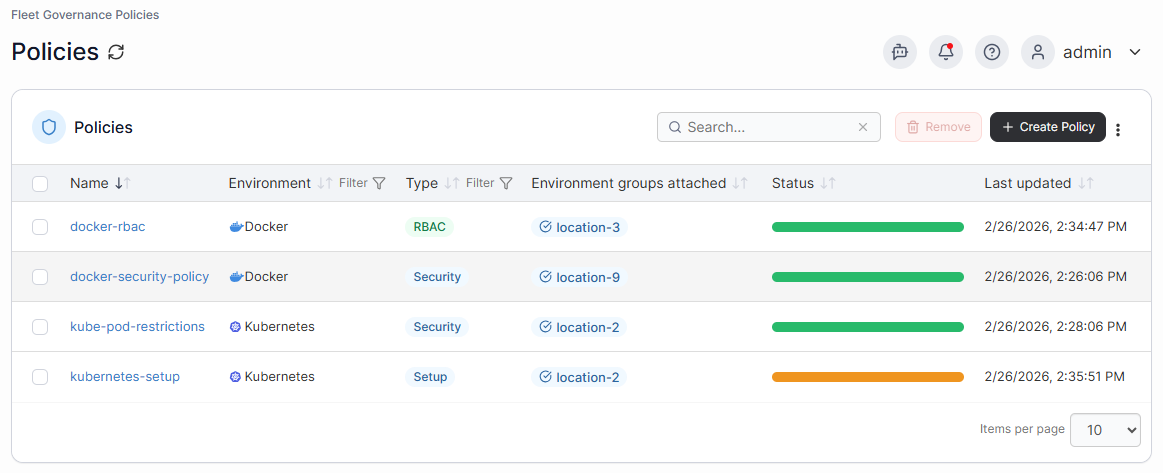
The newest Fleet Governance feature makes the model explicit. A central Portainer server connects to lightweight agents on each cluster. An administrator attaches a policy once, updates it centrally and lets agents detect and repair drift. That is not a replacement for GitOps; it is a backstop for the awkward reality that shared templates are not always applied, local teams make changes, and fleets accumulate differences like kitchen drawers accumulate mystery cables.
visibility · policy · RBAC
This makes Portainer most useful in the wide middle of the market: organizations whose container estates are too important for ad hoc commands, but whose teams do not want to become full-time cloud-native specialists. A two-person university IT group, a managed-service provider with customers restarting their own workloads, a factory fleet with unreliable connections and a regulated enterprise separating developers from troubleshooters all arrive with different nouns. Their shared problem is operational dependence on a few people who know where everything is buried.
You do not need to have CKA-level knowledge of Kubernetes to see how your application is doing.Remy Simons, ilionx
What it costs - and what the alternative costs
Portainer's commercial engine is open core. The free product earns distribution and practitioner affection; the paid edition sells role-based access, audit logs, identity integrations, policy, support and other controls demanded by production environments. In August 2026, published Starter pricing begins at $105 a month and Scale at $209 a month, both with annual commitments. Enterprise and industrial plans are quoted. Home users and students can buy a non-commercial 15-node plan for $155 a year.
Those numbers matter less than the internal alternative Portainer asks buyers to price. A North American energy company said five developers spent nearly two years building an internal Kubernetes interface and management layer, an estimated $1.7 million effort that still required maintenance. It replaced that system with Portainer. Another global technology organization measured a 14.2 percent productivity gain across a seven-person QA team, valuing the annual saving at roughly $226,500. These are vendor-published customer cases, not universal guarantees, but they frame the purchase correctly: the bill competes with labor, delay and key-person risk, not with free YAML.
Two published customer calculations
The first thing that failed was often not Kubernetes itself. It was the operating model around it. At ilionx, a Rancher-based platform proved too complex for the intended team, while operators manually rebooted 70 to 80 customer applications a day. At the energy company, the home-grown interface became a second software product nobody was in business to sell. At Volkswagen, local staff provisioned shop-floor devices with USB drives and returned in person when something broke. The technical pieces worked. The people became the queue.
The edge changed the assignment

Portainer's refusal to pick a single orchestrator looked unfashionable when the industry declared Kubernetes the answer to every question. It now looks useful. Industrial environments contain old hardware, intermittent networks, air-gapped sites and software vendors moving at different speeds. A failed rollout can require a technician and a truck. Portainer's edge agent calls outward to the control plane, allowing centrally prepared jobs to reach remote devices without opening inbound access to the plant.
Cummins is the vivid example. Its containerized automotive program reduced 35 software variants to one standard architecture. Working at that scale also pushed Portainer to rework concurrency and reliability for fleets in which enormous numbers of devices may check in together. The customer did not merely validate the product; the customer's constraints changed it.
KubeSolo reveals a similar change of mind. Portainer first experimented with K2D, translating Kubernetes objects into Docker for small devices. The experiment proved the translation could work and that translation was not enough. Commercial software vendors were shipping Operators and custom resources that expected the real Kubernetes API. Portainer responded with KubeSolo, a stripped-down, single-node Kubernetes distribution designed to use less than 200MB of memory. It keeps the API and removes clustering machinery that a lone edge device does not need.
The limits are unusually important. KubeSolo is deliberately single-node, lacks high availability and is not CNCF certified. Portainer itself says standard distributions are better on hardware with at least 1GB of memory when buyers want the larger ecosystem and clustering. This is the sort of caveat infrastructure marketing often hides in a basement. Here it clarifies the product: KubeSolo is for the device that cannot carry a normal cluster, not a novelty replacement for one.
A new user arrives with AI-generated code
In June 2026, Portainer extended its old thesis to a new source of chaos. Portainer-Run accepts the files produced by AI coding tools, detects the runtime, builds the container and deploys the app onto an organization's existing Kubernetes. The builder never receives cluster credentials. Deployments commit through an approved Git repository, inherit namespaces and access rules, and remain visible to the platform team.
The company calls this a landing pad for AI-built apps. The less cinematic description is better: it is a governed queue that tries not to feel like a queue. Portainer began by letting IT generalists use Docker without memorizing commands. Portainer-Run lets business builders deploy software without learning Docker exists. In both cases, the company hides technique while preserving an operator's veto.
That also marks Portainer's place in a crowded market. Rancher and OpenShift offer broader, Kubernetes-centered platforms. Argo CD and Flux handle GitOps with a composable, code-first philosophy. Lens and Headlamp make clusters easier to inspect, while cloud consoles pull customers toward their own infrastructure. Portainer's answer is not a longer checklist. It is neutrality plus range: one relatively light control plane for a Docker host under a desk, a Kubernetes estate across clouds, and a disconnected machine beside a production line. The trade is clear. Buyers give up some of the depth and native opinion of a single-stack platform in exchange for a common operating language across unlike environments. For managed-service providers and industrial operators, that breadth is a feature. For a Kubernetes-only platform team, it may be unnecessary baggage.
The industry didn't need a translator. It needed Kubernetes itself, just without the cluster.Neil Cresswell on the lesson behind KubeSolo
What a founder can steal - and when it breaks
The Portainer pattern
- Find a powerful system whose adoption is limited by its interface, not its capability.
- Make the first useful experience lightweight and free. Portainer runs as a container itself.
- Watch where teams lose control, then charge for guardrails: identity, roles, audit, policy and support.
- Keep the underlying systems visible enough that experts can inspect rather than distrust the abstraction.
- Let demanding customers alter the roadmap. Fleet reliability came from real automotive constraints, not a trend report.
The pattern does not work everywhere. A small team fluent in kubectl, Helm and GitOps may find Portainer an extra surface to maintain. An organization standardized deeply on OpenShift or a single cloud may prefer that vendor's integrated controls. A platform group building differentiated internal infrastructure may reasonably want composable tools instead of a broad GUI. And self-service fails when permissions are vague: a friendly button connected to excessive privilege only makes mistakes faster.
Portainer's durable insight is narrower and more useful than “make complex things simple.” Complexity never leaves; somebody still owns it. The product decides where that complexity should live, gives experts a control plane, and gives everybody else a safer path through it. The payoff is not that a factory technician becomes a Kubernetes engineer. It is that the factory can run modern software without asking them to.