An industrial loft in San Leandro & a brewery that doesn't ship water
Walk past the warehouses on Alvarado Street and you would not guess that one of them is sending more flavor per cubic foot than any keg yard in the country. Inside, a flat-sheet polymer membrane is doing something almost rude to a tank of beer - politely removing the water while the hop oils, the malt, the carbonation profile and the brewer's intent stay exactly where they were. The beer gets smaller. It does not get worse.
That is the trick. That has always been the trick. Forward osmosis - the slow, low-pressure cousin of reverse osmosis that biologists know as the thing your kidneys do all day - has been a research-paper promise for thirty years. Porifera is the company that decided to ship it.
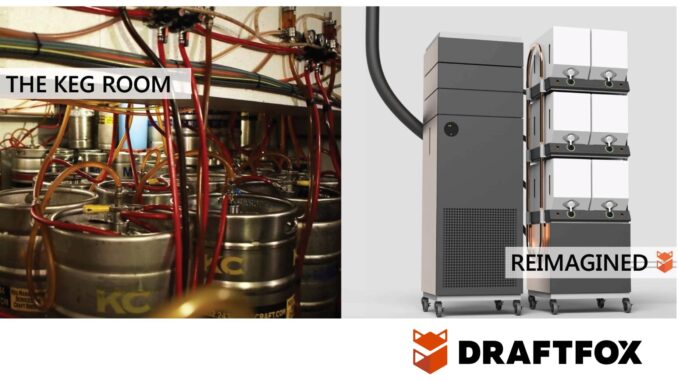
The opening scene is a brewery in 2026 that is not loading water onto a truck. It is loading concentrate. The truck is lighter. The cold chain is smaller. The carbon footprint is, by Porifera's own measurement, about half. And when the beer arrives at a bar, a small dispense system called Draftfox quietly puts the water back, in the exact right place, at the exact right temperature, with the exact right fizz. The drinker has no idea anything unusual happened. That, too, is the trick.
Sponges, more or less
Porifera is the scientific phylum for sea sponges. The name is not a flex - it is a hint. Sponges have spent half a billion years moving water through tiny channels with barely any energy at all. Olgica Bakajin, the company's founder, spent her national-lab years at Lawrence Livermore staring at carbon nanotube membranes that did something similar at the scale of a few nanometers. In 2009 she walked the work out the door.
Today the workhorse is called PFO+ROX - Porifera Forward Osmosis with a recycled osmotic agent. The pitch is plain: match an evaporator's purity, do it without boiling anything, and recycle the draw solution so you do not need a chemical handler on staff. The numbers Porifera publishes are not subtle.
Energy use, by concentration method (relative)
Source: Porifera published estimates; "up to 80% energy savings vs. conventional evaporators." Indicative only.
The same beer. Thirty percent of the savings. Half the greenhouse gas. The drinker tastes none of it.- The Porifera pitch, distilled
Four products, one obsession
PFO Concentrator System
The flagship - an industrial line that swaps a thermal evaporator for an osmotic one. Used on juice, dairy and wastewater.
Draftfox
Launched at Drinktec 2025. Concentrate the beer at the brewery, ship it 90% lighter, reconstitute it at the tap.
Membrane Modules
Flat-sheet FO modules sold to OEMs and integrators handling zero liquid discharge and reuse.
Cold Coffee & Juice Concentration
High-brix concentrates that keep the antioxidants, aroma and color intact. No thermal damage.
The physicist who got tired of waiting
Olgica Bakajin is a Princeton physics PhD with a University of Chicago undergraduate in physics and chemistry. She spent years at Lawrence Livermore National Laboratory on carbon nanotube membranes - the kind of research that produces beautiful papers and very few products. In 2009 she founded Porifera. Sixteen years later the company has 28 people, an SBA Tibbetts Award and a beer dispenser at trade shows. It is the long way around. It is also the only way around.
The team is small on purpose. Physicists and chemical engineers in a building that ships modules. The org chart looks like a national lab spinout because, in a real sense, that is what it is.
From DARPA grant to draft beer
The use case nobody pitched, then everybody did
Beverage makers, until recently, treated water as the unavoidable carrier. You brewed beer, you trucked beer, you stored beer, you served beer. Most of what you were paying to move was water. The same was true for orange juice, for cold brew, for wine destined for restaurants two thousand miles away.
Porifera lets you not do that. Concentrate at the source. Ship the small part. Add the water back at the destination. The freight bill drops, the cold-chain energy drops, the carbon footprint drops, and - here is the part the founders care about - the product on the consumer's tongue does not change.
Outside beverages the use case rotates ninety degrees. Industrial wastewater operators use the same membranes to push toward zero liquid discharge. Oil and gas operators use them on produced water. Municipalities use them as a step in reuse. The membrane is the same. The job description is different.
Breweries
Ultra-high-gravity beer in a Microkeg, dispensed via Draftfox.
Coffee
High-brix cold concentrate that keeps the aroma compounds.
Wineries
De-alcoholization without heat, preserving regional character.
Wastewater
Zero liquid discharge and water reuse for industry & municipalities.
Forward osmosis spent thirty years as a beautiful idea. Porifera spent sixteen turning it into a shipping container.- Editorial note
Quietly funded, mostly by people who measure
Woongjin Chemical
Series A investor; manufacturing and commercialization partner since 2013.
Silverstrand Capital
Climate-focused investor that joined in early 2024.
California Energy Commission
Grant partner, multi-million dollars across food & beverage energy programs.
ARPA-E / DARPA / NSF / NASA
Decade of federal R&D contracts on membranes and water reuse.
Things that amuse, things that inform
The name
Porifera is the phylum of sea sponges. Nature's original filter, hired by analogy.
No heat
The process runs without boiling - so coffee tastes like coffee, not like cooked coffee.
The kidney parallel
Forward osmosis is, in essence, what your nephrons do all day. Porifera industrialized it.
Microkegs
The Draftfox Microkeg is roughly a sixth the size of a traditional keg, by volume of liquid.
Video & demos
Porifera's YouTube presence is sparse on purpose - the company prefers customer trials to influencer reels. A few useful starting points:
Same loft. Different keg yard.
Back to Alvarado Street. The warehouse looks the same - low ceiling, fluorescent light, a stack of pallets near the door. But the pallets are smaller now. Each one holds about six times as much beer as it used to. The truck out front is half empty by weight and just as full by flavor. A brewer somewhere in Wisconsin is shipping into a bar in Singapore for less money than it used to cost to send it to Chicago. The bar manager pours a pint. It tastes like the brewery meant it to taste.
This is what Porifera changed about the opening scene: the water stopped being the cargo. The flavor became the cargo. The membrane in the middle did the editing. The drinker, blissfully, never noticed a thing.