At 20:56 on 30 August 2012, Liverpool Football Club's website encountered a familiar football problem: everybody wanted to be there at once. Traffic jumped 165 per cent in three minutes around the end of the Hearts game. A stadium has turnstiles. A website needs a different way of handling the crowd.
Cloudreach, the company Pontus Noren had co-founded with James Monico in 2009, helped move Liverpool's website onto Amazon Web Services. The attraction was practical: capacity could expand with demand, without the club buying infrastructure for every possible surge. Noren talked about speed, scalability and limited upfront investment. Football supplied an unusually clear demonstration. The cloud had to work when the whistle went.
That episode offers a useful entrance to his career. Large technological changes acquire grand names. Customers tend to arrive with smaller, more awkward questions. Can the website cope? Who will operate it? What must the team learn? Years later, with Noren running Ensemble AI, the questions concern industrial equipment and the information needed to maintain it. The distance from football supporters to factory inventories is considerable. The work of making new technology useful remains recognisable.
A beer project before the cloud
Before Cloudreach, Noren worked across sales, business development and product marketing in the technology industry, with employers including Cisco, Ericsson and Nokia. He already understood the technical world. His MBA at Cass, now Bayes Business School, completed in 2004, widened the frame to accounting, finance, strategy and people management.
One student project involved Cobra Beer and its founder, Lord Bilimoria. Noren remembered the encounter as an illustration of entering a crowded market. His group explored extending the business into beer brands suited to other cuisines, including Chinese and Thai food. A future cloud founder was learning about differentiation over a product rather easier to explain at dinner.
The connection matters because his later business occupied the space between a technology platform and the organisation paying to use it. Knowing how a system works is one qualification. Understanding why a finance director should fund the change, and how employees will live with it, requires several more.
The people who made the migration
Cloudreach's early workplace gave that organisational interest a tangible form. Employees helped define its values. Training received a dedicated budget. Quarterly Skunkworx days let people try creative projects. Shared meals acquired the predictable name of Cloudy lunches. Even a business concerned with remote infrastructure needed somewhere nearby to eat.
“People come to work for a company, not for a salary only.”
Pontus Noren, on Cloudreach's early culture
Noren and Monico also avoided senior and junior labels in job titles. Their objection was to the political energy spent collecting them; pay could still reflect someone's contribution. It was an attempt to separate recognition from the accumulation of impressive words on a business card.
These details belong to the young company, rather than an eternal description of every later office. They explain a founder's choices at a particular stage: give capable people room, pay attention to their development, and make the place worth joining. A consultancy carries much of its capability out of the door every evening. Retaining the people is part of delivering the service.
Two people become a global operation
By July 2015, Monico was describing Cloudreach's passage from two people to a 150-person business in an AWS partner interview. Noren's companion interview concentrated on international reach and the range of customer problems the company could handle. The two perspectives fitted together: a growing organisation and a widening field of work.
In April that year, Cloudreach had secured AWS Managed Services Partner status after an independent audit. Its staffing was reported at 160 in that separate snapshot. Offices in Edinburgh and Vancouver supported a service that followed the working day across time zones. Cloud computing might remove a customer's need to own the machines; it still required somebody to answer when things went wrong.
Noren's explanation of transformation included employees, procedures and skills. That is the less photogenic side of a technology shift. A migration can have a completion date. Learning to run the resulting operation is a continuing responsibility.
In an early warning about cloud skills, Noren argued that employers needed to make training part of adoption, instead of leaving individual IT staff to teach themselves. He also described the necessary cultural adjustment as something that would take time. The timetable of a new tool and the timetable of an organisation rarely match neatly.
A bigger chequebook, a different job
Blackstone acquired a majority stake in Cloudreach in February 2017. The announcement made Noren chief executive and named Blackstone senior adviser Dave Johnson chairman. Cloudreach already had offices in seven countries and customers including BP, Pearson and Hearst. The investment was intended to extend its geography, software and operations capabilities.
There is a distinct management problem inside that kind of transaction. A founder gains resources and shares authority. The business can attempt things it could previously only discuss, while the person who helped create it must learn to work within a different structure. Noren later explored that choice in a conversation with Rackspace's Jeff DeVerter: the move from driving a company to advising it, and the mistakes that accompany building one.
He had a particularly revealing use for the new backing. In August 2017, Cloudreach bought into Philadelphia-based Cloudamize, whose software automated parts of planning and migration. Noren described the appeal as combining software with skilled people. The idea was to reduce the labour required for repetitive work and develop tools the company could control.
That same month brought the acquisition of Virginia-based Emerging Technology Advisors, adding application modernisation and digital transformation expertise. Together, the deals show two sides of his approach: acquire useful software and assemble people who know how to apply it. The technology and the delivery organisation had to advance together.
Learning to sit beside the driver
In 2018, Noren moved from chief executive to vice chairman. Aaron Painter, previously a Microsoft vice president and general manager, took over as CEO. At the transition, Cloudreach was reported to have around 600 employees and 250 enterprise customers. The business was entering a different stage of scale, with a different person running it.
Noren's subsequent roles took him further into helping other teams. He joined GeoSpock's board in 2019. In 2020 he became chairman of API management company Tyk, describing an opportunity for an independent, open-source provider. Tyk founder Martin Buhr highlighted his interest in giving teams freedom to experiment and building a workplace people wanted to join.
The shift did not keep him permanently in the boardroom. Fearless Labs launched in 2021 with Noren as executive chairman and CEO, alongside former Cloudreach colleagues Darren Ritchie and Hatim Abdalla. Its first product, SOsell, addressed the relationship between sales and marketing. Another technology, another awkward handover between groups of people.
Cloudreach itself continued through a separate corporate chapter. Atos acquired it in January 2022; Cloudreach later appeared among the brands operating within Eviden. Those changes belong to the company's subsequent history. Noren's next venture would take him back to the beginning of a business.
 Watch the conversation ↗
The spare-parts test
Ensemble AI emerged in 2024 with Noren as CEO and co-founder and Contino co-founder Benjamin Wootton as CTO. Its opening proposition concerned helping enterprises adopt analytics, machine learning and AI. By September that year, Noren was appearing on a London panel about technology's place in economic strategy.
Today, Ensemble describes its product as operational intelligence for industrial assets. Its team includes COO Richard Wadsworth, another Contino co-founder, and architect Howard Glynn, formerly Cloudreach's global solutions architect lead. There is continuity in the people as well as in the problem of adoption.
The current focus gives the AI discussion physical consequences. Information about equipment can be scattered across maintenance systems, engineering documents and operating history. A useful system has to connect those records to the asset people are actually working on. The glamorous demonstration is only the introduction; the long relationship with the equipment is the job.
Conceptual illustration of Ensemble's stated product focus; not a performance claim.
The programme for the 20-21 October 2026 MAINSTREAM Summit in Birmingham paired Noren with Vicki Orman, Harsco Environmental's vice president of information technology. Their session concerned duplicated and unreliable spare-parts records across sites and systems, and using AI alongside engineering judgement. It is a refreshingly specific test. A duplicate component in a database has little interest in the eloquence of a keynote.
A revolution with the collar up
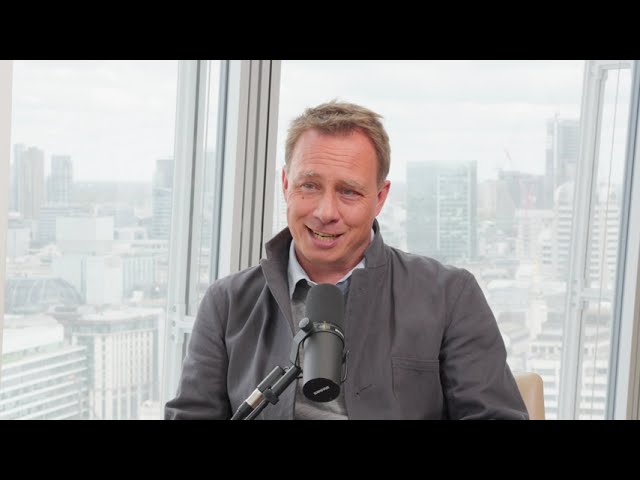
His April 2026 conversation with Arma Partners returned to a recurring difficulty: enterprise adoption takes time. The discussion covered where AI produces value and the prospect of systems that help reason about decisions, extending the role of software beyond recording what happened.
Noren found a less solemn detail to mention afterwards. He had left his collar turned up throughout the recording and compared the result to an accidental ski instructor. The self-mockery is a useful companion to the corporate biography. Even a practiced founder can finish an interview and discover that his wardrobe has been making a separate argument.
He has described himself as Swedish by origin and a citizen of the world, with a particular affection for London's mixture of history and international life. His stated leadership model included Intel's Andrew Grove, admired for combining engineering with commercial judgement. That pairing fits the recurring demand of his work: understand the technology well enough to see the opportunity, then understand a business well enough to make it useful.
At Cloudreach, a football website offered a vivid early examination. At Ensemble, the examination may begin with the contents of a maintenance database. The setting has changed. Noren has again chosen the point where a large promise meets somebody's working day.