Send a million dollars and watch a small piece disappear. In cross-chain finance, that can be the price of getting money from one blockchain to another. A few basis points look harmless on a screen. On a million-dollar transfer, they buy someone a very agreeable lunch. Polymer Labs has found an audience for keeping the money together.
- Prove: establish that an event happened on another chain.
- Execute: let Polymer handle the destination transaction.
- Distribute: reach USDC users through LI.FI and Jumper.
In September 2026, the company reported nearly $2 billion moved through its USDC bridge since January, including $476 million in August. Its most revealing number was smaller: transfers above $100,000 made up just 1% of transactions, yet carried nearly two-thirds of the dollars. Most customers were moving modest sums. A few were moving sums for which modest friction becomes expensive.
First, the islands had to talk
Bo Du and Peter Kim turned their attention to interoperability in 2021 after encountering the difficulty of building interchain products. Their early ambition was broad: extend IBC, the Inter-Blockchain Communication protocol associated with Cosmos, across blockchain ecosystems. A $3.6 million seed round in 2022 bought room to pursue it.
The obstacle was easy to describe and tiresome to live with. Ethereum applications increasingly operated across rollups, separate networks used to scale activity. A contract on one network could not simply assume that a payment, vote or trade had happened on another. Developers needed a way to communicate, verify the information and arrange the next transaction.
In January 2024, Polymer raised another $23 million, with Blockchain Capital, Maven 11 and Distributed Global co-leading. Polymer Hub launched on mainnet that November. The original networking story concerned connecting rollups through IBC primitives. The later product story became more pointed: give builders a useful interface to cross-chain evidence.

A receipt, available when needed
Consider an application whose contract emits an ordinary event when a user deposits funds. Polymer’s Prove API lets someone request an attestation of that event. A destination contract verifies it and decides what to do. The source application keeps its familiar event format; it does not have to compose a special bridge message addressed to one destination.
This changes the timing of the decision. An event can happen first, and an application can request evidence later, wherever supported verification is needed. Developers can separate their application’s business logic from the machinery that connects chains. Polymer’s distinction from messaging systems is therefore partly architectural and partly a matter of how much integration work the customer must own.
The product writing contains an unusually candid clue to this emphasis. Tommy O’Connell, Polymer’s product head, wrote, “I did not spend enough time listening to users.” His critique concerned interoperability builders optimizing their own inventions while applications continued to struggle. It is an admission about product priorities, rather than evidence of a failed company. The response was to make the developer’s job smaller.
“I did not spend enough time listening to users.”Tommy O’Connell, Polymer product writing
The customer who pays before getting paid
A solver illustrates why the distinction matters. In an intent system, a user asks for an outcome and a solver supplies it, often committing capital before reimbursement. Proof that the order was filled on another chain allows repayment to proceed. Waiting for that evidence ties up money that could finance the next order.
Polymer’s May 2026 LI.FI announcement describes it as the recommended settlement system for LI.FI Intents, targeting faster solver reimbursement across more than 55 chains. Everclear provides another concrete use: its clearing system nets cross-chain transfers, and uses Polymer’s proofs and execution together. Polymer reported approximately $600 million of Everclear volume processed since August 2025 in its October announcement.
These are infrastructure customers: developers, liquidity coordinators and networks of professional solvers. They judge a verifier by integration effort, cost, supported routes and how quickly useful evidence becomes available. Hyperlane, LayerZero, Chainlink CCIP and native settlement paths offer alternatives with different assumptions. A faster route can be attractive without being the right route for every transaction.
The bridge that skips the proving engine
The consumer bridge contains a pleasing twist. It uses Polymer’s Execute API for relaying Circle CCTP transfers, without using Prove API. Circle’s transfer infrastructure supplies the relevant transfer mechanism. Polymer handles the destination submission. LI.FI and Jumper provide distribution and the interface people actually encounter.
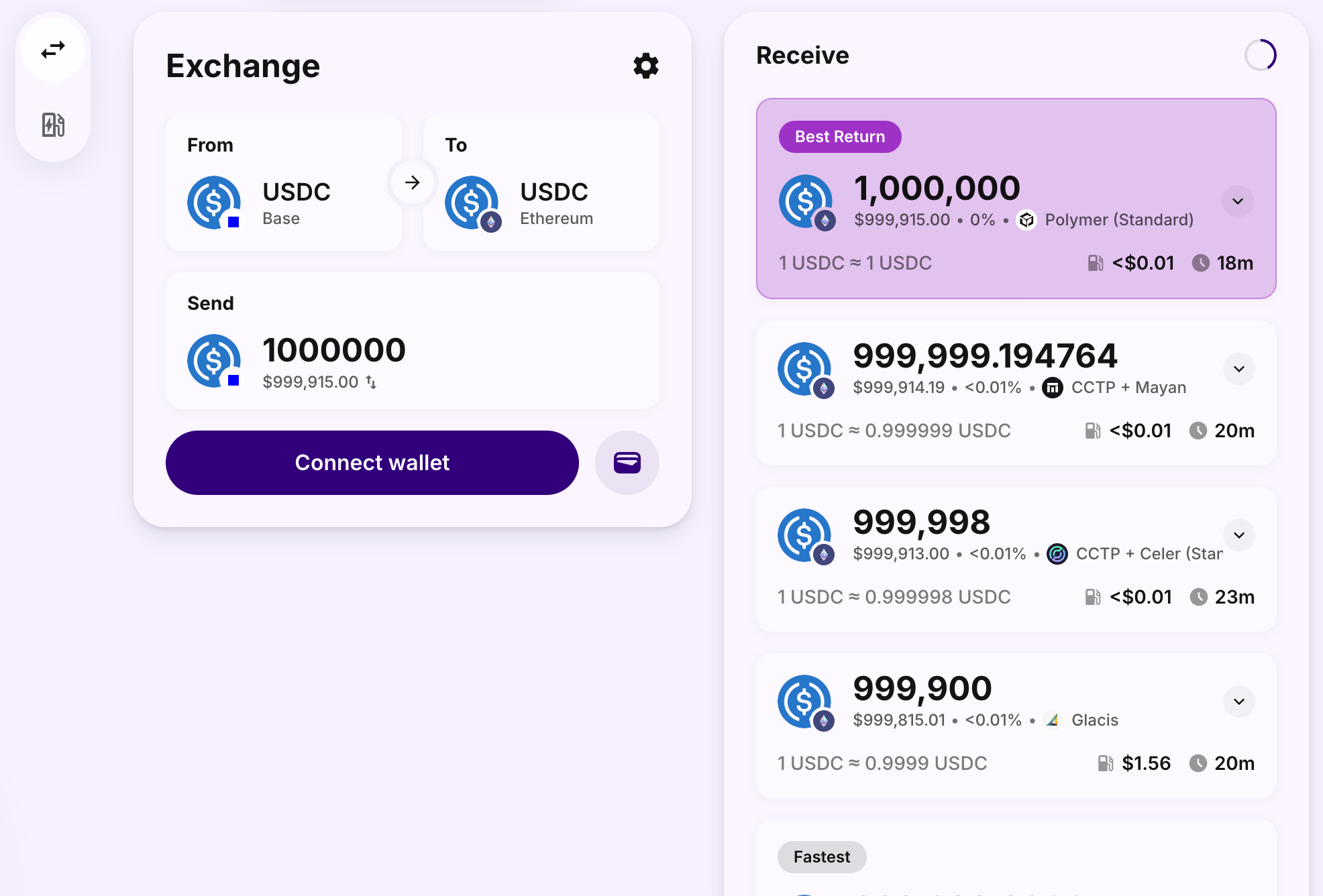
By September, Polymer described support across 23 major chains, including newly announced Arc coverage. It quoted a fee-free, one-to-one standard route and a roughly ten-second fast route charging two basis points. That fast-route fee would be $200 on $1 million. The decision becomes legible: wait, or pay for speed. Network gas and the available live quote still belong in the calculation.
For developers, Execute handles wallets, nonces and retries; partners fund dedicated wallets on each destination chain. Polymer’s commercial materials also describe API credits and x402 microfee access. Consumer route fees, destination gas and API access are different costs. Collapsing them into one cheerful claim of “free” would obscure the business.
The evidence still needs judgment
Current documentation describes proofs as signed attestations backed by agreement among independent data sources. Destination verification checks Polymer’s signature; it does not independently re-run the source chain’s consensus. The application must check the source chain, emitting contract, event signature and replay protection. Accepting a valid attestation of the wrong event is still a mistake.
Speed has conditions, too. Source-chain finality dominates end-to-end proof time. Execute adds dependence on a relayer and funded wallets. The useful lesson for another builder is precise: preserve the customer’s existing interface, remove an operational chore, and show the remaining tradeoff plainly. Polymer’s money-moving ambition becomes persuasive where those details hold. A receipt is useful because somebody knows what it means.
Explore the machinery
Website · Developer docs · GitHub · Live analytics · LinkedIn · X
Company blog · Try Jumper · Polymer videos · Eco’s proof-based intents talk